
Information service of the Pontifical Mission Societies since 1927
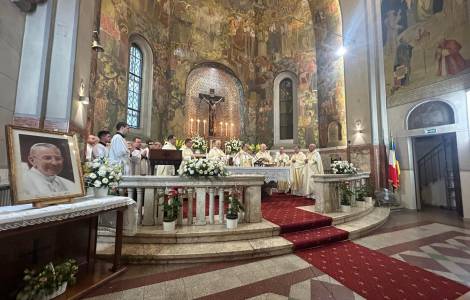
Photo Stefania Falasca
Bucharest (Fides News Agency) – Grateful devotion to Blessed Pope John Paul I remains alive in Romania as well. Around the figure of the Pope born in Canale d’Agordo, old bonds are being renewed and new friendships are giving rise to surprising initiatives.
This was also witnessed today, Sunday, August 30, at the solemn Mass celebrated in Bucharest at the Church of the Holy Redeemer, widely known as the “Italian church.” It was built between 1915 and 1916 to provide pastoral care for the growing community of migrants who, in those years, came from many regions of Italy to seek work in Romania.
The solemn liturgy, celebrated in memory of a Pope who was himself the son of migrants, was presided over by Archbishop Giampiero Gloder, Apostolic Nuncio to Romania, and concelebrants included Aurel Perca, Metropolitan Archbishop of Bucharest; Archbishop Emeritus Ioan Robu; and parish priests.
Romanian and Italian Catholics took part in the celebration, joining for the first time in a solemn liturgy as part of initiatives also promoted by the ‘Asociatia Papa Luciani,’ an association chaired by Cristina Grigore that promotes in Romania the teaching and example of holiness of Blessed John Paul I.
Lina Petri, Pope Luciani’s niece, and Italy’s Ambassador to Romania, Laura Aghilarre were also present at the Mass.
For the occasion, an “ex indumentis” relic and an image of Pope Luciani were brought to the “Italian Church” in Bucharest by a delegation from Rome, led by Stefania Falasca, vice president of the Vatican Foundation John Paul I and postulator of the cause of canonization of the Pope, who was beatified by Pope Francis on September 4, 2022.
Archbishop Gloder’s homily
In his homily, delivered in Romanian, Archbishop Gloder, who was born in Asiago, drew on personal memories of Pope Luciani, beginning with the day of his papal election, which he witnessed as a young seminarian in St Peter’s Square. “I remember,” the Apostolic Nuncio said, “the great joy we felt at seeing a son of our Veneto region, Cardinal Albino Luciani, Patriarch of Venice, elected as the Successor of the Apostle Peter under the name John Paul I.”
Gloder also referred to the friendship between Luciani and Gerolamo Bortignon, the bishop who later ordained Gloder to the priesthood. Previously, as Bishop of Belluno, Bortignon had entrusted the young Albino with positions of responsibility, recognizing his “human qualities and abilities” and eventually appointing him Pro-Vicar General.
Archbishop Gloder highlighted the spirituality and relevance of Pope Luciani by drawing on the homilies, catecheses and Angelus addresses of his brief pontificate. He began with the spontaneous words the newly elected Pope addressed to the communities of the dioceses where he had been formed and had exercised his ministry before becoming Pope.
During those encounters, Pope Luciani asked about the elderly, shared memories and inquired about the parishes of the dioceses of Belluno, Vittorio Veneto and Venice, showing that he had “loved them deeply, to the point of keeping their faces and situations engraved in his heart as a man, a Christian, and a pastor.”
“The closeness to priests and to the people that Pope Francis repeatedly emphasized,” Archbishop Gloder added, “was something Pope Luciani lived throughout his life, having learned it in his poor, united and deeply Christian family.”
The Apostolic Nuncio also recalled the words Pope Luciani chose during the Angelus of September 10, 1978, to describe the fatherly and motherly dimension of God’s love:
“We are the object of God’s everlasting love. We know that he always keeps his eyes upon us, even when it seems to be night. He is a father; even more, he is a mother.”
The celebrant stressed that it was precisely “the experience of being loved by God that prompted him to return that love, giving himself to Him without reserve.”
Gloder quoted a phrase from The Imitation of Christ that Pope Luciani had also cited in one of his catecheses: “Whoever loves God ‘currit, vola, laetetur’: runs, flies and rejoices.”
He then stressed that, for Pope Luciani, faith was not a matter of strenuous effort but of “surrendering to God,” an experience that, through its very dynamic, becomes intimately and freely intertwined with the virtue of humility.
John Paul I devoted his first Wednesday Catechesis precisely to humility.“When I say: Lord, I believe,” Pope Luciani said on that occasion, in words also quoted in Archbishop Gloder’s homily, “I am not ashamed to feel like a child before his mother; one believes one’s mother, and I believe in the Lord, in what He has revealed to me.”
(PR) (Fides News Agency, 30/8/2026)



 CHINA/VATICAN - From “exceptional event” to a common practice: Chinese bishops take part in Holy See initiatives
 In Malawi, a whole stadium celebrates 100 years of World Mission Sunday: “United in Christ, united in mission”
 VATICAN - Bishop Scalabrini and layman Zatti will be canonized on October 9th
 EUROPE/ITALY - Scalabrini: "The image of a saint who knew how to understand and help, can maintain the hope of migrants and refugees"
 Missions in upheaval: World Mission Sunday during the years of war
 One hundred years later. The long journey of China’s first Bishops to receive Episcopal Ordination from the Successor of Peter
 Cardinal Aveline, Archbishop de Moulins-Beaufort, and missionary renewal in France
 Leo XIV: The Catholic Church has contributed to the development of the United States