
Information service of the Pontifical Mission Societies since 1927
by Pascale Rizk
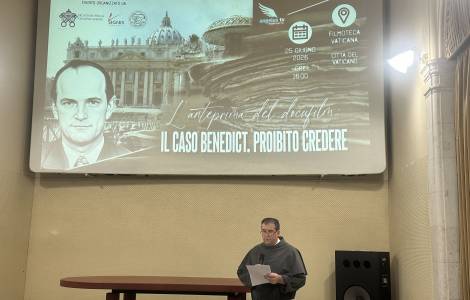
Rome (Fides News Agency) – On the occasion of the 40th anniversary of the death of Romanian Venerable Martin Benedict, the documentary-film “The Martin Benedict case: Forbidden to Believe” premiered at the Vatican Film Library on Thursday, June 25 at 4 p.m..
The Romanian documentary-film recounts the extraordinary life of "a man of harmonious contrasts: a doctor who dedicated himself to the care of bodies at the hospital in Onești, while at the same time a Franciscan priest consecrated in secret," as Franciscan Fr. Silvestro Baejan describes him.
Set in the 1980s, the film traces the life of Fr. Benedict, who worked as a doctor in Răducăneni, Tătăreni, Bacău and, from 1962 until his death, at the hospital in Onești. A man of deep prayer, always with a rosary in his hands, Benedict cared not only for the physical health of his patients but also for their souls. He encouraged prayer and the sacrament of Confession and sought to counter the widespread recourse to abortion by listening to and supporting women who, because of poverty, were tempted to terminate their pregnancies. He offered them psychological, spiritual and material assistance without hesitation.
Born on July 31, 1931, in Galbeni, in Bacău region, Martin Benedict lived and carried out his entire ministry in Romania. Raised in a Catholic family, he attended primary school in his hometown from 1938 to 1945 before entering the Conventual Franciscan seminary in Hălăucești in September 1945, where he studied for three years.
With the onset of Communist persecution of the Catholic Church (see Fides, 20/5/2023), he was forced to leave the seminary, complete his secondary education in Bacău and enroll in the Faculty of Medicine at the University of Iași in 1951. He graduated in 1957.
Following a serious illness in 1972 and what was regarded as a miraculous recovery, Benedict decided to return to his original vocation. Under the guidance of Friar Gheorghe Pătrașcu, he secretly completed his novitiate, made his temporary profession in 1976 and his solemn profession in 1979. He was ordained a priest on September 14, 1980, by Bishop Alexandru Todea (later created Cardinal).
He remained under surveillance by the Securitate for 32 years, from 1954, and was identified as a priest after a trip to Rome on October 30, 1983.
"Venerable Martin Benedict is becoming increasingly well known, both in Romania and abroad, and many people turn to him seeking his intercession," Fr. Silvestro Baejan, the Roman coordinator of the Cause for Canonization, told Fides.
"In recent months we have recorded two cases of alleged miraculous healings: one involving a young woman in Bucharest and another concerning a woman in Suceava. However, we are encountering considerable difficulties in obtaining the medical records and documentation needed to investigate these cases."
Fr. Baejan explained that "because Romania is a predominantly Orthodox country, there is not yet a well-established understanding of the procedures required to investigate miracles attributed to Catholic candidates for canonization. Even so, numerous graces have already been reported, and many ex-votos have been left at his family home. Most concern family reconciliation, minor healings, the birth of children in cases of infertility, but also cases where people do not resort to alcohol and drugs..."
After his death in Onești on July 12, 1986, Martin Benedict immediately gained a reputation for his holiness among those who knew him.
One year after his death, water from a well near his family home in Galbeni reportedly began to smell and taste like roses, and the village soon became a destination for pilgrims.
The cause for his canonization was formally opened on April 14, 2007. The positio has already been completed and is awaiting examination by the Theological Commission.
On December 17, 2022, Pope Francis declared Martin Benedict Venerable.
According to the Dicastery for the Causes of Saints, Benedict heroically lived his dual vocation as a doctor and religious priest while carrying out his ministry in secrecy.
Through the testimonies of his family members and the nurses who worked with him, the documentary-film shows how, despite his fragile health, Benedict exercised his medical profession with extraordinary generosity. His prudent discretion enabled him to carry out his apostolate.
Speaking about the most significant documents gathered during the Cause, Fr. Baejan noted that the first mention of Martin Benedict in the Secret Service (Securitate) archives dates back to 1954, appearing in documents concerning another Franciscan friar.
"He remained under surveillance until the end of his life," the Conventual Franciscan said. He added that Benedict's personal file contained only a few pages and was inexplicably discontinued in 1971.
"Witnesses clearly testify that the persecution continued until his death. So where are the remaining documents? We know that during the 1980s political investigations were reclassified as criminal investigations. After years of persistence, we succeeded in obtaining the cover page and one page from a register proving that a criminal investigation had indeed been opened. Our research continues."
"We are not gathered here this evening simply to watch a film," Romanian Ambassador to the Holy See George Bologan told those present. "We are here to understand what it means to bear witness. We stand before a life that challenges our freedom, our memory and our understanding of faith when it is put to the test. And today, in many parts of the world, including Europe, faith is being put to the test."
The event, organized in cooperation with the Embassy of Romania to the Holy See and the Dicastery for Communication, was also attended by Fr. Igor Salmič, Vicar General of the Conventual Franciscans; Fr. Eusebio Bejan, Vice-Postulator of the Cause for Canonization; the documentary's director Adriana Răcașan and members of her production team; and Fr. Francisc Ungureanu, President of the Catholic Association for Communication SIGNIS in Romania and Secretary General of the Romanian Catholic Bishops' Conference. (Fides News Agency, 26/6/2026)

 ASIA/VIETNAM - Vietnamese Catholic communities stand alongside women in need to combat mass abortion


 Mission beyond the illusions of efficiency: following in the footsteps of Venerable Little Sister Magdeleine of Jesus
 Fulton J. Sheen proclaimed Blessed. Cardinal Tagle: “Blessed is the earthen vessel that draws power from Jesus”
 AFRICA/MALAWI - Archbishop Nwachukwu at the Jubilee marking 125 years of the Gospel in Malawi. Two new priests for a Church called to set out anew on mission
 The Church of the Sheaves: a missionary perspective presented to Newly Ordained Bishops
 US House bill calls to halt aid to Nigeria over anti-Christian violence
 ANGELUS - Leo XIV: May Vietnamese Blessed Truong Buu Diep intercede for "all those who proclaim the Gospel in situations of persecution"
 ASIA/KOREA - "40 days of prayer for life" in response to the intention to legalize abortion and the abortion pill