
Information service of the Pontifical Mission Societies since 1927
VaticanMedia
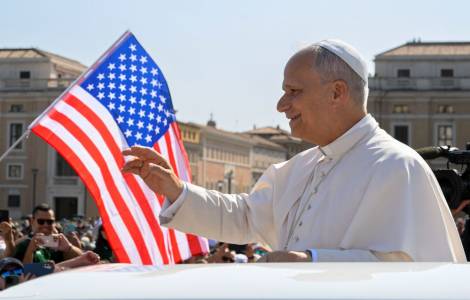
Vatican City (Fides News Agency) – On the 250th anniversary of the United States Declaration of Independence, Pope Leo XIV, the Chicago-born Pontiff, joined the celebrations of that “defining moment” in the history of the United States of America, July 4, 1776, that “gave enduring voice to the ideals of liberty, equality, the pursuit of happiness, justice and democratic self-government.”
In a letter released by Vatican media, the pope reflects on several of the principles that “have guided the development” of the country to which he himself belongs, while also highlighting the Catholic Church’s contribution to the country’s development.
In the letter, dated June 25, 2026, Pope Prevost emphasizes that “among the most cherished of these principles is religious freedom — the right of every person to worship according to conscience and to practice their faith openly, without coercion or fear.” It is precisely this freedom, the first American Bishop of Rome notes, that “has permitted the Catholic Church to take root and flourish within the United States, to the advantage not only of her own members, but of the entire nation.”
Among the “many benefits” that the Church has provided over the years to the development of this nation, the Pope highlights in particular “her service in areas of education, the preferential care of the poor, healthcare and basic social services.” He also cites the 1890 Encyclical Sapientiae Christianae, in which Pope Leo XIII wrote that “no better citizen is there… than the Christian who is mindful of his duty.”
The Christian faith, Leo XIV explains, “far from standing in opposition to the responsibilities of citizenship — lends new vigor to the pursuit of justice, peace and the common good, bringing to perfection every natural gift bestowed by the Creator.” The Pope also recalls that, in his First Letter to Timothy, Saint Paul encouraged the early Christians “to pray for those in positions of authority in order to live a peaceful life in accord with the will of God.” In this renard he adds, “it is in the faithful fulfilment of duty — to God and country — that Catholics are called to continue to serve the nation, as leaven for the growth of a civilization of love.”
Among the principles that have guided the development of the United States, the Pontiff also points to “the God-given dignity of every human life,” that “calls for reverence, protection and care. In this spirit, a full understanding of this dignity leads to recognizing the importance of safeguarding human life from its beginning at conception until natural death, and of building a society in which the vulnerable, the suffering and the forgotten are always met with compassion, solidarity and love.” That concern, Pope Prevost adds, who visited the island of Lampedusa today, a place that has become a symbol of both the tragedies and the hopes associated with migration, “also includes welcoming, protecting and assisting immigrants, whose hopes, sacrifices and contribution have formed part of the history of this country from its very beginning.” “In every generation, those who have arrived seeking freedom, opportunity and a place to belong have helped to shape the nation’s character. To receive them with compassion and generosity is not only an act of charity, but also a recognition of the dignity that belongs to every human person.”
In the closing lines of his letter, the Pope expresses the hope that the “spirit of 1776” will “continue to inspire hope and unity as the United States of America moves into the future.” He entrusts the nation to “the intercession of the Immaculate Conception, patroness of this country, so that she will continue to watch over America and protect all who dwell therein.”(GV) (Fides News Agency, 4/7/2026)



 POPE IN FRANCE/VI - Leo XIV in Paris: A missionary topography
 POPE IN FRANCE/V - The (silent) mission of Lourdes: “God’s charity does not heal those who have no wounds”
 LATIN AMERICA - "Care unites us": CELAM, CLAR and Caritas promote a culture of "caring for others"
 ASIA/BANGLADESH - Bishop Subroto: Silent march of Catholics in Dhaka “to say No to fundamentalism and violence”
 ASIA/INDIA - Christian officer's appeal rejected: "Freedom of conscience trampled upon"
 ASIA/INDIA - Anti-conversion laws: Catholics promote protection of freedom of conscience based on the constitution
 EUROPE/ROMANIA - Faith that unites peoples: The memory of Pope Luciani celebrated in the church of Italian migrants
 Cardinal Aveline, Archbishop de Moulins-Beaufort, and missionary renewal in France