
Information service of the Pontifical Mission Societies since 1927
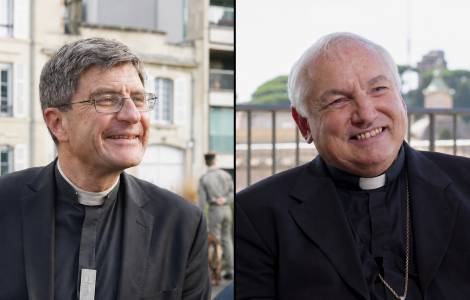
by Marie-Lucile Kubacki
Rome (Fides News Agency) – At the end of June, Pope Leo XIV appointed Cardinal Jean-Marc Aveline, Archbishop of Marseille, and Éric de Moulins-Beaufort, Archbishop of Reims, as members of the Dicastery for Evangelization, respectively in the “Section for First Evangelization and New Particular Churches” and the “Section for Fundamental Questions regarding Evangelization in the World”.
The appointments have drawn attention to two leading figures of missionary renewal in France, just two months before the Pope’s visit to the country. Both developed their understanding of mission by addressing pressing issues and concrete challenges: secularization, migration, religious pluralism, the declining number of priests, social crisis and growing insecurity.
Marc Aveline and Éric de Moulins-Beaufort are also theologians. The Archbishop of Reims earned his doctorate at the Pontifical Gregorian University with a dissertation on the anthropology of Henri de Lubac entitled “Anthropology and Mysticism according to Henri de Lubac: ‘The Spirit of Man,’ that is the Presence of God in Humanity”. Meanwhile, the Archbishop of Marseille founded and directed the Institute for the Science and Theology of Religions (ISTR), fostering theological and pastoral reflection shaped by the unique crossroads of cultures that is the Mediterranean.
In his book “God so loved the world,” Cardinal Aveline presents mission as the Church’s response to the call to imitate Christ in his love for the world, echoing the words of the Gospel of John: “God so loved the world that He gave his only Son (...) not to condemn the world, but so that the world might be saved through him.”
Convinced that mission must be rethought in a secularized Europe, the Cardinal proposes three horizons for reflection: mission as a dialogue of salvation, mission within the horizon of the promise, and mission in the dynamic of catholicity. These horizons are rooted in three experiences: the trauma of exile experienced by the pieds-noirs, the hardships of migration, and the founding and direction of the Institute for the Science and Theology of Religions, in Marseille.
Fully aware of the tensions surrounding ‘dialogue’ with other religions—between those who see it as a form of relativism and those who reduce it to a covert strategy of proselytism or a superficial search for shared ‘values’ without genuine exchange—Cardinal Aveline insists that the missionary is, by nature, engaged in constant dialogue. Dialogue, he argues, is an expression of love for humanity, a loving openness to the other.
He also warns against reducing missionary activity to a mechanical process that exploits human encounters. For him, evangelization means “entrusting the Gospel,” the living Word, enabling others to experience Christ’s love while recognizing that genuine dialogue also entails a mutual process of conversion.
The Cardinal often quotes Michel de Certeau: “We discover God in the encounter that he brings about.” This vision inspires his pastoral ministry in the diocese of Marseille, a diocese marked both by vibrant popular piety and by major social and migration-related challenges, highlighted during Pope Francis’ visit in 2023.
The path followed by Éric de Moulins-Beaufort reflects another dimension of this missionary renewal. Appointed Archbishop of Reims in 2018 after several years in Paris, he discovered a diocese marked—as many others across France—by a small number of priests and profound changes.
Rather than resigning himself, he chose to reverse the perspective, focusing instead on the gift represented by “those who remain,” while reorganizing the diocese. The diocesan project is entitled “On the path to Mission.”
“Missionary spaces” have been established, entrusted to mixed teams of priests, deacons and lay faithful.
Sunday Eucharistic celebrations have been reorganized according to the clergy actually available, while a more itinerant model of ministry is being introduced. Teams spend time in local communities, organize activities tailored to local needs, visit the sick, isolated people and families requesting pastoral care. The aim is both to welcome people and to reach out to those on the margins, fostering Christian life while building small communities of fraternity and mutual support.
The Archbishop of Reims is not the only French bishop to have embraced a genuine missionary conversion, but he is among the pioneers of the movement. More recently, the Diocese of Arras announced a broad pastoral transformation designed to strengthen local Christian communities gathered in small fraternities, while reducing travel distances and concentrating available pastoral resources by reorganizing its 89 parishes into just 11.
Within the French context, the appointments of Jean-Marc Aveline and Éric de Moulins-Beaufort to the Dicastery for Evangelization send a significant signal about the way the Church in France is seeking to respond to the challenges it faces at the beginning of the third millennium.
France, once one of the world's great providers of missionaries, has itself once again become mission territory. It is a highly secularized country where only around two percent of the population attends Sunday Mass regularly, yet where one French person in two still identifies as Catholic and many continue to light a candle in church in moments of hardship.
It is also a country with an extraordinary religious heritage, where sociologists of religion such as Danièle Hervieu-Léger have spoken of the “exculturation” of Catholicism, but where passionate debate on secularism continues and where in recent years have witnessed a notable rise in requests for Baptism among young people and adults.
Already in 1943, Henri Godin and Yvan Daniel described France as a “mission country” in their landmark essay “La France, pays de mission?” but which has become even more so over the years. (Fides News Agency, 5/7/2026)



 BEATIFICATION OF FULTON SHEEN/VI — At the Vespers for Fulton Sheen, “made holy through his friendship with Christ”
 BEATIFICATION OF FULTON SHEEN/IV - Sons and Daughters of the same Father. Fulton Sheen and racial segregation
 Here's how Sweden is quietly rediscovering itself as a "land of mission"
 If the "problem" is no longer atheism. Spain's missionary urgency awaits Leo XIV
 "Here I am; send me." Priestly and religious vocations in Vietnam amid signs of decline and new vocational paths
 AMERICA/PERU - “In persona Christi Capitis”: Latin American Churches reflect on priestly identity in the face of new pastoral emergencies
 EUROPE/ROMANIA - Faith that unites peoples: The memory of Pope Luciani celebrated in the church of Italian migrants
 Leo XIV: The Catholic Church has contributed to the development of the United States