
Information service of the Pontifical Mission Societies since 1927
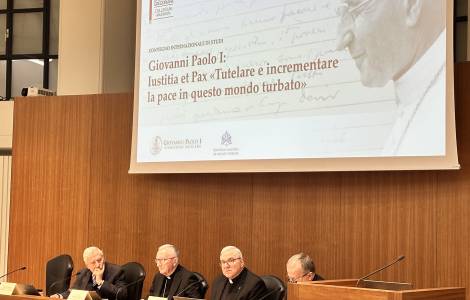
Rome (Fides News Agency) – “‘Safeguarding and promoting peace is a responsibility for each of us and, at the same time, a mission to be cultivated patiently in every sphere of our daily lives.” This was Pope Leo XIV’s message in a telegram read by Cardinal Pietro Parolin at the opening of the international study conference “John Paul I: Iustitia et Pax: ‘Safeguarding and Promoting Peace in This Troubled World’,” held today, 13 October, at the Pontifical Gregorian University.
This was the third conference organized at the Gregorian University by the John Paul I Vatican Foundation. The day of study, Stefania Falasca, Vice-President of the Vatican Foundation, noted, highlighted the continuing relevance of Pope Luciani’s teaching, as well as his spiritual depth and prophetic force in addressing the challenges and emergencies facing the Church in every age, including the suffering inflicted on peoples by war.
The focus of the conference was Pope Luciani’s teaching on peace and the nature of the Holy See’s diplomatic action, which the Secretary of State described – drawing on the words and deeds of John Paul I – as an action that stems from a perspective of faith, not from a presumption of geopolitical protagonism.
In his message, Leo XIV links the peace-building to respect for the human person and justice: “We are well aware that peace is not merely the absence of war. Saint Augustine speaks of it as the fruit of tranquillitas ordinis. It presupposes respect for the dignity and fundamental rights of every person, as well as solidarity among peoples. From this perspective, justice becomes an essential condition.”
The Pope points to the teaching of Blessed John Paul I as a lesson that also speaks directly to everyday life: “Blessed John Paul I, with his simple and direct language, insisted on the need for personal involvement, fraternity and charity in building human relationships founded on trust. International peace begins in the family, at school and in the community, before reaching institutions.”
Hence the invitation not to regard peace as an issue reserved for political and institutional leaders. “Dear friends, I believe that the lesson of John Paul I can be read today as an invitation not to consider peace an abstract idea, entrusted solely to those charged with the high responsibility of ensuring stability and social harmony among nations,” Leo XIV writes. The message then calls for the protection of the most vulnerable, forgiveness, listening to and recognizing others, education in sincere dialogue, and the need to give fraternity a concrete ecclesial, social and political dimension.
The conference theme echoes the last of the six “we wish” statements with which John Paul I outlined the program of his pontificate in his Urbi et Orbi radio message of 27 August 1978, the day after his election: “Finally, we wish to encourage every worthy and good initiative capable of safeguarding and promoting peace in this troubled world.” Forty-eight years later, Parolin observed that these concerns, although rooted in a specific historical context, remain “terribly relevant”.
In his address, the Secretary of State identified two key areas of Luciani’s commitment to peace during his thirty-four-day pontificate: his attention to the dispute between Chile and Argentina over the sovereignty of the islands in the Beagle Channel, and his support for the Camp David talks. Held from 5 to 17 September 1978, the latter brought together US President Jimmy Carter, Egyptian President Anwar al-Sadat and Israeli Prime Minister Menachem Begin.
The key to understanding this commitment, Parolin explained, can already be found in John Paul I’s address to the Diplomatic Corps on 31 August 1978. In that speech, “Luciani, freeing himself from any presumption of geopolitical protagonism, precisely defines the nature and distinctive character of the Holy See’s diplomatic activity as an action that springs from a gaze of faith.”
The Cardinal thus places Pope Luciani’s diplomacy within the framework of the Second Vatican Counciliar Constitution Gaudium et spes and the teaching of Paul VI: a service to peace sustained by charity, in which the religious dimension is inseparable from concrete attention to conflicts and the possibilities of overcoming them.
Documents concerning contacts with the US president also bear witness to this commitment. “As documented in the critical edition of the texts and documents of the pontificate, which includes a complete synopsis and traces the genesis of written and spoken interventions, prepared by the Scientific Committee of the Foundation,” Parolin recalled, “John Paul I maintained a confidential and direct exchange of letters with President Carter, as well as ongoing contact with international diplomatic offices, in an effort to help overcome the Arab-Israeli conflict.” The cardinal also drew attention to the rediscovery of the text of a letter Luciani had addressed to the American president.
Alongside these confidential contacts, Parolin recalled John Paul I’s public speeches, particularly the Angelus address of 10 September 1978, during the Camp David negotiations, when he invited the faithful to pray together for peace. “John Paul I thus played a role of considerable symbolic and diplomatic significance precisely during those weeks in September, when the positive outcome of the Camp David peace accords, mediated by President Carter, was taking shape,” the Secretary of State said.
The reconstruction of these aspects of the pontificate forms part of the research promoted by the John Paul I Vatican Foundation, established in February 2020. Parolin recalled that the Foundation’s work continues the research into original sources carried out for more than a decade as part of the cause for canonization. The critical rediscovery of original documents and texts makes it possible to preserve the legacy of Albino Luciani’s writings and deepen understanding of his theological, ecclesial, cultural and spiritual legacy, opening a new chapter in studies on the pontiff.
Before the conference began, the cardinal announced the appointment of Professor Carlo Ossola as co-chair of the Scientific Committee of the John Paul I Vatican Foundation. Ossola will help define the Foundation’s scientific, cultural and editorial guidelines in pursuit of its statutory aims, “with full confidence in his outstanding scientific expertise and with the hope that he will make a fruitful contribution in the service of the Foundation and the memory of John Paul I”.
(MLK) (Fides News Agency, 13/10/2026)



 Between political neo-messianisms and Augustinian realism: scholars and analysts revisit Leo XIV’s teaching on international politics and Global scenarios
 GENERAL AUDIENCE - Leo XIV: Holiness is a gift from Christ, our daily mission is that of our conversion
 POPE IN FRANCE/XI - Leo XIV in Metz: Europe seeks peace in the "Lantern of the Good Lord"
 Three Churches pray for peace on the border between the Czech Republic, Slovakia, and Poland
 In Malawi, a whole stadium celebrates 100 years of World Mission Sunday: “United in Christ, united in mission”
 ASIA/MONGOLIA - COP17: The gift of faith in Jesus and care for creation in the witness of a young Mongolian woman
 Missions in upheaval: World Mission Sunday during the years of war
 The Pontificate of Leo XIV and Global Politics: A lecture by Massimo Faggioli at the Gregorian University
 ASIA/MALAYSIA - Malaysian Ambassador Assan: "Respect for international law, and the protection of human dignity is the path to peace in the Middle East and Southeast Asia"
 One hundred years later. The long journey of China’s first Bishops to receive Episcopal Ordination from the Successor of Peter
 VATICAN - Cardinal Luis Antonio Tagle is the new Dean of the Sacred College of Cardinals
 CHINA/VATICAN - From “exceptional event” to a common practice: Chinese bishops take part in Holy See initiatives