
Information service of the Pontifical Mission Societies since 1927
Youtube
by Cosimo Graziani
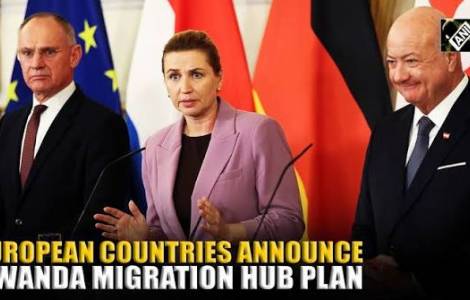
Kigali (Fides News Agency) – On 16 November, five European Union countries – Germany, Austria, Greece, Denmark and the Netherlands – announced an agreement with Rwanda to transfer asylum seekers whose applications have been rejected, to repatriation centres.
This is the second such agreement Rwanda has concluded with European partners, following the deal signed with the United Kingdom in 2022. The announcement has prompted a wave of criticism, particularly from humanitarian organizations and NGOs. Save the Children has drawn attention to the potential impact on migrant children, both accompanied and unaccompanied. According to Federica Toscano, Senior Advocacy Adviser at Save the Children Europe, the measures envisaged under the agreement risk exposing children to forced separation from their families, detention, and restricted access to protection and legal assistance.
The five European governments have presented the agreement as a “historic shift in European migration policy”. Austrian Chancellor Christian Stocker used this description, while Danish Prime Minister Mette Frederiksen stressed that the deal reflects the position of most European countries on the urgent need for a more restrictive migration policy. “We will remove the incentive for illegal migration,” Frederiksen added.
Rwanda’s Interior Minister, Vincent Biruta, was also present at the announcement. He described arrival at a repatriation centre in Rwanda as “a second chance for those who are no longer allowed to stay” in European countries. Biruta added that those who arrive in Rwanda will have the option of remaining in the country with a residence permit, return to their country of origin, or move elsewhere.
Under the terms of the agreement, transfers are due to begin next year, initially with a cap of 20 people for each European partner country. The measure does little, however, to address the underlying causes of migration flows. Rather, it reinforces the impression that the initiative is driven primarily by its symbolic value and by the prospect of strengthening relations between Rwanda and the European countries involved.
The agreement follows the model of the arrangement reached with the United Kingdom, which was blocked by the UK Supreme Court in 2023 on the grounds that the rights of asylum seekers could not be adequately guaranteed. In Rwanda, the poverty rate stands at around 27%, according to the World Bank’s latest estimates – hardly an encouraging prospect for refugees hoping to build a future there.
This raises a pertinent question: why is this small African country so keen to conclude such agreements with European partners? The answer lies in Kigali’s increasingly assertive foreign policy, which seeks to establish Rwanda as a key player in regional and continental affairs. By hosting another centre under an agreement with European partners, Rwanda aims to strengthen its position as a significant interlocutor in relations between Africa and Europe.
Moreover, cultivating closer ties with Western countries is also intended to secure their support amid Rwanda’s often strained and conflict-ridden relations with its African neighbors, most notably the Democratic Republic of the Congo.
In doing so, Kigali addresses one of the most sensitive issues in European politics: migration.
(Fides News Agency, 25/11/2026)



 ASIA/OMAN - From 50 faithful to 100,000: the Sultanate’s first Catholic church celebrates its Golden Jubilee
 EUROPE/ROMANIA - Faith that unites peoples: The memory of Pope Luciani celebrated in the church of Italian migrants
 To use AI wisely, first know what you want to preserve, G20 Interfaith forum highlights
 AMERICA/UNITED STATES - At the "G20 Interfaith Forum" Apostolic Nuncio Caccia points out that technologies and innovations "do not tell us what the good is”
 Egypt, Sudan, Eritrea and Somalia meet to discuss tensions and unresolved issues in the Horn of Africa
 United States lifts sanctions on Eritrea