
Information service of the Pontifical Mission Societies since 1927
by Marie-Lucile Kubacki
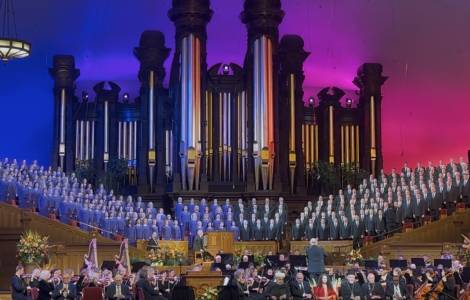
Salt Lake City (Fides News Agency) – “What kind of human future are we building together?” Archbishop Gabriele Caccia, Apostolic Nuncio to the United States, posed this question at the opening ceremony of the G20 Interfaith Forum on October 15 at the historic Tabernacle at Temple Square in Salt Lake City. Addressing representatives of different religious traditions, he called for economic and technological progress to be judged by its service to the human person. He also delivered a message sent on behalf of Pope Leo XIV by Cardinal Pietro Parolin, Secretary of State.
Taking place from October 15 to 17 under the theme “Resilient Hope, Shared Future,” the Forum brings together religious leaders, scholars, civil society representatives and policymakers to explore how faith communities can contribute to addressing global challenges. Its discussions seek to bring religious perspectives and practical experience to the international policy agenda in the lead-up to the G20 leaders’ summit. Established in 2014, when its first gathering took place on Australia’s Gold Coast, the Forum has brought religious perspectives into dialogue with the G20 policy agenda for more than a decade. Its most recent editions were held in Bologna (2021), Abu Dhabi (2022), Pune (2023), Brasília (2024) and Cape Town (2025)
The opening ceremony, accompanied by the Tabernacle Choir and Orchestra at Temple Square, included interventions of Sheikh-ul-Islam Allahshukur Pashazadeh, Chairman of the Caucasus Muslims Board; Metropolitan Emmanuel of Chalcedon, of the Ecumenical Patriarchate; Pujya Sadhvi Bhagawati Saraswati, Secretary-General of the Global Interfaith WASH Alliance; Rabbi Mark Dratch, Executive Vice President Emeritus of the Rabbinical Council of America and Chair of the International Jewish Committee for Interreligious Consultations; and Francis Kuria Kagema, Secretary General of Religions for Peace. Dallin H. Oaks, President of The Church of Jesus Christ of Latter-day Saints, welcomed participants.
Progress must serve the human person
In his address, Archbishop Caccia connected economic growth, energy security and the rapid development of new technologies, especially artificial intelligence, to a fundamental question: “Whether the progress we seek will truly serve the human person.” Recalling his years of service at the United Nations, the Nuncio stressed that technological possibilities cannot themselves determine what is good. “Technology offers extraordinary possibilities, but innovation alone does not tell us what is good,” he said. “We still need the kind of judgment that asks whom progress is serving and whether it is serving them well.”
Archbishop Caccia referred to Pope Leo XIV’s encyclical letter Magnifica Humanitas, recalling the Holy Father’s warning against imagining that everything, “even the mystery of the person,” can be reduced to data and performance. Each generation, he said, bears responsibility for shaping its own time in a way worthy of the human person and open to a more fraternal future. Religious communities have a distinctive contribution to make in this context, not because they possess technical solutions to every economic or technological problem, but because their traditions keep alive a deeper question: what it means to recognise every person as a neighbour and to shape common life accordingly.
Archbishop Caccia stressed that authentic interreligious dialogue “does not ask us to become less rooted in our own faith.” “On the contrary, if we know who we are and what we believe, we can meet others more honestly.” He described the hope invoked by the Forum’s theme as more than optimism: “It is the decision to build that future together, while never losing sight of the human person at its center.”
The Pope’s wish: dignity, religious freedom and the common good
Concluding his intervention, Archbishop Caccia read the message conveyed on behalf of Pope Leo XIV by Cardinal Parolin. The Pope expressed the hope that the gathering would be “a shining example of the solidarity of the human family” and encourage a deeper commitment among nations to “the universal principles of human dignity, religious freedom, and common good.”
The message also expressed the Pope’s prayer that deliberations conducted “with gentleness and respect” would inspire believers to find increasingly compelling answers to those who ask the reason for their hope, helping more people draw closer with confidence to the Creator. Assuring participants of his prayers for the Forum’s success, the Holy Father invoked upon them “an abundance of the Most High’s blessings.” (Fides News Agency 17/10/2026)



 “Wecare” missionary experiences/II - When mission becomes a journey of faith
 The good seed of “Wecare” Missionary Experiences/I - Young hearts and the encounter with reality
 ASIA/KAZAKHSTAN - “Spiritual diplomacy” in the face of global challenges: ethics, artificial intelligence and climate change
 Pope to Latin Catholic Bishops in the Arab Regions: “Do not be afraid of your smallness”
 Egypt, Sudan, Eritrea and Somalia meet to discuss tensions and unresolved issues in the Horn of Africa
 Brazil - October 4 elections could shape the Country’s future
 Leo XIV to the John Paul I Vatican Foundation Conference: peace is a daily Mission
 The Pontificate of Leo XIV and Global Politics: A lecture by Massimo Faggioli at the Gregorian University
 LEO XIV IN AFRICA - Pope in Equatorial Guinea: “The Church’s social teaching offers guidance to all who seek peace and justice”
 ASIA/PHILIPPINES - Impeachment proceedings against Vice President Sara Duterte: Catholics are guided by the spirit of the "Oratio imperata"
 The BRICS between “global governance” challenges and the growing role of African countries