
Information service of the Pontifical Mission Societies since 1927
youtube
by Cosimo Graziani
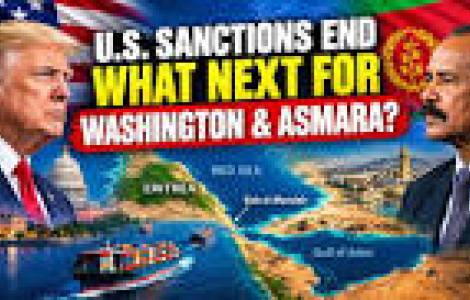
Asmara (Fides News Agency) – The Trump administration has decided to lift sanctions against Eritrea, five years after they were imposed by President Biden. The decision, announced on Friday, 18 September, was justified on the grounds of protecting US national interests.
The entities sanctioned in 2021 were the Eritrean military and President Isaias Afwerki’s ruling party, the People’s Front for Democracy and Justice, which were accused of human rights violations during the conflict in Ethiopia’s Tigray region between 2020 and 2022. During that conflict, Eritrean forces fought alongside the Ethiopian federal army. The sanctions have also been lifted on companies such as the Red Sea Trading Corporation.
According to Reuters, the US government said that the “national emergency” that had justified the sanctions – which were renewed annually – was no longer in effect. The British news agency reported that a US State Department spokesperson said that the sanctions had been unfairly applied and that there was a need to adapt US foreign policy to realities on the ground and to “work with countries to advance American interests”.
The news was received very positively in Eritrea. Asmara’s Information Minister, Yemane Gebremeskel, said that the sanctions had been unjustified and that the government “welcomed the gesture and the remedial measures taken by the Trump administration”.
The decision came just days after the Houthis took control of the opposite shore of the Red Sea, specifically the Bab el-Mandeb Strait. The development is highly significant in terms of its geopolitical and global logistical consequences. Bab el-Mandeb is one of the world’s most important maritime chokepoints, as the trade route linking the Far East with Europe passes through it. Furthermore, following the closure of the Strait of Hormuz, it served as an alternative route for Saudi crude oil exports to Asia. With the Houthis on one side of the Red Sea, Washington has evidently felt the need to implement countermeasures, and it is possible that lifting the sanctions appeared to be the most logical course of action in order to establish a stronger presence in a geopolitical scenario increasingly linked to the Persian Gulf crisis.
But the decision raises serious questions.
In light of the latest developments in Ethiopia, including the seizure of Mekelle airport by Tigrayan militias, the question remains as to whether the United States will stay out of the crisis.
The seizure of Mekelle airport was carried out by militias belonging to a new political and military alliance bringing together Tigrayan forces and other Ethiopian ethnic groups, with the aim of overthrowing Prime Minister Abiy Ahmed’s government.
Eritrea is supporting this group, having switched sides since the 2020–2022 conflict, when it stood alongside Addis Ababa. This makes Eritrea a potential adversary of Ethiopia should a new regional conflict break out.
The crisis did not begin in recent days. In previous months, there had already been clashes between Tigrayan militias and Ethiopian federal forces.
Is it possible that the US administration failed to read the situation correctly when it decided to lift the sanctions on Asmara? If so, we would be looking at what could be described as a strategic error.
The United States risks becoming drawn into a new conflict in this way, potentially causing overstretch not only in terms of resources but also politically, with consequences both domestically and internationally.
The move towards Asmara risks proving counterproductive to American interests, whatever US State Department officials may say.
(Fides News Agency, 27/9/2026)



 Somalia between security transition and terrorism
 AMERICA/CUBA - Caritas continues distributing humanitarian aid: “We cannot reach everyone, but we want to remain close to those most in need”
 ASIA/LEBANON - Six years after the explosion in the Port of Beirut, the Pontifical Mission Societies continue to respond to the emergency facing newly displaced families
 South Sudan's post-independence ordeal: fifteen years of conflict, political instability and humanitarian crises
 The BRICS between “global governance” challenges and the growing role of African countries
 U.S. Secretary of State Rubio’s South American tour: the fight against drug trafficking and the implementation of the “Donroe Doctrine”
 AMERICA/CUBA - New sanctions and a protracted crisis: The Church continues to stand by the Cuban people
 AFRICA/NIGER - Sanctions against coup plotters extended: “The people of Niger are prepared to sacrifice their economy for nationalist pride”
 AFRICA/DR CONGO - Despite ongoing peace talks, massacres of civilians continue