
Information service of the Pontifical Mission Societies since 1927
Kigali (Fides News Agency) – When Jesus "gave the final command, 'Go therefore and make disciples of all nations,' Go therefore and make disciples of all nations", he was not addressing only, or even primarily, specialists in media. He was addressing all his disciples. And also
"Catholic communicators are first and foremost disciples before being influencers."
They are called to recognize, with Christian realism, that the "civilization of love" envisioned by Pope Paul VI and now echoed in the teaching of Pope Leo XIV will never be built by "better algorithms," but by disciples who happen to carry "cameras, microphones and laptops—women and men who understand that discipleship must always come before influence."
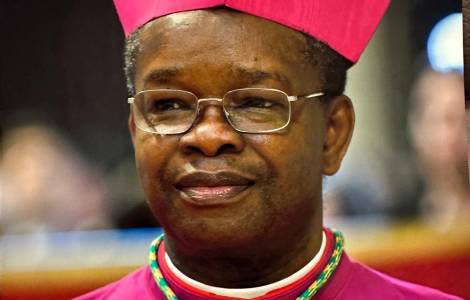
This spirit of Christian realism and “sensus Ecclesiae” permeated the keynote address delivered by Archbishop Fortunatus Nwachukwu on August 4 at the opening of the SIGNIS World Congress, being held in Kigali, Rwanda, until August 8.
SIGNIS, the World Catholic Association, is a global network bringing together Catholic media professionals in more than 100 countries.
Addressing the ever-growing family of "Catholic Communicators," the Secretary of the Dicastery for Evangelization offered a valuable compass to avoid both the clichés of catastrophism and the overexcited rhetoric surrounding the supposedly "boundless horizons and new opportunities" that the digital age and Artificial intelligence are said to offer for apostolic work and the proclamation of the Gospel.
"Technology Is never a neutral instrument"
Drawing on the realism of faith and on the insights contained in Pope Leo XIV's Encyclical Magnifica Humanitas, the Secretary of the Dicastery for Evangelization describes reality as it is today, free from ideological narratives. "We live in an age," he observes, "in which communication no longer simply describes the world; it forms it." It is an era in which "a short video filmed in Kigali can be watched in Manila within minutes. A homily preached in a small parish in the highlands of Kilimanjaro can reach a diaspora community in Brussels before the final blessing of the Mass is given."
The Internet, he notes, "has collapsed geography, and in doing so it has placed an extraordinary instrument of encounter — or of division — in the hands of a single generation, our generation."
The Nigerian Archbishop acknowledges that digital communication, if left solely to the logic of algorithms, "it would likely engender and foster tribalism rather than communion and solidarity." Indeed, "such digital communication, based solely on algorithms, tends to reward what is loud, not what is true; what is polarizing, not what is reconciling." This is because, he stresses, "technology, after all, is never a neutral instrument." Nor should it ever be regarded as possessing any salvific power.
At the same time, Archbishop Fortunatus Nwachukwu notes that "today, the nations, the panta ta ethne of the Lord’s mandate, gather also on Instagram, TikTok, YouTube, and the countless platforms that did not exist only a generation ago. If these platforms are now where people search for truth, meaning, and belonging, then they are also where the Church's communicators must also stand — not to chase attention, but to bear witness with wisdom and love."
It is precisely this wisdom and love, manifested through Christian witness rather than through technical or “professional” skills, that can help Catholic communicators recognize that "cultural harmony is not produced by algorithms that flatten every people into the same content, nor by a globalized monoculture that erases what is distinct and beautiful in each nation."
The biblical text—the Archbishop recalls, drawing on his knowledge as a biblical scholar—"teaches us that God loves differences. In the creation narrative of the book of Genesis, we read that God created all the living things and beings according to their species or differences." It is only the human being, he continues, "that is created according to God’s species. So, cultural harmony is not created by wiping out differences."
Predilections and choices
Another defining hallmark of authentic Catholic communicators, the Secretary of the Dicastery for Evangelization continues, is their preferential concern for the poor and the little ones. "Long before the invention of the printing press, let alone the smartphone, this was already understood as a sacred task. The prophets of Israel gave voice to the widow, the orphan, and the stranger; Christ himself identified with “the least of these”. A Catholic journalist, filmmaker, or broadcaster," the Archbishop adds, "inherits that same prophetic charge. Yours is not simply a professional competence; it is a vocation to be the voice of those whom society has rendered voiceless — the migrant without documents, the rural community without a microphone, the abuse survivor without a platform, the worker without a union, the child without an advocate."
Archbishop Nwachukwu also points out the tension between the self-promotion of the new digital age and artificial intelligence and the fidelity to reality that should characterize the work of media and communication professionals motivated by faith in Christ. He does not hide the fact that the new digital reality can become a powerful instrument for manipulating hearts and minds in every corner of the world.
"Every algorithm on every platform you use," he observes, "is tuned to amplify the powerful, the wealthy, and the already-famous. It takes a deliberate, courageous and often costly choice to turn the microphone instead toward those the algorithms would rather ignore."
The SIGNIS World Congress was dedicated to the theme “Digital Communication for Cultural Harmony and Environmental Well-being.” "As Pope Francis taught in Laudato Si', his Encyclical Letter," the Archbishop noted, referring to the Congress theme, "a true ecological approach must integrate questions of justice, so as to hear both the cry of the earth and the cry of the poor."
Here too, he stressed, digital communication "has a decisive role to play. It can make visible what the powerful would prefer to keep hidden — the drought in one region, the flooding in another, the community displaced by the extraction or mining of resources it never consented to. It can also bury these realities beneath an endless stream of distractions."
Imitating Christ in the digital world
The distinctive traits of the “Catholic communicator,” Archbishop Nwachukwu emphasized, are manifested in their preferences, their critical perspective, their openness, and their fidelity to reality. Yet the true source of this vocation lies deeper: in being conformed to Christ Himself. Because "Catholic is not a label we wear, but an identity we embody." Moreover, "every authentic act of communication ultimately finds its model in Christ himself, the eternal Word made flesh, who came not merely to proclaim the truth, but to reveal it in his very person, reconciling humanity with God and with one another."
For this reason, "every article, every photograph, every interview, every documentary, every post shared in truth and charity," the Secretary of the Dicastery for Evangelization reminds us—echoing the alternative proposed by Leo XIV in Magnifica Humanitas—"is a brick laid toward one city or another, a new Tower of Babel or a new City of God. There is no such thing as a neutral construction project."
Four frontiers for "digital missionaries"
To translate these suggestions and guidelines into concrete actions, Archbishop Nwachukwu, in his address to the SIGNIS Congress, points to four frontiers for “digital missionaries,” presenting them as “brief invitations” directed especially to young communicators: first, "build your mind before you build your platform," reminding them that "a shallow understanding of your own culture, and of your neighbour's, cannot produce cultural harmony. Read deeply. Listen longer than you speak."
Every “digital road”—the Archbishop continues, pointing to the “second frontier”—“must become a road toward encounter, not toward tribalism or divisions. Every story you tell can defend the dignity of a people, or reduce them to a caricature. Choose the former, even when you will likely have more clicks with the latter.”
The third “brief piece of advice” offered by the Secretary of the Missionary Dicastery is to consider the care of Creation as “an integral part of the story you tell, not an afterthought to it.”
The fourth and crucial “frontier” coincides with the invitation to remember “that artificial intelligence can assist your research, but it cannot replace you in bearing witness.” “Let technology serve your mission. Never let it replace your conscience,” the Archbishop emphasized.
The voice (and pride) of "adolescent" African Churches
From the very beginning of his speech, Fortunatus Nwachukwu recalls that the SIGNIS World Congress 2026 is the first in a long series to be hosted in Africa, and that this fact "tells the universal Church what many of us have long known: that the Church in Africa has come of age, and that her voice, her energy, and her hope have something essential to offer the whole communion of believers."
"The voice of the Church in Africa," adds the Nigerian Archbishop, "is no longer, and should no longer be treated as, the voice of a baby in the crib," in
need of receiveing “milk” from the Churches of the oldest tradition. It is time, however, “for the Churches in Africa to wake up and start behaving, at least like teenagers, if not like full adults, capable of providing much of their basic needs.”
Rwanda, the host country—the Secretary of the Missionary Dicastery insists, referring to the tragedy of the genocides that have marked the country’s history—“knows better than most nations on earth, what is lost when communication is allowed to become an instrument of division rather than truth, and what is gained when a people chooses, deliberately and painfully, the harder road of reconciliation.” This nation—adds the Nigerian Archbishop in this regard—"is one of those that tickle our pride as Africans by showing that Africa can also get its acts together when it has courageous leaders who sincerely have the good of their people at heart, even if they remain imperfect as every human is."
(GV) (Fides News Agency, 7/8/2026)

 ASIA/PHILIPPINES - First Assembly of “Catholic digital missionaries” in Asia to be held in September


 ASIA/SOUTH KOREA - Bishop Lee: "Young Koreans hope that Carlo Acutis will be the patron of World Youth Day in Seoul"
 ASIA/KAZAKHSTAN - “Spiritual diplomacy” in the face of global challenges: ethics, artificial intelligence and climate change
 The BRICS between “global governance” challenges and the growing role of African countries
 Missions in upheaval: World Mission Sunday during the years of war
 VATICAN - Sister Mary Teresa Barron appointed adjunct secretary of the Dicastery for Evangelization and president of the Pontifical Mission Societies
 BEATIFICATION OF FULTON SHEEN/II - Beyond the clichés. Fulton Sheen's lessons in ‘communication’
 VATICAN - Cardinal Tagle to “Catholic Influencers”: Let us be “influenced” and changed by the Love of Christ
 ASIA/SOUTH KOREA - In Seoul, the "Signis" world congress: "the apostolate of listening" for Catholic communicators
 ASIA/MALAYSIA - Archbishop Leow to Catholic journalists: "Keep truth and reality together"
 VATICAN - Cardinal Luis Antonio Tagle is the new Dean of the Sacred College of Cardinals