
Information service of the Pontifical Mission Societies since 1927
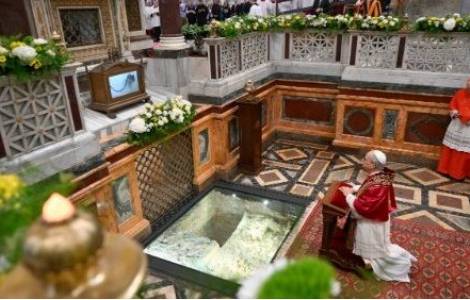
VaticanMedia
by Marie-Lucile Kubacki
Rome (Fides News Agency) – “Your regular book for prayer and meditation should be the Acts of the Apostles. Go there to find your inspiration. And the protagonist of that book is the Holy Spirit.” Pope Francis addressed these words to the directors of the Pontifical Mission Societies during an audience in the Apostolic Palace in 2018.
The early days of Christianity have consistently served as a point of reference whenever the Church has entered periods of profound reflection. This was especially true during the Second Vatican Council, the Council of ‘ressourcement’, the ‘return to the sources’, when bishops and theologians turned to the ancient sources – Scripture, the ancient liturgy and the Fathers of the Church in order to discern the most faithful path for the Church in the contemporary world.
As an heir to that history, Leo XIV, who has launched a new cycle of catecheses on the II Vatican, also turns his gaze to the mission as described in the Acts of the Apostles, as if it were a book of the origins: that of a Church enlivened by the Holy Spirit, shaped by the ministry of Peter, marked by the martyrdom of Stephen, and forever "coming into being."
From this vision flows his missionary approach, shaped by Pentecost, proximity to the wounded, the unarmed witness of the martyrs, and the conviction that, even today, "Christianity is only just beginning," in the words of the Russian Orthodox priest Alexander Men, who was murdered in 1990.
Pentecost: The spirit who opens doors
A month after his election, on 8 June 2025, in his homily for the Solemnity of Pentecost, Leo XIV interpreted the second chapter of the Acts of the Apostles as the foundational scene in which the Holy Spirit "opens" the doors of the Upper Room while the Apostles remain locked inside out of fear. This dynamic of "opening doors" has become a defining feature of his missionary vision.
The Spirit, he explained, "opens borders, first of all, in our hearts," freeing us from our hardness of heart, our narrowness of mind, our selfishness, the fears that enchain us and the narcissism that makes us think only of ourselves. The Spirit "also opens borders in our relationship with others," enabling us to overcome fear of the other, exposing "the hidden dangers that disturb our relationships, like suspicion, prejudice or the desire to manipulate others", and bringing to maturity "the fruits that enable us to cultivate good and healthy relationships: “love, joy, peace, patience, kindness, generosity, faithfulness, gentleness and self-control" (cf. Gal 5:22).
Beyond the individual, the Spirit "also opens borders between peoples," replacing the confusion of Babel with the possibility of mutual understanding. This episode teaches that a Church is truly apostolic when it allows the Holy Spirit to break through its closures and overcome its inward-looking tendencies in order to encounter the other.
In 2026, again on the occasion of Pentecost, Pope Prevost further developed this perspective by presenting the Holy Spirit as the Spirit of peace, mission and truth. The forgiveness entrusted to the Church, he affirmed, is a divine gift offered "because it excludes no one" and that proclamation is based "not on our own merits or privileges, but on the word of the Lord, who sanctifies sinners, heals lepers, makes an apostle those who denied him."
Drawing on St Augustine (Sermon 269), he interpreted the gift of tongues as the sign of unity within "the one faith," while explicitly denouncing "partisanship," "hypocrisy" and "fashions" that obscure the Gospel. At the same time, he stressed that God's truth is a liberating word capable of "transforming every culture from within." This vision also underpins his critique of the theory of the "just war" in the encyclical Magnifica Humanitas (no. 192). In today's world of interconnected networks and algorithms capable of profoundly distorting mutual understanding, the traditional category of the "just war," he argues, has become both inadequate and dangerous.
Peter and the ministry of proximity
The missionary impulse born at Pentecost takes concrete form above all in the figure of Peter. In an address delivered in the Clementine Hall in June 2025, Leo XIV offered a personal reading of Acts 3:1-10, applying it to both the Petrine ministry and papal diplomacy.
The episode recounts the encounter between a crippled man sitting at the ‘Beautiful Gate’, reduced to begging, before being helped to his feet by Peter, who grants him healing in the name of Christ rather than offering him money.
By applying this account to the role of the Successor of Peter, in the service of a ‘resigned humanity’, represented by the sick man in the biblical text, he places at the heart of the Pope’s ministry and that of the papal representatives the ability to build bridges, to listen to the cry of today’s wounded and to heal them through the saving word of Christ.
Peter's response to the beggar—"Look at us!"— highlights the need to live out the Gospel message through relationships. The refusal to rely on "silver and gold" and the exclusive trust placed in "the name of Jesus" likewise reflects one of the defining characteristics of the primitive Christian communities described in the Acts of the Apostles, communities marked by the sharing of goods, prayer and charisms at the service of mission.
By inviting papal representatives to become "the eyes of Peter" on the world's peripheries, Leo XIV transforms papal diplomacy into a missionary program at the service of human relationships, dignity and healing, far removed from the logic of power.
Stephen, Christian martyrdom and the unarmed way
Through the figure of Stephen, Leo XIV deepens the relationship between the Acts of the Apostles and his missionary perspective by offering a reflection on the Christian meaning of martyrdom.
In his Angelus address of 26 December 2025, he recalled how the first Christians spoke of Saint Stephen’s “birthday,” convinced that human beings are "not born just once." He dwelt on the amazement of those who witnessed Stephen's martyrdom before "the light of his face and of his words." His face, "like that of an angel," becomes the face of the authentic witness: of one who does not leave history indifferently, but responds to it with love." "Yet the beauty of Jesus, and of those who imitate his life, is also rejected, for from the beginning, his magnetic force has provoked the reaction of those who struggle for power, those who are exposed by their acts of injustice because of a goodness that reveals the intentions of their hearts," the Pope observed, repeating—as Benedict XVI and Pope Francis had already done—that mission proceeds "by attraction."
Stephen dies whilst forgiving, thereby choosing to respond to violence without violence and to place his trust in the paradoxical power of love. "Today, those who believe in peace and have chosen the unarmed path of Jesus and the martyrs are often ridiculed, excluded from public discourse, and not infrequently accused of favoring adversaries and enemies. Christians, however, have no enemies, but brothers and sisters, who remain so even when they do not understand each other."
From this vision emerges the "unarmed way," that "disarming and unarmed peace" evoked by the Algerian martyrs Pierre Claverie and Christian de Chergé. As with the protomartyr Stephen, the strength of their witness lies not in spectacular demonstrations, but in the simplicity and joy of a life hidden in God and offered to the very end.
In his homily for the Solemnity of Saints Peter and Paul on 29 June 2026, Leo XIV presented Paul as the "tireless herald of the Good News," symbolized by the book and the sword. These two symbols express "what God accomplished in the heart of the young Saul, winning him over
(cf. Phil 3:12), bringing him first to conversion to the Gospel and giving him a new name, and then sending him to proclaim it throughout the world. Finally, like Peter, he was to bear witness to the Gospel even to the point of giving his life in this very city."
"The Apostle to the Gentiles allowed himself to be transformed by the power of God’s word, which rescued him from the way of violence and led him onto the path of love," he concluded. Here lies the deepest meaning of martyrdom: a testimony of love, offered in simplicity, revealing the true power of the Gospel, summed up in the Apostle's words: "When I am weak, then I am strong."
A "continually reborn" Church
For Leo XIV, the "continually reborn" Church depicted in the Acts of the Apostles remains the primary reference for living the Church's mission in the contemporary world.
He articulated this vision most fully during his apostolic journey to Africa, in the Basilica of Saint Augustine in Annaba on 14 April 2026.
Reflecting on Augustine's conversion, the Pope insisted that "Christians are truly born from above, regenerated by God as brothers and sisters of Jesus." The Acts of the Apostles bears witness to this by describing "the lifestyle that characterizes humanity when it has been renewed by the Holy Spirit," characterized by faith, charity, justice, fraternity and communion.
"Inspired by this law, inscribed in our hearts by God, the Church is continually reborn, for where there is despair she kindles hope, where there is misery she brings dignity, and where there is conflict she brings reconciliation."
Before leaving Annaba, Leo XIV encouraged Algeria's small Christian community to become "like a grain of incense": a humble presence spreading its fragrance because it burns with faith in Christ, persevering in hospitality and openness amid the trials of history.
To be "continually reborn" therefore means accepting the destabilizing dynamism experienced by the Church of the Acts of the Apostles—both within its historical context and in the debate over the reception of the pagans that culminated in the Council of Jerusalem—without allowing oneself to be paralyzed by the fact of being a small number.
Faithfulness to our origins, not out of nostalgia, but because
the origins remain for every generation a source of living water. Every generation is, in its own way, a generation of early Christians, called to experience anew the burning reality of conversion—that is, the gift of a new life. (Fides News Agency, 10/7/2026)



 New episcopal ordination in China: Ignatius Ding Zuyao ordained Bishop of Haimen
 Leo XIV to the John Paul I Vatican Foundation Conference: peace is a daily Mission
 COLOMBIA - "Mission remains urgent": the Colombian Church renews its missionary commitment on the centenary of DOMUND
 100 YEARS SINCE THE ORDINATIONS OF THE FIRST SIX CHINESE BISHOPS - Bishop Joseph Hu Ruoshan and the Diocese of Taizhou
 Bible and cultures: Christian identity as encounter
 The feast of the Transfiguration of the Lord Jesus in a world disfigured by war
 Leo XIV: in the lives of new martyrs and witnesses, the reflection of Christ’s victory over death
 ASIA/SOUTH KOREA - Official hymn for Seoul WYD 2027 unveiled: "Take courage; I have overcome the world"