
Information service of the Pontifical Mission Societies since 1927
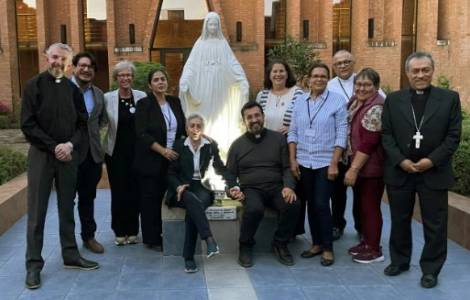
Bogotá (Fides News Agency) – "Care is not the responsibility of a few, but the mission of everyone." With this message, the Latin American and Caribbean Network for the Culture of Care launched the continental campaign "Care Unites Us. Caring is everyone's responsibility," an initiative aimed at strengthening a lasting culture of prevention, protection and accompaniment within ecclesial communities across Latin America and the Caribbean, with particular attention to children, adolescents and people in vulnerable situations.
The campaign was presented during a webinar organized by the Network, which brings together the prevention commissions of the Episcopal Conferences throughout the continent, alongside the Latin American Confederation of Religious (CLAR) and Caritas Latin America and the Caribbean. Representatives from Colombia, Argentina, the Dominican Republic, Honduras, Panama, Costa Rica, Chile, Mexico and several other countries in the region took part in the event.
The initiative is the result of the journey undertaken by the Network since 2023 to foster communion, formation and the exchange of experiences among the various ecclesial bodies committed to promoting safe environments.
"A culture of care cannot be built through isolated initiatives; it requires collaboration, listening and shared responsibility," said Bishop Lizardo Estrada Herrera, Secretary General of the Latin American and Caribbean Episcopal Council (CELAM) and member of the Dicastery for Promoting Integral Human Development, during the presentation of the campaign.
According to Bishop Estrada, the work carried out by the Network represents "a journey of communion, formation and coordination among the local Churches and the various ecclesial bodies throughout the continent." It is an experience that demonstrates the importance of sharing skills and experiences in order to present "a Church that is closer to the people, more transparent and more committed to defending the dignity of every human being."
From prevention to a culture of care
One of the campaign's central objectives is to move beyond a narrow understanding of prevention as merely a response to abuse or the implementation of protocols. Instead, it seeks to make care a permanent dimension of community and pastoral life.
"This campaign is not simply a communication initiative or a collection of materials to be distributed. It is an invitation to strengthen an authentic culture of care that permeates our relationships, our communities, our pastoral structures and our formation programmes," Bishop Estrada explained.
The CELAM Secretary General recalled that "our beloved and late Pope Francis repeatedly affirmed during his pontificate that caring for people, especially the most vulnerable, is an essential part of the Church's evangelizing mission."
He added: "Pope Leo XIV recently reminded us that prevention is not simply a set of protocols or procedures. It means fostering throughout the Church a culture of care in which the protection of minors and vulnerable persons becomes a natural expression of our faith."
The protection of vulnerable people is therefore presented as an integral part of the Church's evangelizing mission and of respect for the dignity of every person. "Caring for others is not the exclusive responsibility of specialists or particular offices; it belongs to the whole People of God," he stressed.
The campaign's motto, "Care Unites Us," reflects precisely this communal dimension. "Only a Church that knows how to care can credibly proclaim God's love," Bishop Estrada said, recalling that prevention, transparency and shared responsibility are all part of an ongoing journey of conversion.
A campaign at the service of ecclesial communities
Presenting the campaign materials, María Fernanda Díaz, Production Coordinator of the Foundation for Education and Social Communication of Honduras, explained that the initiative seeks to provide concrete tools enabling communities to address these issues starting from their own realities.
"Prevention is born not of fear but of responsibility. Those who love do not look the other way; they face reality, embrace the truth and act with transparency," she said.
The campaign promotes three fundamental attitudes: respect for the dignity of every person, active listening and non-judgmental accompaniment.
Designed as a shared resource, the initiative can be adapted by Episcopal Conferences, dioceses, religious institutes, parishes and other pastoral bodies according to their specific contexts. The materials, available in Spanish, Portuguese and English, include videos, graphic resources, a guide for communities and pastoral resources intended to support awareness-raising and formation.
Father Pedro Brassesco, Coordinator of the Latin American and Caribbean Network for the Culture of Care, explained during the webinar that the campaign originated at the request of local prevention commissions, which had expressed the need for shared materials adaptable to different realities.
"From the outset, the idea was that everyone could promote the campaign within their own local context and personalize it by adding the logo of their institution, organization or Episcopal Conference, making it truly their own," he said.
The priest also urged participants not to reduce the initiative to a simple communication effort. "We must not allow this campaign to become merely a slogan or a series of activities," he said. Rather, it should become "an invitation to continue building together an authentic culture of care, in which every person can find communities that are safe, welcoming and genuinely committed to protecting the dignity of all."
The campaign will be rolled out progressively over the coming months through the digital platforms of CELAM and the organizations belonging to the Network, with the aim of consolidating a culture of care as a permanent and shared practice within ecclesial communities throughout the continent.
(LGR) (Fides News Agency, 5/8/2026)



 The Heaven opened, the Bishop’s Mission, and the Grace of being a little flock
 The Gospel bears fruit among mountainous ethnic minorities in Northern Vietnam
 Leo XIV: The Catholic Church has contributed to the development of the United States
 ASIA/BANGLADESH - Bishop Subroto: Silent march of Catholics in Dhaka “to say No to fundamentalism and violence”
 POPE IN FRANCE/V - The (silent) mission of Lourdes: “God’s charity does not heal those who have no wounds”
 At the Course for Newly Appointed Bishops, practical tools for missionary communion with the Successor of Peter were presented
 Archdiocese of Bogotá brings aid and hope to Cuba: “The Cuban people need us and ask for our support”
 ASIA/CHINA - Data on the generous participation of Chinese Catholic Communities in the 2026 national Collection