
Information service of the Pontifical Mission Societies since 1927
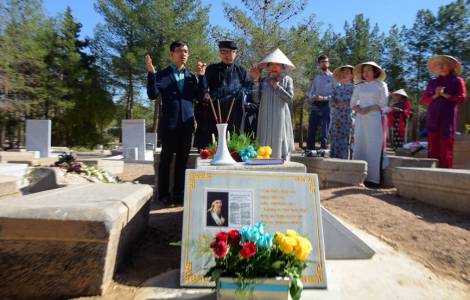
Photo: Arcidiocesi di Hô Chí Minh
by Marie-Lucile Kubacki
Hanoi (Fides News Agency) – A Holy Year marking 400 years since the Gospel was first proclaimed in the territory of what is now the Archdiocese of Hanoi opened today in the Vietnamese capital.
The anniversary recalls the first Jesuit missions in Tonkin. In 1626, Jesuit Giuliano Baldinotti made a brief visit to Thăng Long and the following year, Alexandre de Rhodes arrived. He is known in Vietnam as Đắc Lộ. Together with Father Pedro Marques, Rhodes landed on 19 March 1627 at Cửa Bạng, in what is now Thanh Hóa province, and reached the capital on 2 July. To mark the anniversary, the Archdiocese has launched a Jubilee Year and organized a conference on Thursday, 26 November, focusing on the missionary's cultural and linguistic legacy.
The Holy Year will conclude on 24 November 2027. In two decrees dated 12 August 2026, the Apostolic Penitentiary granted a plenary indulgence, under the usual conditions, to the faithful who make a pilgrimage to St Joseph's Cathedral or another church designated by Archbishop Joseph Vũ Văn Thiên. The indulgence is also granted to those who receive the Apostolic Blessing imparted by the Archbishop, including those who follow the ceremonies through the media. Those unable to take part because of old age or serious illness may join spiritually.
The Jubilee churches are St Joseph's Cathedral, the National Shrine of the Vietnamese Martyrs in Sở Kiện, and the churches of Cửa Bắc, Vĩnh Trị, Bút Đông, Bằng Sở, Từ Châu and Mường Cắt.
Three main celebrations will mark the Jubilee. The opening Mass, presided over by Archbishop Vũ Văn Thiên, is being celebrated today in Sở Kiện, bringing to a close the third major national pilgrimage in honor of the Vietnamese martyrs, which began at the same shrine on 16 November. On Friday, 2 July 2027, the 400th anniversary of Rhodes's arrival in Thăng Long, the Cathedral in Hanoi will host a commemorative Mass. The closing Mass will take place on Wednesday, 24 November 2027, again in Sở Kiện.
Words as a lasting legacy
The theme of the Holy Year is “Cùng Nhau Loan Báo Tin Mừng” – “Proclaiming the Good News together”.
In his pastoral letter of 15 November, Archbishop Joseph Vũ Văn Thiên recalled the journey that led to the anniversary: “On 19 March 1627, the boat carrying Father Đắc Lộ and Father Marquez landed at Cửa Bạng, in Thanh Hóa. More than three months later, on 2 July, the missionaries reached the capital, Thăng Long-Kẻ Chợ, to proclaim the Good News.”
After three years of missionary work in Tonkin, around 5,000 people had embraced the Christian faith. His account highlights the close link between the proclamation of the Gospel and the meeting of cultures: “With a burning heart and deep understanding, Father Đắc Lộ not only brought the light of the Gospel to our people, but also helped lay the foundations, together with other missionaries, for the development of the quốc ngữ script. This was a twofold gift: the Gospel of salvation, which saves souls, and a new language that helped renew our national culture.”
This encounter left behind a legacy of books and written texts. In 1651, the Dictionarium Annamiticum Lusitanum et Latinum, a Vietnamese-Portuguese-Latin dictionary with a grammatical description of the language, was published in Rome. The same year saw the publication of Phép giảng tám ngày, a bilingual catechism in Latin and romanized Vietnamese. A copy is kept in the historic church of Mằng Lăng, in Phú Yên.
However, quốc ngữ was not the work of one man alone. Francisco de Pina, other Jesuit missionaries and Vietnamese collaborators all contributed to its development. Rhodes played an important role in organizing and spreading the writing system. His works, published in Rome in 1651, helped establish a form of writing that would have a lasting impact on the country's cultural history.
For the Archbishop, preserving this legacy means more than remembering the past. It also means thanking those who embraced and passed on the faith. “Thanks to their faith and dedication, the flame of faith has always remained alive in our land,” he wrote. He added: “The Holy Year is not just a time to remember the past, but a call to move forward and take action.”
The Archbishop also encouraged young people to use social media to spread the Gospel.
“Turn your social media pages – Facebook, TikTok, Instagram… – into places where you spread goodness. Instead of negative comments or pointless trends, have the courage to share a meaningful passage from the Word of God, an image of charity, or a story about good people and good deeds that can inspire others. In this way, you can bring light to the heart of the virtual world.”
The letter also calls on everyone to support young people facing difficulties, people with disabilities and those who are less fortunate.
The stone that disappears and returns
The memory of Rhodes in Hanoi has changed over the years. Nguyễn Xuân Diện traces its history in an article published on 17 September 2026 by the Hán Nôm Institute, part of the Vietnam Academy of Social Sciences, which studies ancient Chinese and Nôm texts.
According to the researcher, on 29 May 1941, a pavilion with four roofs was inaugurated beside Bà Kiệu Temple, opposite Ngọc Sơn Temple. It housed a stone stele bearing inscriptions in quốc ngữ, Chinese and French. In September of the same year, a street in the city was named after the Jesuit. Today, it is known as Đặng Trần Côn.
Following the political and social upheavals of the mid-20th century, the pavilion was dismantled. The stele was found in 1987 by a former museum official after years of being lost. A conference held on 22 December 1995, marking 335 years since Rhodes's death, brought renewed attention to its history. For the author, the 400th anniversary is an opportunity to examine the very history of this memory and understand who preserved it, why it was forgotten and how it was eventually found.
Memory will also be the focus of the conference. On Thursday, 26 November, scholars and Church representatives will meet at the Archdiocesan Conference Hall, (40 Nhà Chung), for a day dedicated to “Father Đắc Lộ: His missionary journey, cultural and linguistic legacy, and the formation of the local Church in Tonkin”.
The morning sessions will focus on Rhodes's journey and mission. They will include a presentation of the Initium Missionis Tunquinensis, a historical account of missionary work between 1627 and 1630, as well as talks on François Pallu's role after Rhodes and the formation of the local clergy in Ayutthaya. The afternoon will focus on the missionary's legacy, including the development of quốc ngữ, the writings of Rhodes and other Jesuits on Vietnamese culture and religion, and the role of archives in preserving historical memory.
The final presentation, by Nguyễn Đăng Hưng, will take participants far from Hanoi, to Isfahan in Iran, where he will recount the story of the monument erected in honor of Father Đắc Lộ, following the footsteps of his final journey.
Rhodes died there in 1660. In 2018, a Vietnamese delegation placed a commemorative plaque at his tomb, bearing words of gratitude in four languages: Vietnamese, French, English and Persian. A stone stele from Quảng Nam also stands in front of the tomb.
(Fides News Agency, 24/11/2026)



 ASIA/CHINA - New Bishop of Xiamen: “Communion and Mission are at the heart of Church Life”
 St. Louis: On the Trail of the French Roots of a Diocese
 ASIA/KYRGYZSTAN - “The fate of the flock is my fate”: Bishop Anthony Corcoran’s missionary road
 EUROPE/SLOVAKIA - Mission at the heart of the Jubilee Year dedicated to the first Rector of the "Russicum", Vendelín Javorka
 Bible and cultures: Christian identity as encounter
 POPE IN FRANCE/XI - Leo XIV in Metz: Europe seeks peace in the "Lantern of the Good Lord"
 The Conference on the first Chinese Bishops: The “new beginning” that sheds light on the present of the Catholic Church in China
 POPE IN FRANCE/VI - Leo XIV in Paris: A missionary topography
 Columba Kang Wan-suk, a martyr and a “companion” on the journey towards WYD “Seoul 2027”
 THE POPE IN FRANCE/X - In Lourdes, where the vulnerable bring light
 Three Churches pray for peace on the border between the Czech Republic, Slovakia, and Poland