
Information service of the Pontifical Mission Societies since 1927
by Marie-Lucile Kubacki
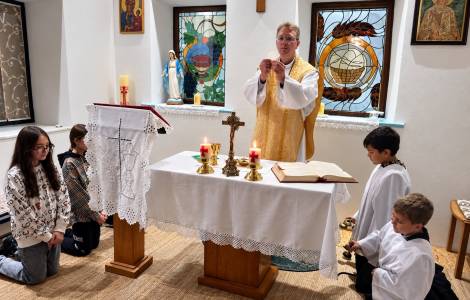
Biškek (Fides News Agency) – On September 29, Cardinal Giorgio Marengo will lay his hands on the head of Father Anthony Corcoran, an American-born Jesuit, who will become a bishop that day. He will be confirmed in what he has been for nearly a decade: the shepherd of a few hundred Catholics scattered across a Muslim-majority country in Central Asia, Kyrgyzstan.
Ask him how he got there, and he smiles before he answers. "I love the question: how did a boy from Texas end up as bishop of Kyrgyzstan? It can only be the mystery of the Providence of God. I think every step we take has something to do with a larger plan for our lives. When we try to say yes to Him and surrender, He leads us to the next step," he tells Fides, while attending the training for new bishops provided by the Dicastery for Evangelization and the Dicastery for Bishops.
The boy from Texas was born, in fact, in Arizona, on April 19, 1963, in Tucson. As highlighted in profiles published by the Diocese of Tucson, both his parents came from Bisbee, in Cochise County, and two of his grandparents were themselves children of southern Arizona. He was baptized at Saint Andrew’s, in Sierra Vista, before the family moved to Texas during his childhood.
In the family memory he has described in a previous interview with the Diocese, faith belonged to the texture of ordinary life, inseparable from a community formed by many origins and confessions. His father’s closest friend, a practicing Polish-American Catholic, became one early and concrete witness of that faith. Corcoran also recalls his parents’ admiration for their Mexican Catholic neighbours: not as an abstract lesson in coexistence, but as a recognition of the seriousness, generosity and dignity with which those neighbours lived their belief.
That early experience of a plural and welcoming borderland would remain with him.
Nevertheless, the priesthood was not the plan. Not at first. "When I was discerning a vocation to the priesthood, I had gone to study something totally unrelated to the priesthood," he remembers for Fides. "I went to a university where the Jesuits taught, and I met the Jesuits. I didn't think of myself as a Jesuit until the very end of my studies, when they invited us to do the Spiritual Exercises. I fell in love with Ignatius, with the Exercises, with the idea of being a missionary."
In Siberia after the collapse of the USSR
Anthony Corcoran the Society of Jesus in Grand Coteau, Louisiana, in 1985. Behind that decision was something older, something learned on his knees as a child. "From there I went into the novitiate. I had always dreamed of becoming a missionary. When we were children, we prayed every day, three Hail Marys for the conversion of Russia, as Our Lady of Fatima had asked. I suspect that allowed Mary to get into my heart and my soul, to prepare me for coming to these people."
He earned a degree in political science from Marquette University, a master's in international political economic development from Fordham, and, later, a licentiate and a doctorate in sacred theology from the Weston Jesuit School of Theology. He was ordained a priest on June 8, 1996, at Spring Hill College in Mobile, Alabama. By then, history had already answered his childhood prayer, in its own way. "When I was ready to be ordained a priest, the Soviet Union had just collapsed, and Saint John Paul II asked for priests to go. My community sent me to Russia, to Siberia at the beginning. From there I got to know Kyrgyzstan, and was assigned here," he relates to Fides.
He would spend more than twenty years in Russia as vicar general in Novosibirsk, then as major superior of the Jesuits' Russian Region in Moscow, where he professed his final vows in 2002. In 2017, Pope Francis named him apostolic administrator of Kyrgyzstan.
Looking back on the whole arc of it, he resists tidy explanations. "Of course," he affirms, "it is all God's Providence: when we try to say yes to one step, however imperfectly we do it, that step leads us somewhere. It's not so important for us to know exactly where and how. What matters is to know with whom—with God. That's how I got here."
Bordering China
In Kyrgyzstan, a country of more than seven million people bordering China, Catholics number only several hundred, Corcoran says. Pope Francis had a word for it. “The Church in Kyrgyzstan is lovely,” Father Corcoran tells Fides. “It’s tiny. Pope Francis called the Church in Central Asia and Mongolia a germoglio — a young shoot. Because we are a little flock.”
The bud among the deportees
Their story begins in exile. "Their families were sent to Central Asia and Siberia during the war, by Joseph Stalin. Their children and grandchildren are the ones we have mostly worked with, since the end of the Soviet Union." Then, almost as soon as the community found its footing again, it began to empty out. "The vast majority of these people have emigrated out of the country—it's really not an exaggeration to say that perhaps ninety-eight, ninety-nine percent of our Catholic population has left. We feel that, please God, the foundation they received in the faith here allows them to bring it elsewhere. I've heard from parishes where they've moved—to Germany, to Russia—that the people who came from Kyrgyzstan were often very faith-filled. It was part of God's plan."
What remains is small by any measure, and he does not pretend otherwise. Nine priests serve across the entire country. The prayers are said mostly in Russian; some of the priests, including him, are learning Kyrgyz. A few young ethnic Kyrgyz now come to Mass, alongside the mixed community that is left. And yet he calls it a joy. "It's a beautiful witness of hope, that Jesus has His Church here, where He would have it—perhaps for the next generation, or perhaps, if we're faithful, we will see His fruit in this generation. It's His work. I understand as bishop—sometimes people say I'm the head, but really I'm hopefully a loyal second worker with Him. That's how we understand our little community."
Lands and peoples united by the Silk Road
He speaks of the Kyrgyz themselves with the attentiveness of a man who has spent years watching a people from the inside, with faith and high emotional intelligence. "The history of the Kyrgyz people is short compared to many other cultures in the world, but it definitely has a sense of its own identity, and the dignity of that identity, the pride of it, in a good way. At the same time, because of their culture, they are quite open to different peoples. This was the area of the Silk Road, and the Silk Road was possible partly because of people such as the Kyrgyz. Someone noted very astutely that the Kyrgyz generally do not like fanaticism. They take life for what it means, centered on how nature happens, how God acts, how their families are. I think these are natural virtues: God gives these to a people who develop them, for the sake of building up their society, for the sake of meeting God the way He would have it."
He returns, unprompted, to a lesson from his own Catholic school days. "When I was a child in Catholic school, they taught us that a virtue is like a muscle—a gift from God. Without it, we could do nothing, we could not move. But then it depends almost entirely on us to develop it each day. A muscle grows most effectively when there's an opposing force against it—it can even break down, and then build back up. This is what I see among the Kyrgyz and the Central Asians: a hospitality, an openness, and at the same time a sense of who they are, of their identity. This is a trait of the people here."
Belonging to Christ, belonging to His people
Becoming their bishop, he says, is not a title conferred by any community. It is something else entirely. "The call to priesthood, or to the episcopacy, is from Jesus Christ Himself," he assures. "It's not something a community gives us. And yet, like any spirituality that is incarnated, the spirituality of being a bishop is incarnated to specific people, at a specific time, in specific circumstances. God knows that. He knows everything, and He chooses to match. When God chooses the bishop, He chooses the people too; the relationship is sealed in His love for them, and their goodness. We all belong to Jesus Christ, and I think the way that happens is concrete: we belong through concrete people, concrete places, concrete times. As He says, He has called us, we have not called Him."
Knows his little flock by name
It is a claim he has made with his own life, not only his words. He recently obtained Kyrgyz citizenship and is now a local citizen. "Being a bishop seals that even more. You're all in. So getting citizenship feels so natural to me. The fate of the flock is my fate. I will never be a native, but I can take on whatever I can that is theirs, so that hopefully I can become theirs, and they are in my heart." He has known crowded parishes. Now he knows nearly everyone by name.
"When I was first ordained, still in the United States, finishing my preparation to come to Russia, I would be at a parish with hundreds and hundreds of people, sometimes several Masses at once. Now, to come to a place where there are several hundred Catholics and it's really touching.” Corcoran says he understood Pope Leo’s decision as a sign that, even if they are very few, they should have their own pastor, a bishop.
The opportunity to be small
“To me, it's very touching to know almost all the Catholics personally, to be part of their lives. Of course, we pray that people come to Jesus Christ and the Church grows." Smallness, for him, is not a problem to be solved. It is a shape mission has always taken.
"Being a missionary, and being local, not born there, not a native, but hopefully rooted, is always being a missionary, like everyone, even if they stay in the city where they were born. Because mission is not entirely about territory or geography, even though that's part of where it's incarnated. Mission is about the territory of hearts, minds and souls.
During our ad limina, and in other places, Pope Francis would repeat that for God, small is not a problem, it's a possibility, an opportunity. Think of the first community in Bethlehem: how few they were, and how precious. His plan is there, for every single person, whether they know Him or believe in Him, or one day will stand before Him and be tasked to know Him and love Him and share Him. Being part of a small community, to me, is a real joy and a consolation—and at the same time a challenge. One day, may our Church be bigger, with more people. And at the same time, this core that is here now—God works through His remnant."
The small remnant
Two memories anchor everything he believes about that remnant. The first is recent, and it is small enough to hold in one hand. "There's a story I love," he remembers with a smile. "A little boy came out of the mosque on a Friday, in a small town where I was. I was dressed as a priest. He had obviously heard something about us at school. He had a little hat on. He came up to me, looked at me with total innocence, curiosity and real respect, and said: 'You're a follower of the Christ.' He didn't speak Russian, and he didn't know the word for 'disciple' in Kyrgyz—I think he was just intrigued, as if he had never met one, or never thought to ask somebody. I remember being very moved by that, thinking: what a grace, to say yes. What a grace, if people can come to us and look at us with curiosity, or skepticism, or hope—but what greater words are there for us to hear, and let sink into our hearts, than 'Are you a follower of the Christ?' I hope, my whole life, I can be marked as a person—as a follower of Christ."
In the sign of the cross, all the faith of the deported grandmothers
The second memory is older, and it reaches back before he ever set foot in Kyrgyzstan. "In the nineties, when I first arrived in Siberia, I would visit Central Asia sometimes. I was always struck when I met people who called themselves Catholic. The grandmothers, the babushkas, had been arrested in 1937, in 1941, and sent to Siberia and Central Asia. That is largely how, by Providence, the Church exists as a structure now. I remember meeting people who had never met a priest but were very convinced they were Catholic. I would ask them: what does it mean to be Catholic, when you've never been to Mass, never received any sacraments other than baptism? Some had been baptized by their grandmothers. I asked: what do you know about being Catholic? How did you keep your faith? There were three things people had in common, though there were as many answers as there were people. One seems very simple to us: they knew how to cross themselves, as we do. They would show me, with such devotion, that I still become emotional remembering it."
On September 29, with these images engraved deep in his soul, Anthony Corcoran will say yes again.
(Fides News Agency, 29/9/2026)



 100 YEARS SINCE THE ORDINATIONS OF THE FIRST SIX CHINESE BISHOPS - Bishop Joseph Hu Ruoshan and the Diocese of Taizhou
 New episcopal ordination in China: Ignatius Ding Zuyao ordained Bishop of Haimen
 100th WORLD MISSION SUNDAY - Pope Leo XIV: May the Church always remain faithful to the mandate of the Risen Lord
 The Church of the Sheaves: a missionary perspective presented to Newly Ordained Bishops
 EUROPE/SLOVAKIA - Mission at the heart of the Jubilee Year dedicated to the first Rector of the "Russicum", Vendelín Javorka
 EUROPE/ESTONIA - Beatification of Missionary Bishop Eduard Profittlich: Remaining in the light of Christ in the face of darkness