
Information service of the Pontifical Mission Societies since 1927
VaticanMedia
by Marie-Lucile Kubacki
Metz (Fides News Agency) – “An American Pope speaking from Metz, on the border with Germany, about “De Gasperi” with a French accent,” journalist Iacopo Scaramuzzi wrote on the social network X.
Perhaps this sentence sums up what happened during Leo XIV's visit to the city of the three borders, where traces of war are still visible on the stones of some houses and in the history of its inhabitants. This is the meaning of the Bishop of Rome’s visit to this city in eastern France, which perhaps more than any other recalls why some of its sons, such as Robert Schuman — buried just a few kilometres from here, in the town of Scy-Chazelles — once sought to build Europe.
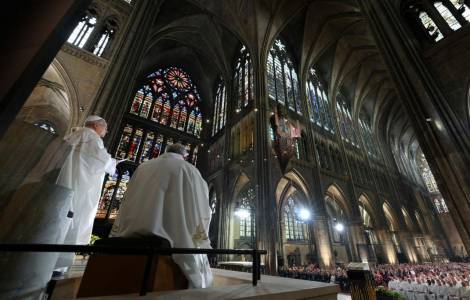
At the conclusion of his visit to France, the Pope celebrated Mass in Saint Stephen’s Cathedral, in the heart of a city shaped by conflict and changing borders. Here he entrusted “the diocesan community of Metz and the whole of Europe to the Lord.” “Peace,” he recalled, “is a gift from God, but also requires a response from human beings through combined effort.”
Drawing on the images of the prophet Isaiah — the desert, the garden and the house — Leo XIV spoke of law, justice and peace, before turning to forgiveness, mercy and reconciliation.
Light and differences
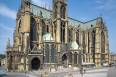
The most evocative image in the homily was that of the cathedral, known as the “Lantern of the Good Lord” because of its 6,500 square metres of stained-glass windows. Its builders, the Pope observed, seem to have “sought to minimize the walls — which remain solid — so that light might flood in abundantly to the faithful.” The stained glass makes the cathedral a biblia pauperum, a “source of prayer and meditation, through the reflections of a thousand colors.”
In this place of light, the splendor of the historic stained-glass windows has recently been enhanced by the genius of Marc Chagall. The works of the “great Jewish painter”, set into the cathedral’s walls, transform the “Lantern of the Good Lord”, Leo XIV said, into an “extraordinary symbol of ecumenism and interreligious dialogue.” It is an image of unity that does not mean uniformity: “this cathedral teaches us that God’s light does not erase our unique identities but rather unites different histories and cultures into a single marvelous mosaic of peace,” Leo XIV said.
“Europe’s future does not lie in uniformity, but in the harmony of differences,” he continued. In this harmony, he added, “the wounds of the past become openings through which light shines.”
In Metz, a city where the scars of history remain visible, the idea that differences and wounds can contribute to a common cause has a particular resonance beneath the cathedral’s vaults. Its walls still bear the scars left by bullets and shrapnel during the fighting for the liberation of the city in the autumn of 1944.
Applying this metaphor to the Church, the Pope stressed that her structures “have meaning insofar as they help us to bring the light of the Gospel to the world.” Without these stained-glass windows, the windows of Saint Stephen’s Cathedral would be mere “spaces flooded with blinding light.” With these stained-glass windows, however, “they become books that bring us together to remember wonderful stories full of heroism, goodness, mercy, love and moral beauty.”
At the roots of Europe
Earlier in the morning, at the Robert Schuman Conference Centre, the Pope had already placed his visit to Metz under the sign of European memory. Addressing participants in the meeting “To the Roots of Europe, for Peace and Unity,” he paid tribute to Robert Schuman, whose life was shaped by the vicissitudes of this region and its changing borders. The Declaration of 9 May 1950, he recalled, was both “the starting point and the culmination” of his lifelong commitment to the reconciliation and unity of the European continent.
Leo XIV placed the construction of Europe within a history of encounters, marked by crises and conflicts, but capable of renewal when peoples are able to welcome others and reinterpret their own heritage. He recalled in particular the contribution of Christianity and monasticism to the cultural and social formation of Europe, also invoking Saint Chrodegang and the spirit of fraternity, communion and sharing associated with Metz.
Schuman’s legacy, he stressed, calls Europeans today to defend dialogue, international law and multilateralism, at a time when war has returned to Europe. Peace cannot be confused with “naive irenicism”: it requires “creative efforts” and courage in negotiation. It also requires a willingness to sacrifice certain positions for the greater good of peace. The Pope urged people to beware of the illusion that rearmament alone can provide security and to ask whether genuine creative efforts are being made to advance peace.
The Metz Appeal and the responsibility of believers for peace
During the interreligious meeting, also held at the Robert Schuman Congress Centre, the Pope had stressed the shared responsibility of believers. Metz, a “city of borders and crossings”, reminds us that lines of division can be transformed into bridges, he said. “Dialogue does not diminish our identity, but expresses it with simplicity and truth, opening it to the diversity of the other.”
To invoke God in order to justify violence or oppression, he warned, “is to profane his name.” “Nothing that disfigures human dignity can claim to be inspired by God,” he continued, urging religious discourse to “disarm hearts and words.”
According to the Pope, religious traditions also have a responsibility to safeguard life and protect the most vulnerable: “The greatness of a civilization is not measured by its material achievements, but by the way in which it cares for the human person, protects and defends him.”
The meeting was marked by the signing of the “Metz Appeal” by representatives of various religious confessions, forty years after the interreligious meeting in Assisi. The text stresses that, in a world where the escalation of conflicts threatens international law, religious traditions have a responsibility to contribute to dialogue and peace.
From the tribute to Schuman to the encounter among communities of believers, and finally to the homily in the cathedral, the visit to Metz thus brought together three demands: to remember divisions, to rebuild trust and to make room for others without renouncing one’s own identity.
At the conclusion of his visit to France, Leo XIV expressed the hope that the community of Metz would be “a beacon of hope for this country, for Europe and for the world.” In the “Lantern of the Good Lord”, his concluding image was that of a light that does not overwhelm differences with dazzling intensity, but enables them to exist in harmony.
(Fides News Agency, 28/9/2026)



 100th WORLD MISSION SUNDAY - Pope Leo XIV: May the Church always remain faithful to the mandate of the Risen Lord
 New episcopal ordination in China: Ignatius Ding Zuyao ordained Bishop of Haimen
 POPE IN FRANCE/VI - Leo XIV in Paris: A missionary topography
 Pope in France/III - Metz, at the roots of European peace in the “city of three borders”
 Brazil - October 4 elections could shape the Country’s future
 ASIA/SOUTH KOREA - The journey toward WYD 2027 crosses paths with the Church’s social doctrine
 Bible and cultures: Christian identity as encounter
 ASIA/SOUTH KOREA - Catholic Culture Fair in Seoul serves as a “trial run” ahead of World Youth Day 2027
 100 YEARS SINCE THE ORDINATIONS OF THE FIRST SIX CHINESE BISHOPS - Bishop Joseph Hu Ruoshan and the Diocese of Taizhou
 To use AI wisely, first know what you want to preserve, G20 Interfaith forum highlights
 AMERICA/UNITED STATES - At the "G20 Interfaith Forum" Apostolic Nuncio Caccia points out that technologies and innovations "do not tell us what the good is”
 Leo XIV to the John Paul I Vatican Foundation Conference: peace is a daily Mission
 Three Churches pray for peace on the border between the Czech Republic, Slovakia, and Poland
 Missions in upheaval: World Mission Sunday during the years of war