
Information service of the Pontifical Mission Societies since 1927
VaticanMedia
by Marie-Lucile Kubacki
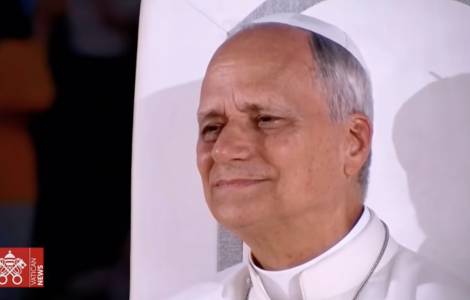
Lima (Fides News Agency) – In Buenos Aires, as in Lima, Pope Leo XIV was visibly moved as he sang “Alma Misionera” together the young people gathered in prayer.
“Oh Lord take my new life you gave me before my time of waiting takes many years from me. I'm here I'm ready when You need me: not matter where You lead me Lord, call me to serve You.” These are the opening lines of the song that accompanied several moments of the Pope’s journey, from his visit to the Cottolengo Don Orione to the conclusion of the prayer vigil at the National Stadium in the Peruvian capital.
In her biography of Leo XIV, journalist Elise Ann Allen recounts the Pope’s sensitivity to songs and hymns. “Alma Misionera” seems to resonate with his own story: that of a man who set out to share the life of another people, eventually coming to see himself as one of them.
Written in the final decades of the twentieth century, the song has become a classic of the Latin American Catholic repertoire, making its way from one community to another through Masses, retreats and youth gatherings. It is a prayer of self-offering, asking God to lead us wherever hope is lacking, wherever someone is waiting for a word that can restore their confidence and rekindle their hope.
Whose faces might have come to the Pope’s mind as he sang? The deepest reasons for his emotion belong to him alone. Yet the memories of his years in Latin America, evoked during the trip, offer a glimpse into the depth of those bonds. Even the memory of the “ceviche” served in people's homes, mentioned during his meeting with the civil authorities, representatives of civil society and the diplomatic corps, tells part of this story: an open door, a place set at the table, the joy of feeling welcomed. These are everyday gestures through which a distant land becomes home.
Missionaries set out to give, only to discover how much they have to receive. Called to become living dictionaries, they gradually learn to move from one point of view to another, embracing different perspectives in the light of Christ. They are bilingual by vocation. Learning the language of a people takes time; understanding their silences, their wounds and their hopes may take even longer. Meanwhile, the encounter transforms them, too.
This journey involves moments of bewilderment and fragility. Far from everything familiar, missionaries discover just how fragile they are and how much they need others. There are deserts to cross, hardships that shake their certainties. This, too, is part of a love story with a people: the willingness to be touched, challenged and converted by those with whom they share their lives. Then a friendship deepens. Someone is waiting for them; someone entrusts them with a personal concern, calls them by name or gives them a name in the local language. Day by day, a new sense of belonging takes shape, woven together with the affections and bonds of their homeland.
“Alma Misionera” can touch these deep feelings, especially when sung by thousands of young people: the experience of leaving everything behind, the gratitude, and the joy of discovering that one is loved by the people one has learned to love. “Loving a stranger as oneself also means learning to see oneself as a stranger,” writes Simone Weil in Gravity and Grace. This, too, is part of the missionary experience. The parable of the Good Samaritan invites us to see things differently: those who set out to help others discover that they, too, need someone to help them.
This is why the sight of Leo XIV visibly moved as he listened to and sang this song stands out as one of the most beautiful and evocative images of the journey. It is a powerful reminder of what mission truly means: a love that opens the heart to embrace an entire people.
(Fides News Agency, 14/11/2026)



 Pope Leo XIV to young people in Argentina: “No one has fallen so low that Christ cannot raise them up”
 Charity, family, work and saints: the treasures of the Argentine people blessed by Leo XIV
 700 participants enrolled in new online course in missiology and missionary spirituality in English, promoted by the Pontifical Missionary Union
 ASIA/MONGOLIA - From the letters of Giovanni da Montecorvino towards an ecumenical Bible: Ulaanbaatar marks 720 years of Scripture in Mongolian
 WYD Seoul 2027, Father Justin Choi Inbi: “We are preparing to welcome those who will come, without forgetting the young people who are always with us”
 POPE IN FRANCE/IV - A song to welcome the Successor of Peter
 ASIA/MALAYSIA - Radio Veritas Asia Mandarin Service marks 50 Years with Malaysian concert tour celebrating Chinese sacred music
 VATICAN - Course for new Bishops: Bishop García Macías: Inculturation can become one of the most beautiful forms of Evangelization, “when it enables a people to recognize that Christ is no stranger to them”
 In Dar es Salaam, African Liturgists call for an end to the “folklorization” and “theatricalization” of inculturation