Information service of the Pontifical Mission Societies since 1927
VaticanMedia
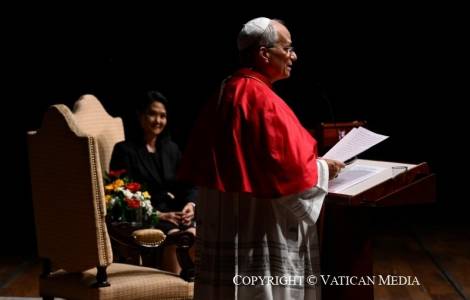
Lima (Fides News Agency) – “Today I understand how much of this land remains with me and how much of my own story also belongs to you.” In his address to the authorities, civil society and the diplomatic corps, delivered on November 11, at the Gran Teatro Nacional in Lima, Pope Leo XIV began by reflecting on his personal bond with Peru before turning to the country’s history and the theme of peace. He has returned as the Successor of Peter to the land where, through sharing the life and faith of its people, the Lord shaped his heart as a shepherd.
In his address, the Bishop of Rome recalled the homes that had welcomed him, the meals shared, “and, of course, some good ceviche”, the concerns people had shared with him and the many signs of affection he had received and still continue to accompany him.
He also highlighted the importance of the Peruvian citizenship he received in 2015, the fruit of a shared history with the people, which had taken shape over the years, even before he was entrusted with the Diocese of Chiclayo. These are years he says he would gladly relive, if given the opportunity, embracing both their happy moments and their difficulties. “That is why I can tell you, with deep gratitude, that I am also returning to my homeland,” he stressed.
Starting from his own personal story, Leo XIV broadened his perspective to encompass the history of the country. “Peru has a history stretching back thousands of years, shaped by peoples of diverse languages and traditions. Part of that history continues to be told in Quechua, Aymara, and the languages of the Amazon,” he explained. Over the centuries, other heritages have been woven into it, including the Afro-Peruvian and Asian-Peruvian traditions, which have also helped shape the country’s identity. Along this journey, nearly five hundred years ago, the proclamation of the Gospel opened “a decisive chapter,” taking root in local traditions and giving rise to countless works of charity. The Pope recalled this heritage by invoking Saint Rose of Lima, the first flower of Latin American holiness.
This plurality, Pope Prevost continued, is also relevant to the present life of the country’s institutions. The unity of a people is strengthened when these differences find their place and each person contributes from their own history and convictions. In a country where so many languages are spoken, “listening also requires ensuring that everyone can make themselves understood”. For public decisions to reach people who live far from the places where they are made, it is essential never to forget that behind the files, routine paperwork, or the abstract national census number there are “real people awaiting answers on which much of their peace of mind depends”.
Loving a people, the Pope reiterated, means wanting everyone to be able to live with dignity. “It is a sentiment that I have come to understand better thanks to you, and which I wish to share today with those who hold public office,” he explained. He therefore called on the authorities to cultivate honesty, integrity and a willingness to engage with others, “qualities that sustain trust among people and give strength to the life of institutions”. The painful events of the past, particularly the suffering caused by violence, must also be addressed “with justice and sensitivity”. For families, he explained, peace has a very concrete meaning: “going out to work without fear, caring for one’s children, and returning home with peace of mind”.
The Church, the Pope assured those present, knows the suffering caused by violence and wishes to remain close to those who endure it, supporting all those who protect life, dignity and rights “through law and justice”. The Pontiff also addressed the participation of women, who run soup kitchens and community meal programs, and of those who, through their professions and public responsibilities, contribute to the good of the country. He expressed the hope that they may participate fully in the life of their communities and live “free from violence and any form of exploitation”.
Leo XIV concluded his address with an image deeply rooted in the country’s spiritual history: “At the well of Saint Rose of Lima, generations of Peruvians have placed their petitions and hopes,” he recalled. He then added: “Today, from here, I too would like to place my prayer into that blessed well. Through the intercession of the Blessed Virgin Mary, Saint Rose, and all the saints and blessed of this land, I ask the Lord that the love of Christ may help you to recognize in every Peruvian a brother or sister, and in each one, yet another reason to love your homeland.”
Following his first address in Peru, Leo XIV travelled to the Apostolic Nunciature in Lima, where he greeted the people from the balcony. Urging those gathered outside to become builders of peace and thanking them for their warm welcome, he imparted his blessing to those present and their loved ones. He then invited the crowd to observe silence so that their neighbors could “sleep in peace”.
(MLK) (Fides News Agency, 12/11/2026)