
Information service of the Pontifical Mission Societies since 1927
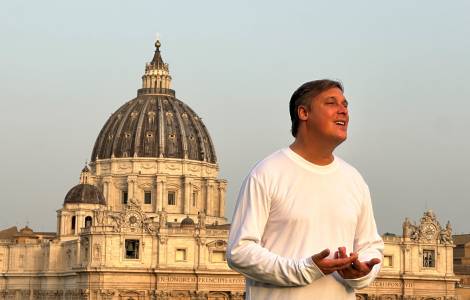
photo MLK
by Marie-Lucile Kubacki
Rome (Fides News Agency) – Dawn is breaking over the domes of St Peter’s Basilica in Rome. On the Janiculum Hill, Grégory Turpin sings the opening notes a cappella of Pour que le monde ait la vie, a song he will perform at the Stade de France and in Lourdes in a duet with French-Canadian singer Natasha St-Pier during Pope Leo XIV’s visit to France. His voice rises into the cool morning air, under the attentive gaze of Leonardo, an Italian journalist and videomaker.
A Christian artist active for many years, Grégory Turpin is particularly known for his musical projects inspired by the figure of St Thérèse of the Child Jesus and by Carmelite spirituality, the spiritual family closest to his heart. His latest composition, created for the Pope’s forthcoming visit to France, has received the support of the Pontifical Mission Societies (PMS) of France, with all proceeds being donated to support the mission in France and throughout the world. This is not, in fact, the artist’s first collaboration with the PMS. Between music and the proclamation of the Gospel, he has taken part in several initiatives, including a tour with the Pontifical Mission Societies in Benin.
“When I heard that the Pope was coming, like many others, I felt the desire to do something,” he tells Fides as he makes his way towards St Peter’s Square.
For the singer, the main challenge was not to place himself at the centre of the event. “Above all, I hope to be of service,” he explains. “Throughout this project, I have tried to place myself at the service of the Pontifical Mission Societies and of the event itself. I am not doing this for myself.” While he sees the invitation as recognition of his “twenty-five years of mission”, his foremost desire is to involve other artists.
Mission itself continually returns in his reflections. In his view, young generations today are seeking coherence between the faith they profess and their concrete lives. “For a long time, we tended to separate our professional lives from our Christian lives. Increasingly, young people want to establish a connection between their faith, their work, their mission and the way of being present where they live.”
For Turpin, proclaiming the Gospel does not mean confining faith to the private or family sphere, however precious that sphere remains. It means becoming “lights where we have been placed”.
Such coherence requires a faith that is “simple, at ease and, above all, consistent”, he continues. What does this mean? Grégory Turpin stresses the unity of life and the quality of fraternal relationships within the Church, seeing communion as a powerful witness. “It is by the love you have for one another that you will be recognized,” he quotes. Therefore, he adds, if Christians are “neither kind nor loving”, they risk hiding rather than revealing the love of God. “To be lights, we must become transparent to God’s love so that we can shine with His light.”
But there is more. The artist rejects any attempt to present Christian life as an unattainable ideal or as a succession of successes. “It is the exact opposite of Instagram,” he observes, referring to the polished and idealized images that social networks can impose. “We should not try to hide our difficulties. Christian life is not a life without problems; it is a life in which we receive the strength to overcome problems.” He evokes the biblical image of Moses standing before the Red Sea: God does not make the obstacle disappear, but gives his people the possibility of overcoming it. “The sea remains, but it opens,” he says.
Grégory Turpin recounts that he went through a period of profound psychological exhaustion, marked by burnout, anxiety and great difficulty in returning to the stage. “Today I am gradually beginning to approach the public again. I have the feeling that the Lord has begun to heal me from this, but I also needed this pause.” This experience leads the artist to recall that faith does not exempt us from the need for human and professional support. Faced with the existential crises affecting many young people, he stresses the importance of being able to seek help, including psychological assistance. “Priests are not psychologists,” he points out. Trust in God, he explains, goes hand in hand with the search for a balanced life, especially at a time when social networks and the endless scrolling of content can contribute to distress. “God can also act through genuine psychological support. These dimensions should not be set against each other: I myself needed both.”
Behind public recognition and exposure, Grégory Turpin finally identifies another spiritual question: where one’s gaze is directed. Media exposure did not come naturally to him; what proved more difficult, he explains, was “the change in the way others see things”. At a time when people compete for “likes”, he invites people to discern what constitutes their personal identity: public recognition and the approval of others, or God’s gaze. “Is it the public that gives me my value, or God’s gaze? Am I serving God, or am I using God for my own ends? Am I serving the Church, or am I using the Church?” Referring to Jesus’ Baptism and the words he heard before beginning his mission – “You are my beloved Son” – he says: “It is in this received identity that the freedom not to depend on external approval takes root. This freedom, lived as a purification from the human desire for recognition, is also a condition for service.”
Between the echo of the Red Sea opening and the trap of virtual mirrors, Grégory Turpin recalls what is essential: faith is not about shining in the spotlight, but about allowing the light to pass through our very cracks.
(Fides News Agency, 2/9/2026)



 Leo XIV: in the lives of new martyrs and witnesses, the reflection of Christ’s victory over death
 Leo XIV to the new Bishops: Remain with Jesus, the “Good Shepherd,” to keep a missionary heart
 ASIA/MALAYSIA - Radio Veritas Asia Mandarin Service marks 50 Years with Malaysian concert tour celebrating Chinese sacred music
 ASIA/SOUTH KOREA - Official hymn for Seoul WYD 2027 unveiled: "Take courage; I have overcome the world"
 BEATIFICATION OF FULTON SHEEN/IV - Sons and Daughters of the same Father. Fulton Sheen and racial segregation
 The seed of the Gospel and mission: Archbishop Sangalli concludes the formation Course for bishops in Nemi with a meditation on St Charles de Foucauld
 ASIA/SOUTH KOREA - Second International Preparatory Conference for “WYD Seoul 2027” underway
 EUROPE/ROMANIA - Pontifical Society of the Holy Childhood: Jesus’ “torch” at the heart of missionary summer Camps
 Cardinal Tagle: the Pope's journey to Asia and Oceania is an "act of humility and obedience to the mission"
 ASIA/INDONESIA - Fraternity and mercy, the words that express the meaning of the Pope's visit to Indonesia
 AFRICA/MALAWI - Archbishop Nwachukwu at the Jubilee marking 125 years of the Gospel in Malawi. Two new priests for a Church called to set out anew on mission