
Information service of the Pontifical Mission Societies since 1927
by Paolo Affatato
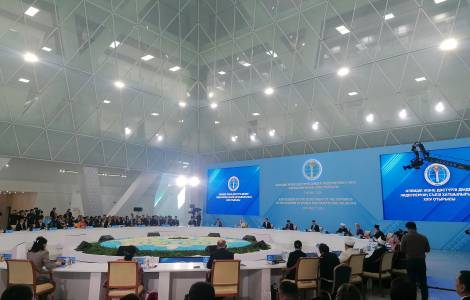
Astana (Fides News Agency) – The 24th meeting of the Secretariat of the Congress of Leaders of World and Traditional Religions, taking place today, October 7, at the Palace of Peace and Reconciliation in Astana, Kazakhstan, is not simply an occasion for interreligious dialogue, but a forum in which faith communities are called to reflect on their role in the face of the major crises of our time.
Islam, Christianity, Judaism, Hinduism, Buddhism, Taoism, Shintoism and the Bahá’í Faith, together with representatives of international organizations, public institutions and experts from around twenty countries, are gathering to continue a process launched more than two decades ago. Two documents are at the centre of the meeting and are expected to be of particular significance: an ethical Code for the use of artificial intelligence in religious contexts, and a document on the role of religions in combating climate change.
The Astana process now appears to be taking on a new dimension. Whereas in the past interreligious dialogue focused primarily on mutual understanding, conflict prevention and peacebuilding, religions are now being called to engage with issues that concern humanity as a whole. Artificial intelligence, in particular, raises questions that are not merely technical: they concern truth, human dignity, responsibility, freedom and humanity’s relationship with technology, as Pope Leo XIV emphasized in his encyclical Magnifica Humanitas.
The project for an ethical code on AI stems from the recognition that religious communities are now deeply involved in the digital transformation. Artificial intelligence is being used to produce content, disseminate teachings, reach younger generations and expand the presence of religious communities in the digital sphere. Yet this also gives rise to unprecedented challenges: religious disinformation, fabricated statements attributed to spiritual authorities, manipulation of sacred texts, artificially generated hate speech and online radicalization.
Faced with a technology advancing faster than the States’ ability to regulate it, the question emerging from Astana is therefore also a question about the public role of religions: what can spiritual authorities offer when the law has not yet succeeded in establishing effective global rules?
The answer lies in what has been described as “spiritual diplomacy”, which does not seek to replace political diplomacy or to assign religions responsibilities that properly belong to States. Rather, it is conceived as a complementary channel: a space in which the moral authority of religious leaders can help keep dialogue open when political relations are deadlocked, counter the dehumanization of opponents and identify shared principles beyond confessional differences.
In this sense, the strength of Astana lies not only in its final declarations, but in the continuity of a process that began in 2003 and has gradually become institutionalized. From the 17 delegations representing 13 countries at the first Congress, participation grew to more than 100 delegations from around 60 countries at the eighth Congress, held in September 2025, while preparations are now under way for the 2028 Congress.
The Catholic Church’s presence in this process is far from marginal. Pope Francis’ visit to the seventh Congress in 2022 was a particularly significant moment, reaffirming the value of the Congress as an international forum for interreligious dialogue. In 2025, Pope Leo XIV’s message to the eighth Congress likewise emphasized the importance of “working together”, recalling that dialogue does not require differences to be erased, but can instead transform them into opportunities for cooperation. Cooperation between Astana and the Holy See continues: Father Laurent Basanese, SJ, Head of Office at the Dicastery for Interreligious Dialogue, is taking part in the Secretariat session.
The decision to place artificial intelligence, climate change and the protection of human dignity around the same table addresses areas in which the normative framework remains fragile or fragmented at the global level. This is where, it was stressed at today’s conference, religious leaders can play a crucial role—not because they can replace parliaments or international institutions, but because they possess a different form of authority: moral, educational and community-based.
They can reaffirm the primacy of the human person over the algorithm and educate people in the responsible use of digital tools. They have extensive social networks, a strong educational capacity and a daily presence within communities, enabling them to influence the question of environmental responsibility—an issue that is political, but also a moral and spiritual concern: responsibility towards creation, towards the poor and towards future generations.
The challenge today is to turn dialogue into concrete initiatives. The Astana Congress is seeking to build the kind of moral consensus without which even regulations risk remaining ineffective. The aim is to create common ground around several fundamental principles: human dignity, respect for life, truth, responsibility, justice, compassion and peace.
The experience of Astana appears to convey precisely this message: religions do not need to become political actors in order to be actors for peace. They can exercise a public responsibility through education, witness, dialogue and the formation of a shared conscience.
Astana’s “spiritual diplomacy” helps remind us that the question is not merely how to govern technology or relations between States, but also what understanding of the human person and of humanity itself we wish to protect and promote.
(Fides News Agency, 7/10/2026)



 Pope to Latin Catholic Bishops in the Arab Regions: “Do not be afraid of your smallness”
 Cardinal Vesco: in Algeria, Augustine is also a “universal brother”
 The BRICS between “global governance” challenges and the growing role of African countries
 What lies behind the diplomatic clash between Argentina and Brazil
 POPE IN FRANCE/XI - Leo XIV in Metz: Europe seeks peace in the "Lantern of the Good Lord"
 United States lifts sanctions on Eritrea
 ASIA/ARAB EMIRATES - Safeguarding the Earth, protecting Peace. Pope Francis' speech at COP28
 ASIA/ARAB EMIRATES - Bishop Martinelli on the cancellation of the Pope's visit to Dubai: “We continue to pray for the Pope and the success of COP28”