Information service of the Pontifical Mission Societies since 1927
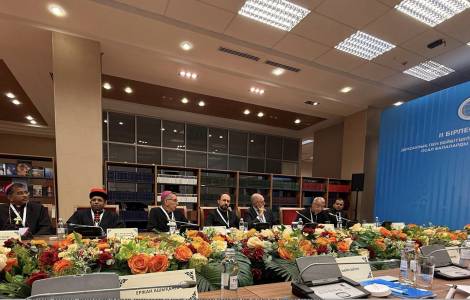
Astana (Fides News Agency) – Caring for children with incurable illnesses, safeguarding their dignity, and exploring the contribution religions can make in responding to human vulnerability are at the heart of the Second Joint Colloquium between the Kazakhstan’s International Center for Interfaith and Interreligious Dialogue and the Holy See’s Dicastery for Interreligious Dialogue, taking place at the National Museum of Astana on 2 and 3 October. The Holy See delegation to the Colloquium is being led by Cardinal George Jacob Koovakad, Prefect of the Dicastery for Interreligious Dialogue, who will meet with Erlan Karin, Vice-President of the Republic of Kazakhstan and Head of the Secretariat of the Congress of Leaders of World and Traditional Religions.
Entitled “Promoting Health, Promoting Peace: A Shared Commitment to Caring for Vulnerable Children,” the meeting brings together institutional representatives, religious leaders and communities, paediatricians, experts in bioethics and theology, scholars and specialists. According to the official program, discussions focus on three main areas: the ethical foundations of caring for children and interreligious solidarity; the protection of children’s rights and dignity in the context of illness; and the development of medical, scientific and institutional cooperation. Particular attention will also be given to the opportunities and ethical issues surrounding the use of artificial intelligence in paediatrics.
At the heart of the two-day dialogue lies a fundamental moral question: how can a child with an incurable illness be guaranteed not only appropriate medical care, but also full respect for his or her human dignity and due attention to psychological, social, family and spiritual needs?
A child’s dignity is not diminished by illness, nor does it depend on the possibility of a complete recovery. This is also the principle guiding discussions on the “Charter of the Rights of the Child with an Incurable Illness,” drawn up by the Bambino Gesù Children’s Hospital. The document places the child first and foremost as a person, rather than simply as a patient or clinical case, and recalls the child’s right to be accompanied and cared for even when medicine can no longer provide a cure. The Bambino Gesù Charter, drawn up in 2018, has become part of the broader international debate on the rights of children with incurable illnesses and on paediatric palliative care.
From this perspective, the duty to care does not cease when the possibility of curative treatment comes to an end. On the contrary, it includes the alleviation of suffering, accompanying the child and the family, providing psychological support and, when requested, attending also to the spiritual dimension.
The dialogue in Astana therefore goes beyond strictly medical issues. It addresses the value of human life, the meaning of care and society’s responsibility towards those who are the most vulnerable. It is precisely here that interreligious dialogue takes on a concrete dimension: different religious traditions, while starting from distinct theological perspectives, can come together in defending the dignity and rights of children and in building a culture of care.
A second area of discussion concerns artificial intelligence. New technologies are providing increasingly advanced tools for diagnosis, data analysis and support for clinical decision-making. At the same time, their development raises questions concerning responsibility, the protection of personal data, equity in access to healthcare and the role of physicians. The fundamental challenge is to ensure that patients are not reduced to a collection of data: technology can assist care, but it cannot replace the human relationship that is an essential part of caring.
For Kazakhstan, the protection of vulnerable children forms part of a broader path of cooperation with the Holy See in the field of interreligious dialogue. The country has made the Congress of Leaders of World and Traditional Religions, established in Astana in 2003, one of the main international platforms for dialogue among representatives of different religious traditions.
Pope Francis personally attended the Seventh Congress in September 2022, highlighting the role of religions in building peace and defending human dignity.
This process has led to more structured cooperation with the Holy See. The First Joint Colloquium between the Dicastery for Interreligious Dialogue and the Kazakhstan’s International Center for Interfaith and Interreligious Dialogue was held in Rome in April 2024. The issue of vulnerable children has become one of the concrete areas of this cooperation. In 2025, during the Eighth Congress of Leaders of World and Traditional Religions in Astana, the Bambino Gesù Children’s Hospital proposed to religious and political authorities the development of a “culture of care,” beginning with the most vulnerable children, and signed a letter of intent with the University Medical Center of the Kazakh capital.
The Second Colloquium marks a further step forward: from dialogue on the major questions surrounding peace to cooperation that seeks to address a very concrete question—how a society can care for its most vulnerable members.
From this perspective, health and care become closely connected with peace. Protecting a sick child means recognizing that no person loses their value when they become vulnerable, dependent on others or unable to recover. It also means calling upon institutions, healthcare professionals, families, civil society and religious communities to contribute, each according to their respective responsibilities, to a shared culture of care, placing dialogue at the service of the person and of peace.
(PA) (Fides News Agency, 2/10/2026)