
Information service of the Pontifical Mission Societies since 1927
Beirut (Fides News Agency) – Six years after the explosion in the port of Beirut on August 4, 2020, the call for justice continues to rise from the grief of the families of the more than 220 people who lost their lives.
Every year on August 4, Lebanon observes a national day of mourning in memory of the victims. Pope Leo XIV met with some of their relatives during his Apostolic journey to Lebanon, when he visited the port for a moment of silent prayer. On the fifth anniversary of the tragedy, Pope Prevost sent a message reaffirming that "death does not have, and never will have, the last word."
Entire neighborhoods of Beirut were devastated by the blast that struck the city that evening. Hundreds of thousands of people were displaced, homes and buildings were destroyed, and economic losses were estimated at between 10 and 15 billion US dollars.
Lebanon continues to face new crises and displacement from the south caused by Israeli military operations in Lebanese territory. Although many families have returned to their villages following the ceasefire, many others have remained in the north because their homes were destroyed, infrastructure severely damaged and insecurity persists. Over the past year, around one million people from southern Lebanon have been forced to leave their homes.
Hosted by relatives or in schools and other facilities, these families remain heavily dependent on humanitarian assistance to meet their basic needs.
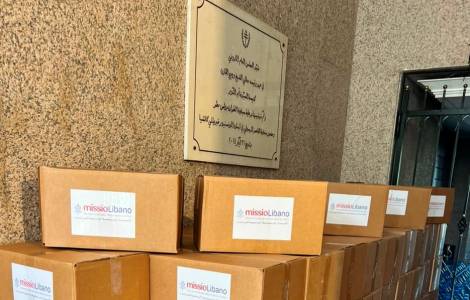
In this context, the Pontifical Mission Societies in Lebanon, led by their National Director, Father Georges El Ters, together with a group of volunteers, prepared and distributed 100 food parcels to support displaced families from Aïn Ebel.
In the predominantly Christian village of Aïn Ebel, near the Israeli border, much of the population has chosen to remain despite isolation, shortages of essential goods and the continuing military tensions.
"In cooperation with the Deputy President of the Municipality of Aïn Ebel, Mr. Ayman Barakat, on Saturday, August 1, the Lebanese Pontifical Mission Societies prepared and distributed food supplies at the aid distribution centre in Raouda, based on the lists of names drawn up for the beneficiary families," Father Georges told Fides.
The initiative, he explained, was intended "to bear witness to the Church's closeness to the most vulnerable and to support communities affected by the conflict."
"We are deeply grateful to the Pontifical Mission Societies of Great Britain, whose generous support made this initiative possible," the National Director of the Pontifical Mission Societies in Lebanon concluded.
(PR) (Fides News Agency, 5/8/2026)



 “Listen before proposing, accompany without replacing”: Caritas aid workers share their experience alongside communities
 Wildfires in Spain: “People have allowed themselves to be embraced”: parishes and Caritas stand alongside evacuees
 United States lifts sanctions on Eritrea
 South Sudan's post-independence ordeal: fifteen years of conflict, political instability and humanitarian crises
 The hidden tragedy of suicides in refugee camps
 AFRICA/CHAD - Generations without schooling. Programs to ensure access to education for school-age Sudanese refugees have come to nothing
 EUROPE/HUNGARY - Message of the annual gathering of the Pontifical Society of the Holy Childhood: Different yet united in the love of Christ
 EUROPE/POLAND - Mission seeks new paths: the message that emerged from the autumn meeting of the Pontifical Mission Societies