
Information service of the Pontifical Mission Societies since 1927
uNHCR
by Cosimo Graziani
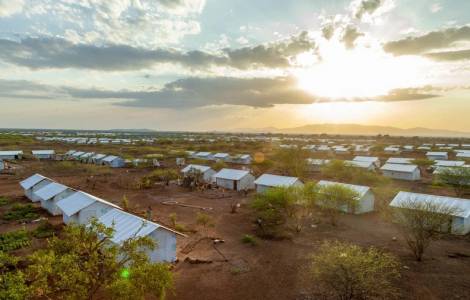
Nairobi (Agenzia Fides) - The trauma endured to get here, the abandonment while waiting to leave, perhaps by taking advantage of international programs that the developed world has recently begun to dismantle; or the terrible hardships of daily life, which make existence a struggle where everything becomes increasingly unbearable. An insidious evil thus seeps into the minds of thousands of people, leading them to psychological annihilation and extreme consequences.
It is difficult to obtain exact and up-to-date figures when discussing this silent scourge of suicides in refugee camps, but it is estimated that depressive syndromes and suicide attempts or completed suicides are about three times more frequent than what is recorded in the societies of host countries. And Africa, according to the World Health Organization, is the continent with the highest suicide rates on the planet. In camps located in Sudan, Chad, Ethiopia, and Cameroon, suicide rates range from 15 to 40 per 100,000 refugees.
Among the most common causes, writes a team of analysts, including Steven L. Senior of the University of Liverpool, are “a combination of socioeconomic disadvantages, exposure to potentially traumatic events, increased depression and anxiety, and a lack of appropriate and accessible care.” These are inevitably general observations: to understand what is happening, they must be examined meticulously, one by one.
First, the traumas that lead to the decision to leave one's place of origin must be considered. Then come the traumas related to the journey, often undertaken in extreme conditions and in a hostile and dangerous environment. Then there are the difficult living conditions in numerous camps (the number of which is itself difficult to assess, as they are often improvised or temporary structures that can operate for many years or only a few months, depending also on the evolution of humanitarian emergencies). Finally, there is the stress of waiting: the processing of the asylum application, even the departure for the destination country. This situation of uncertainty and suspension can last for years and amplifies the risk of collapse in the face of insurmountable difficulties. A person forced to leave to escape war, often after the destruction of their home and the violent loss of at least part of their family, who remains in limbo for years in an inevitable state of precarity, finds it very difficult to cope with the pressure of losing a job or the breakdown of a marriage.
In the Dadaab refugee camp in Kenya, recent suicides involved a father whose wife had left, abandoning their two children, and another who had lost his job with an international refugee aid program. This program was closed for budgetary reasons by the country that had launched it several years earlier.
The situation of women deserves particular attention. Many women who arrive at reception centers have already been raped at least once. Many of them are young girls who will bear the scars of this violence for the rest of their lives. Once admitted, they are often left alone to face particularly difficult family and personal situations, marked by physical and psychological abuse. They are often the silent victims of the hidden tragedies unfolding in refugee camps. (Agenzia Fides, 4/4/2026)



 AFRICA/MOZAMBIQUE - 900,000 people in Cabo Delgado need humanitarian assistance
 AFRICA/CHAD - Generations without schooling. Programs to ensure access to education for school-age Sudanese refugees have come to nothing
 ASIA/HOLY LAND - Ecumenical reflection group: Positive aspects and weaknesses of the UN Resolution on the future of Gaza
 US House bill calls to halt aid to Nigeria over anti-Christian violence
 AFRICA/SOUTH AFRICA - Catholic bishops denounce the increase in violence against migrants
 ASIA/LEBANON - Six years after the explosion in the Port of Beirut, the Pontifical Mission Societies continue to respond to the emergency facing newly displaced families
 AMERICA/CUBA - Caritas continues distributing humanitarian aid: “We cannot reach everyone, but we want to remain close to those most in need”
 Archdiocese of Bogotá brings aid and hope to Cuba: “The Cuban people need us and ask for our support”