
Information service of the Pontifical Mission Societies since 1927
VaticanMedia
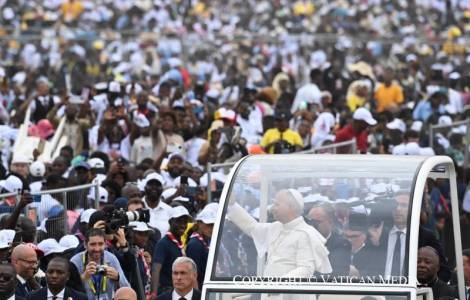
Luanda (Agenzia Fides) - Even in Angola, a ‘beautiful yet wounded’ country, the encounter with the Risen Christ “who walks beside us” can grant us the grace to “afresh and rebuild the future”. In Kilamba, a suburb of Luanda, the Angolan capital where he arrived yesterday afternoon, Leo XIV celebrated Mass today, 19 April, on the Third Sunday of Easter before a crowd of 100,000 people. A crowd vibrant with expectation and affection, gathered from the early hours of the day on the esplanade in front of the temporary structure where the altar was set up, to listen to the words of the Successor of Peter.
In his homily, the Bishop of Rome reminded everyone that even the healing of the wounds and sufferings experienced by the Angolan people in the recent chapter of their history can come as a gift and a miracle from the Risen Lord. He does so in the light of the Gospel of the day, which tells of the two disciples walking towards Emmaus “with broken and sad hearts”, after having seen “the death of Jesus, whom they had faithfully followed”.
“Their story,” suggests Pope Leo, “reflects in some way the history of Angola, a country marked by a long civil war with its aftermath of enmities and divisions, of squandered resources and poverty.”
The wound in the hearts of the disciples of Emmaus is healed when they recognize that their mysterious travelling companion is Jesus himself: “He is alive, he has risen, and he walks beside us as we journey along the path of suffering and bitterness, opening our eyes so that we may recognize his work and granting us the grace to start afresh and rebuild the future”. The same experience – the Pontiff suggested – that everyone is called to share, experiencing the Lord’s companionship “in prayer, in listening to his word that sets our hearts ablaze like it did to the hearts of the two disciples, especially in the celebration of the Eucharist.”
“For this reason,” urged Pope Prevost, “we must always be vigilant regarding those forms of traditional religiosity that certainly belong to the roots of your culture, but at the same time risk confusing and mixing magical and superstitious elements that do not aid your spiritual journey. Remain faithful to what the Church teaches, trust your pastors, and keep your gaze fixed on Jesus, who reveals himself in the word and in the Eucharist. In both we experience that the risen Lord walks beside us and, united to him, we too overcome the “deaths” that besiege us and live as those who have “risen.”
Angola’s history, including its recent past, and the conditions in the country, marked by “various forms of poverty”, said the Pontiff, “call for the presence of a Church that knows how to walk alongside you and how to heed the cry of its children”. Angola needs “bishops, priests, missionaries, men and women religious, and lay people who carry in their hearts the desire to “break” their own lives and give them to others, to commit themselves to mutual love and forgiveness, to build spaces of fraternity and peace, and to perform acts of compassion and solidarity towards those most in need. Through the grace of the risen Christ, we can become like this broken bread that transforms reality. Just as the Eucharist reminds us that we are one body and one spirit, united to the one Lord, so it is possible to build together a country where old divisions are overcome once and for all, where hatred and violence disappear, and where the scourge of corruption is healed by a new culture of justice and sharing. Only in this way will a promising future be possible, especially for the many young people who have lost hope.” On this journey – assured Leo XIV, concluding his homily – “you can count on the Pope’s closeness and prayers! But I too know I can count on you, and I thank you.”
At the conclusion of the Eucharistic liturgy, after listening to the words of thanks addressed to him by the Archbishop of Luanda, Filomeno do Nascimento Vieira Dias, and before joining the crowd in reciting the Marian prayer of the Regina Caeli, the Pope also turned his gaze and thoughts to the conflicts afflicting other peoples and other parts of the world. Pope Prevost is saddened by “the recent escalation of attacks against Ukraine, which continue to afflict civilians as well.” He expressed his closeness “with those who are suffering.” and assured his prayers “to all the Ukrainian people.” He reiterated “the call for weapons to fall silent and for the path of dialogue to be pursued.”Then, referring to the conflicts in the Middle East, he added that the ceasefire announced in Lebanon “offers cause for hope, it represents a glimmer of relief for the Lebanese people and for the Levant. I encourage those who are working toward a diplomatic solution to continue peace talks, so that the cessation of hostilities throughout the Middle East may become permanent.” (GV) (Fides News Agency, 19/4/2026)



 100th WORLD MISSION SUNDAY - Pope Leo XIV: May the Church always remain faithful to the mandate of the Risen Lord
 New episcopal ordination in China: Ignatius Ding Zuyao ordained Bishop of Haimen
 100 YEARS SINCE THE ORDINATIONS OF THE FIRST SIX CHINESE BISHOPS - Bishop Joseph Hu Ruoshan and the Diocese of Taizhou
 Bible and cultures: Christian identity as encounter
 The feast of the Transfiguration of the Lord Jesus in a world disfigured by war
 Egypt, Sudan, Eritrea and Somalia meet to discuss tensions and unresolved issues in the Horn of Africa
 United States lifts sanctions on Eritrea
 Papua New Guinea, the miracle of ecclesial unity in the Country of 800 languages
 LEO XIV IN AFRICA - Eastern Angola: plundered riches, calls for autonomy, and witchcraft
 The BRICS between “global governance” challenges and the growing role of African countries