
Information service of the Pontifical Mission Societies since 1927
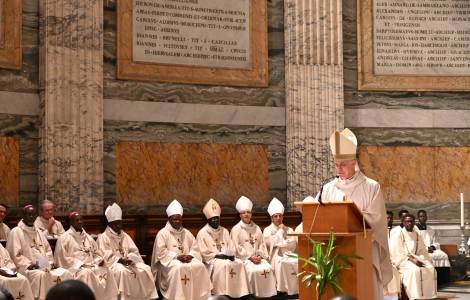
by Father Stefano Camerlengo*
Dianra (Fides News Agency) - I met Osorio personally at the theological seminary of the Consolata Missionaries in Kinshasa, where he arrived from our novitiate in Mozambique. My first impression was of a young man full of life and joy, eager to do good and to do it well. He had a great gift for building relationships, a characteristic that accompanied him throughout his life. Wherever he went, he built bridges, created communion, opened paths.
I remember when he was forced to remain for several years in Italy for medical treatment, after a serious car accident he had suffered with other missionaries in Congo, which had left him paralysed, bedridden and in need of very painful intensive care. He lived all of this with joy and gratitude towards those who devoted themselves to him. Knowing and appreciating his kind and welcoming disposition, it pains me all the more to think of the way he died. He, the man of dialogue, of encounter, of the joy of being together, was killed in his own home.
His sad and painful death is a seed, a love that embraces everyone and everything and breaks down every barrier. A love that encourages us to give our lives out of fidelity to the Gospel and that today moves me to share some reflections with those who will read me.
The struggle against evil
What happened to Bishop Osorio has neither explanation nor justification; it is the power of evil imposing itself and claiming its victims. Faced with this, the powerlessness of human beings and the tragic condition of their existence are laid bare. Tragic is the fact of not being able to do the good we would like and of not managing to prevent evil.
The apostle Paul described with great force the tragic condition of the human being confronted with evil in chapter 7 of the Letter to the Romans: it is the condition of the “I”, powerless before the good it fails to do and the evil it does. For Paul, this powerlessness is what the Son of God made his own, through the power of a boundless love by which the tragic is welcomed into the very depths of the divinity. It is the disconcerting revelation that God “did not spare his own Son but handed him over for us all” (Rom 8:32), built on the model of the sacrifice Abraham was ready to make of his beloved son Isaac (Gen 22). Projected into the very depths of God, the tragic is inhabited by his Spirit, whose groanings, as described in the Letter to the Romans, point to the distance between the evil that is present and the good that is promised, between experience and expectation. The tragic in God thus becomes the true revelation of who we are: only thanks to this revelation is it possible to perceive in all its tragic depth the contingency of the world.
In this way, redemption becomes possible: if God dwells in powerlessness, that powerlessness is redeemed. Only infinite compassion redeems the stage of this passing world, without weakening its contingency, but on the contrary exalting it in its dignity, because it has been taken up by the Redeemer.
A careful reading of the Letter to the Romans shows that the Christian message is anything but the elimination of the tragic through easy moralism; rather, it is the transformation of the tragic within the very condition of those who experience weakness and suffering, even though they have been justified by their adherence to Christ. Christian tragic experience involves not only the Son, but also God who did not spare him for us, and the Spirit who shares our groaning and that of all creation.
Only a God who inhabits tragedy can bring into it the Good News of grace: only the God made man, who bears the weight of the evil that devastates the earth, can set us free and set the world free. Evil has been taken up into God, the only one who could thus conquer it. This is what the Letter to the Romans tells us, with a burning relevance in the face of our present time and its shipwrecked condition, which does not look for easy saviours but for another, deeper kind of closeness capable of restoring meaning to our shared journey. It is Paul who tells us that, in Christ, God has made himself the companion of human suffering and the foundation of a possible hope: it is in this “folly” that his message lies.
In the paradox of this “tragic Gospel” lies all its provocative relevance: this is where Christian hope shows itself for what it is – not an escapist consolation, but a militant anticipation of the future that has entered this world in the Son, who has inhabited our pain, the evil that wounds us, and death. The experience and recognition of this “radical evil” call us to a greater good, which cannot be the mere fruit of flesh and blood, but comes from elsewhere.
From evil, only God can save us: not just any god, but the one who has inhabited our tragic condition and made it his own in order to overcome it in our place and for us. The God of infinite charity: the God of Jesus Christ. And the gift of Osorio becomes a seed to overcome evil with good.
Osorio, martyr of justice
The very sad events that led to the brutal killing of our Osorio suggest a full and authentic witness, a martyrdom for justice. For a Christian, Jesus Christ is the faithful and true witness, and his disciples are his witnesses. Martyrs are, according to the etymology of the term, witnesses – indeed, the witnesses par excellence, in whom witness finds its fulfilment.
Martyrs are uncomfortable warners; they manifest traits of a disconcerting firmness which, in today’s society, cause a strange unease in many. Osorio used to say that one cannot remain silent in the face of injustice, in the face of evil. For the first Christians, martyrs had a very close union with Christ; they were the fulfilment not only of his perfect love, but also of his bloody death on the cross.
A few considerations:
The confession of faith and the commitment to bringing about the Kingdom of God cannot be regarded as two separate realities. For the early Christian communities, bearing witness was not an exclusively private matter; it required a public confession, with obvious repercussions, including political ones, in the public life of the faithful, in sharp contrast with the totalitarian conception of the Roman imperial cult. In the face of this cult, Christians claimed that God – and God alone – has the right to human obedience. All this was closely intertwined with the proclamation of the Kingdom of God and his justice (Mt 6:33) and with the Sermon on the Mount, with its calls to commitment to justice, a commitment that could lead all the way to martyrdom, persecution and death, as Jesus himself had foretold and embodied.
Commitment to bringing about the Kingdom of God, after the confession of faith in creation, must be seen as the second fundamental motive of the theological understanding of martyrdom. Those who are persecuted for the sake of justice can therefore legitimately be called martyrs in the proper sense, and “qualified witnesses of Christ.” The link between love of God and love of neighbour, as it emerges from all the texts of the New Testament, without exception, must be held in the highest regard: for Christ, it is not only the one who suffers for faith in him who suffers for Christ, but also the one who, out of love for Christ, suffers for any work of justice, like our dear Osorio.
The mother’s sorrow
In thinking of Osorio’s tragic end, how can we not think of his mother who, after the immense joy of seeing him become a bishop, found him killed by evildoers? Just like the mother of Jesus, with her Son nailed to the cross… How can we not imagine – as popular tradition tells us – the Virgin Mary walking alongside her Son on the way to Calvary? Strangely enough, the Gospels say nothing about this walk; not even a sigh, a tear or a cry is recorded. Yet we find her at the foot of the cross. Mary does not open her mouth, she does not utter a word. We can imagine her words: they must have been words laden with love, as only mothers know how to speak, as the Son had taught her.
It is in this perspective that the meaning of death in the life of the missionary is to be understood: where by death we also mean pain and the cross, trial and tribulation, self-offering and sacrifice. Yes, this is one of the fundamental, indeed constitutive, ideas of the apostolate in general and of missionary apostolate in particular. The missionary gives and commits his whole life, placing it entirely at the disposal of the most needy, or else he is not a missionary.
The apostle is, by nature, someone who is offered and sacrificed in the most radical and total way. Saint Paul, who presents himself as the ideal apostle, uses language that is striking and very forceful. According to him, the apostle is a man destined for death, like a sheep to be slaughtered: persecuted and abandoned by all, he must face hardships and tribulations of every kind.
Paul suffers for his children like a mother, and like a mother he begets them in pain, protects them and warms them at his breast; like a mother, he is constantly in anguish and wears himself out; like a mother, he has the supreme honour and joy of communicating life through his death.
This splendid image is also used by Jesus, who said: “A woman, when she is in labour, has sorrow, because her hour has come; but when she has delivered the child, she no longer remembers the anguish, for joy that a human being has been born into the world.”
The image of the suffering mother recalls another fundamental one: that of Abraham, our father in faith, who leads his son Isaac, “his only son whom he loved,” up Mount Moriah to offer him to God. The missionary’s mother, too, sacrifices and offers her son to Christ and to his most needy brothers and sisters. She imitates the heroic gesture of Abraham who, while weeping and suffering, nevertheless courageously obeys the word of God that puts his faith to the test.
This is a second kind of begetting, another kind of fruitfulness, which, by necessity, cost tears and blood, in accordance with the law of all begetting: “you shall bring forth children in pain.” And if the pain of the mother who brings forth according to the flesh is great, how much greater must be the pain of the mother who brings forth her son to the apostolate. But greater still will be her joy. Pain, joy and apostolate form an indissoluble triad.
This is the law willed by God and sealed by the life and teaching of Jesus, who died on the cross for us and said to us: “Unless a grain of wheat falls into the earth and dies, it remains alone.” Without the death of the grain, there can be no ear of wheat and no bread that nourishes. To refuse this law of sacrifice is to choose sterility.
Like the mother, the missionary must become good bread that is broken and good wine that is poured out, in the image of Christ in the Eucharist. Like the mother, the apostle must live what takes place on the altar: becoming daily bread that is broken and wine that is poured out. In this daily self-offering, he will find his joy and the fruitfulness of his apostolate.
We cannot fail to think of the words of Saint John Bosco’s mother: “Remember, my son, that to be a priest means to suffer.”
In conclusion, we can say that our Osorio fought and gave his life for this. The difference is made by those who struggle, who teach others to struggle, who offer themselves and who suffer. The difference is made by those who persevere; by those who do not flee from pain and who continue to dream; by those who do not seek to live forever, but to live fully; by those who do not hide their joy and who embrace all the more tightly. The difference belongs to those who act rather than those who speak, to those who take risks, who stay, who love.
And he, by giving his life for the cause of justice and of Christ, has loved by remaining a seed that bears abundant fruit. (Fides News Agency, 18/6/2026)
*Consolata Missionary



 The blood-stained Breviary and other "Family Memories" of Father Amédée Benoît
 Cardinal Tagle at the memorial Mass for Bishop Osorio Afonso Citora: "Freely you have received, freely give"
 New episcopal ordination in China: Ignatius Ding Zuyao ordained Bishop of Haimen
 CHINA/VATICAN - From “exceptional event” to a common practice: Chinese bishops take part in Holy See initiatives
 Mission beyond the illusions of efficiency: following in the footsteps of Venerable Little Sister Magdeleine of Jesus
 Fulton J. Sheen proclaimed Blessed. Cardinal Tagle: “Blessed is the earthen vessel that draws power from Jesus”
 ASIA/SOUTH KOREA - Catholic Culture Fair in Seoul serves as a “trial run” ahead of World Youth Day 2027
 Cardinals Vesco and Marengo: "At the school of the Acts of the Apostles, in the deserts of the world"
 VATICAN - Cardinal Luis Antonio Tagle is the new Dean of the Sacred College of Cardinals
 VATICAN - Sister Mary Teresa Barron appointed adjunct secretary of the Dicastery for Evangelization and president of the Pontifical Mission Societies