
Information service of the Pontifical Mission Societies since 1927
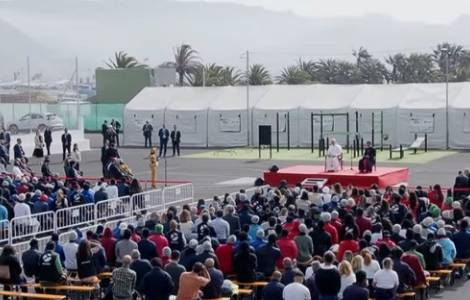
Tenerife (Fides News Agency) – As part of his visit to Spain, Pope Leo XIV arrived on the island of Tenerife early this morning, June 12, from Gran Canaria. During the day, the Pontiff dedicated two key moments to the plight of migrants: a visit to the “Las Raíces” reception center and a meeting with those involved in integration in the Plaza del Cristo in La Laguna.
The Holy Father emphasized from the beginning that “God’s love knows no borders, makes no distinctions, is given to all and brings us together in unity,” recalling that the experience of migration directly challenges the Christian and human conscience.
At “Las Raíces”: God’s love knows no borders
At the “Las Raíces” first reception center, the Pope was received by those in charge and toured some of the camp's facilities. He stopped at several tents where migrants reside, greeting them personally.
The Pope placed his message within the context of the Solemnity of the Sacred Heart of Jesus, which he defined as an expression of God's "merciful and infinite love for every human being." A love that "knows no borders, makes no distinctions, is given to all and brings us together in unity."
Addressing migrants, he affirmed: "I look at your faces and listen to your stories, I also think of your hearts — wounded by so many difficulties, yet also comforted by the love you have received from other open, generous and merciful hearts."
The Pope evoked the parable of the Good Samaritan as an example of a love that transcends cultural and religious boundaries, and he also recalled the figures of Saint Brother Pedro and Saint José de Anchieta, who departed from the Canary Islands for America, carrying with them faith, hope, and charity as a missionary impulse. In this regard, he invited migrants to share “the treasures of your humanity, of your dreams and of your culture, which you have brought to these islands, and to be open to receiving what is offered to you. We must live this exchange responsibly, considering the future generations to whom we wish to bequeath the heritage of a civilization of love.”
The Pope affirmed that in a sense, “all of us are migrants, for we are all pilgrims on our way to our heavenly homeland,” and he expressed his gratitude for the collaboration of the institutions and people of goodwill who make humanitarian aid possible.
Finally, he highlighted the name of the center, “Las Raíces,” (roots) and recalled an image dear to Pope Francis about the importance of not forgetting one’s origins and remaining steadfast in trust in God. He concluded by entrusting those present to the Virgin Mary, “Consolation of Migrants.”
La Laguna: “Integration means preventing a second shipwreck”
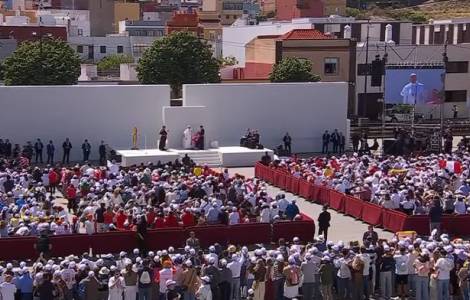
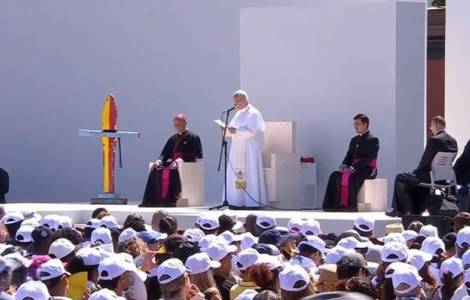
In the second meeting of the morning, held in the Plaza del Cristo in La Laguna, which he reached directly from the “Las Raíces” center, the Pope pointed out that “the barriers that are the hardest to break down are not always made of stone; sometimes they lie in our attitudes, in fear or in indifference.” He therefore invited everyone to “learn the language of closeness, which is understood more with hands than with words.”
Referring to the Gospel, he recalled that Christ makes himself present in the hungry, the thirsty, and the stranger, emphasizing that the Christian response cannot remain theoretical but must be expressed in concrete gestures of attention and care.
In this sense, the continuity between welcome and integration is fundamental: “Welcome opens the door; integration helps one cross the threshold,” the Pope explained. “Assistance applies a salve to the wound, and integration rebuilds the future.” This is not merely a matter of social management, but a human journey in which the dignity of the person is always at the center.
Leo XIV recalled that “integration does not mean erasing the history of those who arrive or demanding that they leave behind everything that is part of their memory,” but rather building genuine coexistence, avoiding both exclusion and the creation of “parallel worlds.” “Integration is a reciprocal journey: those who arrive learn to inhabit a new land, and those who welcome them learn to expand their own homes without diluting their identity or closing their hearts to the encounter,” he insisted.
The Pope emphasized that every person must be recognized in their dignity, since “we are speaking, above all, of persons created in the image and likeness of God,” and not of statistics or administrative questions. “Your life is not a waste; your suffering is not invisible; your dignity has not been washed away in the waters you have crossed,” he said, referring directly to migrants.
Furthermore, he expressed his gratitude for the commitment of the ecclesial and social communities that accompany these processes, highlighting the dynamic of reciprocity that arises from welcoming others: “when those who once needed a helping hand begin to extend their own, the charity received is transformed into shared responsibility.” He also called to recognize the contribution of migrants already integrated into the life of the Church and society, asking communities
to also allow themselves to be “evangelized by them.”
Addressing Catholics in particular, he added: “Those who come to our parishes need bread, shelter, language assistance, work and protection. They also must find a community capable of offering paths to knowing Jesus Christ through the witness of life and word, while always respecting the conscience and freedom of each person.”
The Pope warned of the risk of a “second shipwreck,” which occurs after arrival when people are left alone, without a language, without work, and without ties. “Integration means preventing that second shipwreck,” he affirmed.
He also made a strong appeal to those who exploit the vulnerability of migrants: “those who organize death routes, traffic in human beings, withhold documents, exploit workers, threaten women, deceive families and turn the suffering of others into a business. Stop. Repent. The tears and blood of these brothers and sisters cry out to God.”
Finally, he reminded everyone that “yesterday’s stranger can be today’s brother and neighbor,” entrusting all migrants and refugees to the Holy Family of Nazareth as a model for every family on the move. (LGR) (Fides News Agency, 12/6/2026)



 New episcopal ordination in China: Ignatius Ding Zuyao ordained Bishop of Haimen
 Leo XIV to the John Paul I Vatican Foundation Conference: peace is a daily Mission
 EUROPE/ROMANIA - Faith that unites peoples: The memory of Pope Luciani celebrated in the church of Italian migrants
 Cardinal Aveline, Archbishop de Moulins-Beaufort, and missionary renewal in France
 POPE IN FRANCE/XI - Leo XIV in Metz: Europe seeks peace in the "Lantern of the Good Lord"
 THE POPE IN FRANCE/X - In Lourdes, where the vulnerable bring light
 CHINA/VATICAN - From “exceptional event” to a common practice: Chinese bishops take part in Holy See initiatives
 “Doing things for free” is “God’s job”: ‘Operation Mato Grosso’ in Peru
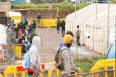 The Las Raíces Center, between migrant reception and preparation for the Pope's visit to Tenerife