
Information service of the Pontifical Mission Societies since 1927
VaticanMedia
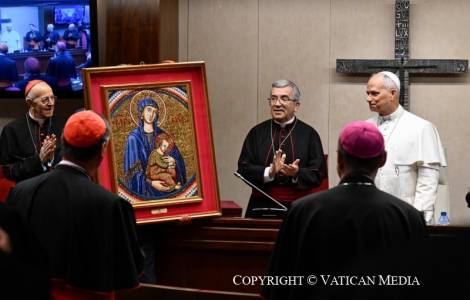
Madrid (Fides News Agency) – “I would like to propose the image of a journey whose destination is God, toward whom we lift our gaze.” In his address to the bishops of Spain on Monday, June 8, a significant moment of his apostolic visit to Spain, Pope Leo XIV reiterated that the Church’s mission is first and foremost a journey of faith, rather than a set of things to do or results to be achieved.
The Pope warned against the temptation of fixating on what we leave behind, “places, things, ways of life”, without “opening ourselves, in docility to the Spirit, to the newness of what we encounter”, inviting us to “prudently combine freedom and courage” in order to “leave behind structures that do not help us, do not respond to our needs, or even lead us away from our goal, while having the strength to treasure what facilitates it”. In saying this, he highlighted the beauty of Spain’s architectural heritage, pointing to the ‘tremendous challenge’ of ensuring that “this heritage may reach its potential in bearing good fruit.”
The strength of the Church, the Pope emphasized, “does not come from the greatness of her resources, but from the holiness of her children, from the communion of her pastors, and from the humble and persevering fidelity of those who allow themselves to be guided by the Spirit”, from walking together as one body, even in a time “of increasingly harsh polarisation and conflict”. Communion thus becomes the primary missionary sign, capable of speaking to the world more effectively than strategies or the shrewd use of available resources. “This call to be a sign of communion in Christ, walking in unity and reaching out to the brother or sister we meet — places us before another challenge that touches the hearts of many today: the difficulty of making definitive commitments and profound life decisions,” he continued. “For so many young people — and not only them — the question, “For whom am I?” resonates as a sincere search for meaning, belonging and self-giving. The human heart is not filled by accumulating experiences, possibilities or a fleeting sense of security; it is filled when it discovers a calling, when it understands that life reaches its fullness only if it is given away.”
Within this context, we can also understand the call to vocational ministry, which “cannot be reduced to a mere pursuit of numbers”. Vocations spring, from living communities, “from happy priests” and from families capable of bearing witness to the beauty of fidelity”.
For Leo XIV, mission is also a journey of encounter and dialogue. The Pope invites us to “learn the language of the other”, to “forge bonds” so that Christian heritage becomes “an instrument and an opportunity for dialogue” with diverse realities, from the “vast Castilian plains” marked by depopulation to the metropolises where “silence and distance are not spatial but interpersonal”.
Along this journey, the Church is called to recognize the “profound thirst for meaning” that dwells in many men and women, offering the ‘treasure’ entrusted to her: Jesus Christ, in whose name man “can rise and walk”.
Along this journey marked by encounters, difficulties “can be approached as opportunities”. “At times, we find it difficult to explain the vocation of the laity and their integration into this journey of life that we as a Church are undertaking,” he acknowledged. “On the other hand, we see how in many ministries, traditionally managed by religious, lay collaborators are being called upon to continue the work. It is a difficulty that we can turn into an opportunity for encounter, dialogue and communication. It is up to us to ensure that these laypeople come to perceive their participation in this ecclesial service as a call from God to take on their responsibility as Christians, internalizing the spirit and feeling part of the mission that the Lord entrusted to the religious who established it.”
Among these encounters is also that with people “wounded precisely by those who were supposed to care for them, including members of the clergy”, before whom the ecclesial community is called to truly become a “Samaritan”, responding “with listening, truth, justice and reparation” and with a firm commitment to “prevention and a culture of care”.
In a secularized world – added the Bishop of Rome – men and women of our time do not “directly reject God”, but carry within them “a deep thirst for meaning, truth, belonging and hope”; the mission then consists in recognizing these longings, to listen to them with respect and offer, like Peter and John did to the paralytic at the temple gate, the ‘treasure’ that the Church has received: Jesus Christ, “in whose name a person can rise and walk”.
Thus, the mission takes the form of a shared pilgrimage, in which “we walk with Him”, guided by Christ and accompanied by Mary, “small in the eyes of the world” yet capable, when united to Christ, of “leavening the dough”.
The Pope concluded his reflection by quoting St John of Avila, patron saint of the Spanish clergy: ““If you command me, Lord, to do what you did, give me your heart” (Sermon 57:20). (ML) Fides News Agency, 8/6/2026)

 ASIA/PHILIPPINES - First Assembly of “Catholic digital missionaries” in Asia to be held in September


 President-elect Keiko Fujimori visits the Presidency of the Peruvian Bishops’ Conference
 "Christianity is only just beginning": How Leo XIV's missionary vision is rooted in the Acts of the Apostles
 LEO XIV IN SPAIN - Jesus “travels the streets”. Corpus Christi with the Pope in Madrid
 "You will see greater things": FABC opens its 12th Plenary Assembly in Jakarta
 ASIA/CHINA - “Running for the Lord”: second edition of the “Synodal Half Marathon” of the Archdiocese of Beijing
 AMERICA/PERU - Earthquake strikes Andean region of Junín; the ecclesial community involved in relief efforts