
Information service of the Pontifical Mission Societies since 1927
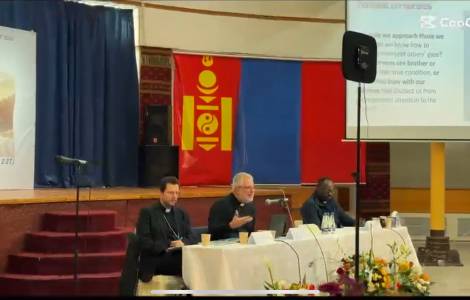
Ulaanbaatar (Fides News Agency) - At the heart of a numerically small (less than 0.1% of the country’s population) yet surprisingly creative Church, the “pastoral week” recently held by the Apostolic Prefecture of Ulaanbaatar offered this year a very concrete workshop on synodality and inculturation, marked by the presence of Father Giacomo Costa, consultant to the General Secretariat of the Synod of Bishops.
Among the week’s most significant moments, the inauguration on 5 May of the Studium, a new research centre on Mongolian language and culture, speaks volumes about how the Catholic Church in Mongolia has, for years, sought to take deep root in the country’s cultural fabric. Promoted by the Apostolic Prefecture, this project is, as the Apostolic Prefect, Cardinal Giorgio Marengo, told Fides, “a hub for cultural research, a physical space, but above all a team of people”. Located next to the cathedral, the Studium will include a space dedicated to a library currently under construction, as well as an office and a meeting room, “where people, particularly members of our team, will be able to meet figures from the world of culture and university professors”. Beneath these rooms there is also a large, fully equipped conference hall, where the inauguration took place. But, the Cardinal insists, the heart of the Studium is not primarily its infrastructure: “We are working on two fronts: the first is to offer a monthly conference, aimed primarily at missionaries, on topics related to Mongolian cultural identity, with a view to providing a program of ongoing formation that enables a better understanding of Mongolian culture and identity from cultural, historical, political, religious and linguistic point of view.”
The other front is that of language: “We wish to provide increasingly accurate translations, and to check and revise the materials we already possess in order to offer linguistic support in the translation of texts useful to the Church,” adds the Cardinal. Through this dual service – formation and linguistic work – the Studium places itself at the centre of a long process of inculturation.
It is in this context, at the intersection of inculturation and synodality, that Father Giacomo Costa’s participation in the Pastoral Week takes place. A Jesuit and theologian involved in the synodal process undertaken by the universal Church, Father Costa is accompanying a theological-pastoral journey in Mongolia that seriously takes the reality of a young Church, composed of faithful from a culture shaped by other religious traditions.
Father Costa, you are accompanying a synodal theological-pastoral journey in Mongolia. How do you perceive this ecclesial reality? What strikes you most?
When you arrive in Mongolia, you really get the impression of entering a different ecclesiastical context. There, Christianity is not merely a minority: it does not represent a shared cultural memory, nor does it form part of society’s everyday symbolic landscape. I was told of a child who, upon entering a chapel for the first time, was frightened by the crucifix and began to cry. It is a very simple episode, but it reveals something profound: there, the cross has not yet become an image tamed by habit. It regains all its strangeness and all its power. In some way, it forces us too to look at it anew.
This has a very concrete consequence for the Church. In Mongolia, one cannot start from implicit assumptions. There is no existing Christian lexicon, no spontaneous familiarity with the Gospel, nor even that set of cultural structures which in Europe continue, at least in part, to support the ecclesial experience even when religious practice weakens. For this reason, the missionary question regains its original radicalism: what does it mean to proclaim Christ to people who have no prior image of Christianity? Where does one really begin? Furthermore, many regions of the country remain virtually unknown from an ecclesiastical perspective. It is clear that evangelization does not primarily coincide with the expansion of an institutional presence, but rather the opportunity to foster trustworthy, human and selfless relationships. In Mongolia, the Gospel is once again revealed above all as a way of life, even before being a religious discourse. And perhaps this is one of its most evangelical and fascinating aspects.
What is the specific nature of the synodal journey in a Church as young and small as the Mongolian one, with just over 1,400 baptized members?
The current phase of the Synod’s implementation places great emphasis on the fact that every Church is called to embody the synodal journey within its own concrete history. In Mongolia, this takes on a particularly strong meaning, because it is a Church that was practically born from scratch after 1992. Paradoxically, it is precisely such a young Church that risks being quickly weighed down by imported models. When a community is born, it is almost instinctive to reproduce structures, languages and pastoral categories that come from the missionaries’ Churches of origin. The problem concerns not only practical organization. It concerns the very way of conceiving the Church. The risk is that institutional structures will precede the ecclesial experience, that the building of structures comes before truly listening to people’s lives and to the concrete way in which the Gospel can take root in that culture.
Synodality, on the other hand, introduces a different approach. It compels us to slow down, to listen, and to discern together. It continually asks: what is truly necessary for a Christian community to emerge here? What forms truly help the Gospel to become shared life? In this sense, synodality protects the young Mongolian Church from the temptation to become a scaled-down copy of foreign ecclesial models.
There is also another very significant element. The Mongolian Church is made up of missionaries from almost thirty different countries. Here, ‘unity in diversity’ cannot remain a spiritual or diplomatic formula. It becomes a very concrete daily practice, concerning the way decisions are made, authority is exercised, and relationships are built between missionaries and Mongolian laypeople, between different religious congregations, and between ecclesial cultures that are sometimes very distant from one another. Synodality offers precisely a space in which this plurality can be transformed into communion without being reduced to uniformity.
The theme of the pastoral week was “The Catholic Church in Mongolia: gift and mission”. In what way does this pairing express the synodal vocation of a local Church?
Rather than a pairing, I would almost speak of a circularity. In Mongolia, it is abundantly clear that mission arises solely from the experience of having received something that does not belong to us. The Gospel is not primarily a project to be realized or an identity to be defended. It is a gift that precedes the Church itself. As Pope Francis said in Evangelii Gaudium, “Christians have a duty to proclaim it […] as those who share a joy, point to a beautiful horizon, offer a desirable banquet”. Pope Leo also emphasized that the Church evangelizes “by attraction”.
In such small and fragile contexts, another issue immediately comes to the fore. A missionary Church easily runs the risk of being identified with its own works, its organizational capacity, and the financial resources it manages to mobilize. Of course, all this has real value, especially in a country marked by many social vulnerabilities. However, the heart of the mission lies elsewhere. If the evangelical relationship does not remain at the centre, the Church inevitably ends up being perceived as just one of the many humanitarian agencies present in the area.
In Mongolia, then, it is understood with greater clarity that the Christian message is conveyed through the quality of relationships: time given freely, listening, the ability to share life without immediately occupying the other’s space. In Mongolia, the Church can only emerge within this logic of gratuitousness and openness. And perhaps it is precisely here that we touch upon one of the deepest core aspects of synodality: a Church that understands itself as a network of relationships animated, permeated and regenerated by the presence of the Lord.
Pope Francis, speaking of Mongolia during his visit, praised the missionaries who ‘inculturated’ themselves in order to ‘preach the Gospel in the Mongolian style’. How does this process of inculturation fit in with synodality?
If one takes the perspective of the Synod’s Final Document seriously, the relationship between inculturation and synodality appears almost inevitable. Synodality does not, in fact, consist of a participatory technique or a functional redistribution of ecclesial tasks. It concerns the way in which the people of God listen together to what the Spirit says within a specific history and a specific culture.
In Mongolia, this point emerges with particular clarity because Christianity is still in the early stages of taking root, and the steps taken by the missionaries and the Mongolian people are truly admirable. It is clear that the issue is not simply a matter of translating certain contents into the local language. It concerns something much deeper: how the Gospel can take root in the imagination, in the way relationships are lived, in the relationship with time, with nature, with the family, and with the hospitality characteristic of Mongolian culture.
Such a process cannot be imposed from above nor developed exclusively by missionaries. Rather, it requires genuine spaces for shared discernment. Dialogue in the Spirit takes on a very concrete significance here, because it allows newly baptized Mongolians to express what they genuinely feel is compatible with the Gospel and what, on the other hand, still seems alien or imposed from outside. Authentic inculturation always arises from reciprocity: the Gospel transforms a culture and, at the same time, the Church is transformed by its encounter with that people. Synodality safeguards and encourages precisely this reciprocal dynamism.
What is the added value of the synodal methodology for a Church that already lives out simple and flexible structures?
In reality, the structures I have encountered are fragile, perhaps simple, but not necessarily flexible. Even in Mongolia, there is a fairly rapid risk of building pastoral structures modeled on the ecclesial habits of missionaries. This is understandable, because every missionary inevitably brings with them their own way of conceiving the Church.
The synodal approach emphasizes the quality of relationships. Above all, it allows us to discover how rare it is, even within the Church, to listen authentically both to the Word of God and to others. We must recognize that many dynamics emerging in Mongolia are the same as those found elsewhere: the tendency to react immediately without pausing to consider what the other person is saying, the difficulty of allowing oneself to be truly questioned, and the struggle to discern together in the light of the Word of God rather than solely on the basis of one’s own pastoral convictions.
And the experience of the past few days has truly been a significant step forward. For example, some Mongolian laypeople spoke about their understanding of hospitality. It is striking how much importance is given to that very first contact, to the quality of one’s presence, and to the sensitivity with which one enters into another person’s life. This raises very practical questions for all of us: do our parishes, charitable organizations and schools truly reflect this sensitivity? How can we welcome, without expecting anything in return, someone who arrives for economic reasons and is not interested in the faith? How can asymmetrical relationships between those who give and those who receive be lived out in a spirit of generosity? Synodality allows us precisely to dwell on these questions without closing them off too quickly, whilst remaining attentive.
Finally, there is a very significant fruit already visible in the journey we have undertaken: the emergence of a small group of facilitators capable of guiding conversation in the Spirit and community dynamics. In a Church that feels a strong need to grow spiritually, this represents something very precious. The house of spirituality near Ulaanbaatar is moving precisely in this direction. However, places alone are not enough. A Church grows when there are people capable of nurturing spiritual processes, accompanying discernment and supporting mature ecclesial relationships.
Can the Mongolian experience offer something to the universal Church, both in terms of understanding synodality and the relationship between evangelization and inculturation?
I am certain of it: Mongolia compels the Church to return to questions that elsewhere risk being obscured by habit. In many countries with an ancient Christian tradition, people unconsciously continue to think of the Church within a cultural horizon which, though weakened, remains available: a shared religious language, a certain symbolic familiarity, established structures, and moral and social references settled over time. In Mongolia, however, what is essential and what belongs to secondary historical layers re-emerges with greater clarity.
The Mongolian experience reminds us all once again that synodality does not arise from an organizational need. It arises from the need to build real communion within a fragile, scattered, multicultural and minority Church, to nurture the missionary impulse, and to value each of the few baptized members who make it up. In such a context, it becomes particularly clear that synodality does not take shape around a logic of opposition or internal rebalancing, but around a shared responsibility for the proclamation of the Gospel and for the concrete life of the ecclesial community.
The Mongolian experience also serves as a reminder that synodality is not simply a matter of holding more and more consultations. It concerns the way in which the Church learns to live in relationships that are non-dominant, non-clerical and non-self-referential. In this sense, the ‘relational conversion’ referred to in the Final Document appears to be very much a reality in Mongolia.
Furthermore, Mongolia offers a valuable lesson even to the oldest Churches: it reminds us that Christianity never coincides perfectly with a civilization, a culture or a definitive historical form. The Gospel always transcends the structures and cultures that host it.
Pope Leo XIV, from his very first address, highlighted the importance of synodality for the Church. What would be the specific nature of the Holy Father’s approach in comparison to synodality defined as “mission, participation, communion” in the previous Synod?
Every Pope inevitably brings his own spiritual style, his own language and his own ecclesial sensibility. However, the decisive point of the synodal journey does not lie in the Pope’s personality, but in the process of assimilating the Second Vatican Council. Both Pope Francis and Pope Leo XIV have strongly emphasized this continuity. Synodality represents, in fact, one of the ways in which the Church is seeking to embrace conciliar ecclesiology more deeply within the historical conditions of the present.
For this reason, I would not speak of a break between a “Synod of Francis” and a new phase inaugurated by Leo XIV. The process is the same. The emphasis, priorities and way of exercising the Petrine ministry inevitably change, but the conviction that the Church is called to walk together through history under the guidance of the Spirit remains shared.
It seems to me, however, that the current context makes the prophetic significance of synodality even more evident, and that Pope Leo is fully grasping it. We live in a world marked by growing polarization, identity conflicts, and a progressive inability to live with differences without turning them into opposition. In this context, it is clear that synodality supports the way in which the Church bears witness to the possibility of a reconciled coexistence. Ecclesial communion does not eliminate tensions, but it prevents them from becoming a logic of mutual exclusion. And this is what can be offered to the broader society as well.
The categories of “communion, participation, mission” therefore remain central to Pope Leo XIV’s approach as well. In particular, mission increasingly appears as the horizon capable of bringing everything else together. A truly missionary Church cannot operate in self-referential ways, because the Gospel continually pushes it beyond itself.
There remains, moreover, a very strong awareness that has matured throughout the synodal journey: documents, on their own, do not bring about ecclesial transformation. They can guide, clarify and initiate processes. However, the true fruit of the Synod will depend on the concrete ability of the Churches to allow themselves to be transformed in their relationships, in the exercise of authority, in pastoral practices and in structures, with a view to mission. Ultimately, the Synod does not invite the Church to become something other than itself, but to allow that way of living, relating and walking together—which finds its source and criterion in Christ and his Gospel—to emerge more deeply, even in the concrete forms of daily life. (ML) (Fides News Agency, 19/5/2026)

 Cardinal Tagle to the Churches of Asia: “Walking Together”: Learning from the First Steps of a Child


 VENEZUELA/COLOMBIA - When the earthquake has passed, brothers and sisters remain by the side of those who continue to suffer
 ASIA/CHINA - Spiritual retreat of communion and healing for the priests of Zhangjiakou
 The Church of the Sheaves: a missionary perspective presented to Newly Ordained Bishops
 BEATIFICATION OF FULTON SHEEN/II - Beyond the clichés. Fulton Sheen's lessons in ‘communication’
 XII FABC Plenary Assembly: Asia's Bishops Renew Commitment to Synodal Mission and Bridge-Building
 ASIA/CHINA - Andrew Ding Yang ordained Archbishop of Chongqing
 VATICAN - Course for new Bishops: Bishop García Macías: Inculturation can become one of the most beautiful forms of Evangelization, “when it enables a people to recognize that Christ is no stranger to them”