
Information service of the Pontifical Mission Societies since 1927
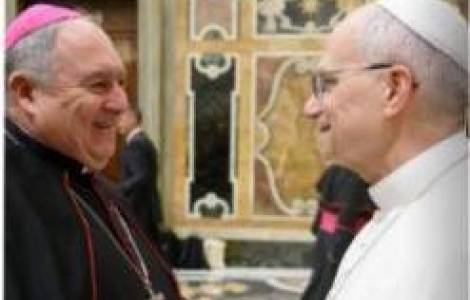
Las Palmas de Gran Canaria (Fides News Agency) – Pope Leo XIV's visit to the Canary Islands, scheduled for June 11 and 12, is part of his first apostolic journey to Spain, which will take place from June 6 to 12, with stops in Madrid and Barcelona before arriving in the archipelago.
The visit to the Canary Islands is the final leg of his itinerary, highlighting the pastoral nature of a trip to one of Europe's main migration borders.
The Bishop of the Canary Islands, José Mazuelos, recognizes the Pope's presence as an event of profound pastoral and ecclesial significance, especially in relation to the archipelago's migration situation.
In an interview published on the diocese's official website, Bishop Mazuelos emphasized that the visit reflects the universal Church's concern for those arriving on the Canary Islands' shores via the Atlantic route, one of the most dangerous in the world. “The Pope is coming for several reasons. One of them is the migration crisis at the port of Arguineguín, the ‘port of shame’, which we are experiencing in the midst of the pandemic,” the bishop stated.
The Arguineguín dock became one of the major symbols of the migration crisis in 2020 when a makeshift camp was set up there, cramming nearly 3,000 people within just 200 meters, all of them arriving in a large, flat-bottomed wooden boat (cayucos).
The Pope will begin his stay in Gran Canaria with a visit to this dock. There, he will meet with some of the migrants who made this journey, as well as volunteers, staff, and representatives from institutions working on the front lines of reception, who will share their experiences with him—a gesture the diocese considers of “profound symbolic and evangelical value.”
Caya Suárez, coordinator of the event, explained at the last press conference that the meeting in Arguineguín will be a simple, but carefully planned, organized “for and by the people, reflecting the reality of migration in the Canary Islands.” She also emphasized that the Canary Islands, on this trip, represent a stage of charity, highlighting that “24% of the population are migrants” and praising “the Church’s work in accompanying and welcoming these people.”
The visit will also include gestures and initiatives in memory of the victims of migration routes, such as a photographic exhibition on the dock, and a moment of prayer for the hope and dignity of those arriving on the Canary Islands’ shores in search of a better future. The Pope’s presence seeks to give new meaning to Arguineguín, known as the “dock of shame,” symbolically transforming it into a “port of hope,” where the “Angels of the Ocean” work, as the Bishop of the Canary Islands calls the Maritime Rescue Service, the Red Cross, and the emergency teams who are the first to rescue migrants.
The Canary Islands, Europe’s Atlantic border
To understand the significance of this visit, it is necessary to look back a few years, to the pontificate of Pope Francis, who left an indelible mark on the pastoral and moral care given to migrants.
Bishop Mazuelos recalled the impact of the image of three young Nigerians who arrived in the Canary Islands after eleven days of hiding, sitting perched on the rudder of an oil tanker that had set sail from Nigeria. That photograph, released in 2013, deeply affected Pope Francis, who confessed, “That photo touched me.” Since then, the Canary Islands have held a prominent place in the pastoral concerns of the Holy See. On several occasions, Francis expressed his closeness to the archipelago, even stating his desire to visit because he wanted to “be close to the government and people of the Canary Islands,” acknowledging that it faces one of the most dramatic border situations in Europe. In a letter sent to the bishops of the Canary Islands in November 2023, he thanked the local Church for its welcoming work and encouraged the creation of “networks of love and beacons of hope” in the face of the ongoing migration crisis.
In January 2024, the President of the Government of the Canary Islands, Fernando Clavijo, along with Bishop José Mazuelos and Auxiliary Bishop Cristóbal Déniz, were received at the Vatican, where they outlined the three major challenges they were facing: the humanitarian emergency on the Atlantic route, the difficulties of reception and integration—especially for minors—and the lack of stable prospects for those transferred to the peninsula.
The Catholic community, in this sense, has promoted initiatives such as the so-called "hospitality corridors," aimed at facilitating the reception, training, and integration of young migrants in various Spanish dioceses.
The visit of Pope Leo XIV is interpreted as a further step in the continuation of this pastoral care, the meaning of which, according to Bishop José Mazuelos, cannot be understood without this prior history of listening to and accompanying one of the most complex human realities of the present.
An ecclesial community that accompanies and hopes
Mazuelos emphasized the continuity of the Church's commitment in the Canary Islands, especially in accompanying minors and people in vulnerable situations. "A Church that doesn't tire and that remains present," he affirmed. In his reflection on the reality of migration in the context of globalization, he stressed the need to "shed light on this reality, so that it doesn't remain hidden." He also highlighted the three dimensions of the pastoral response: "immediate reception, addressing the root causes, and integration." In this regard, he explained the urgency of the response with an image: "When there's a gas leak, I can't tell people, 'I won't do anything until the leak stops.' I'll have to give them a mask so they don't die. And then we'll go and fix the leak." Therefore, he insisted that it is necessary to t welcome them, but also integrate them and prevent further migration by addressing the root causes in their countries of origin, such as organized crime, the plundering of raw materials, and the situation of war.
Mazuelos also highlighted the suffering of those who undertake the journey: “A person must endure immense hardship or suffering to embark with a hundred others in cayucos on the Atlantic Ocean for at least five or eight days, without knowing if they will arrive.”
At the same time, he pointed out that, as Pope Leo XIV said, they “are teachers of hope,” because “they teach us to have hope.”
According to the report presented on June 2nd by the Diocesan Caritas of the Canary Islands, social services in the province of Las Palmas assisted 21,372 individuals and 7,633 households in 2025, a 2% increase over the previous year, of whom 54% were migrants.
In light of these figures, Bishop Mazuelos recalled: “As encouraged by Pope Leo XIV, who will visit us in a few days, we must look up and work together as a community to promote greater justice and equality so that there is no need to emigrate; and even less so via the Atlantic route, which continues to claim so many lives.”
A message of hope for the local Church
Among the expected fruits of the Holy Father’s visit, the prelate expressed his wish that “the Atlantic and the Sahara cease to be a graveyard.” “May we all be able to humanize both the places of origin and the arrival of migrants,” he added. “I have hope that a path will open up in the face of this tragedy. Migration is not something temporary; it is the result of a global reality: the world is changing and becoming increasingly interconnected. Therefore, we have the duty and the obligation to welcome and, together with those who arrive, work to create a more humane environment in their countries of origin as well. It is important not to generate rejection towards those seeking a better future, but rather to shed light on dignity and shared responsibility.”
The Pope’s visit strongly reaffirms that the Canary Islands are not a forgotten periphery, but a central place where human dignity is at stake. His presence on the islands will be an act of listening to those working on the front lines of welcoming migrants, a gesture of comfort for the communities bearing the burden of this crisis, and a call to international conscience, reminding us that migration is not a local phenomenon, but a global one. Following in the footsteps of his predecessor, Leo XIV arrives with a clear message: each migrant is not a number, but a face; not a burden, but a brother or sister. The Pope “comes to confirm this Church that pilgrimages and journeys in the Canary,” concluded Bishop Mazuelos. (LGR) (Fides News Agency, 7/6/2026)

 “200 Years of the Living Rosary”: From Pauline Jaricot to the worldwide Pontifical Mission Societies
 ASIA/PHILIPPINES - First Assembly of “Catholic digital missionaries” in Asia to be held in September


 President-elect Keiko Fujimori visits the Presidency of the Peruvian Bishops’ Conference
 "Christianity is only just beginning": How Leo XIV's missionary vision is rooted in the Acts of the Apostles
 Cardinal Aveline, Archbishop de Moulins-Beaufort, and missionary renewal in France
 Leo XIV: The Catholic Church has contributed to the development of the United States
 EUROPE/SPAIN - El Hierro, prayer for migrants who died in the Atlantic on the eve of the Pope's visit
 AMERICA/GUATEMALA - Temporary reception centers for immigrants "end up being detention centers, where human rights are violated"
 ASIA/VIETNAM - Archbishop Joseph Vu Van Thien: “The Church in Vietnam, grateful for the missionaries and martyrs, sings its Magnificat”
 “Doing things for free” is “God’s job”: ‘Operation Mato Grosso’ in Peru
 ASIA/INDONESIA - Capuchin Friars in Sumatra welcome displaced people after flooding