
Information service of the Pontifical Mission Societies since 1927
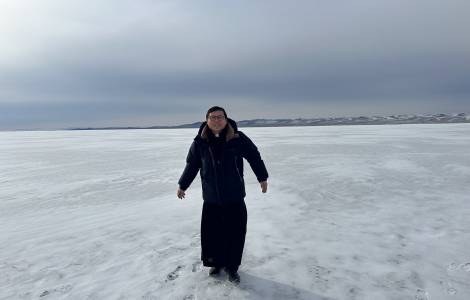
Foto MLK
by Marie-Lucile Kubacki
Ulaanbaatar (Fides News Agency) - Three years after his death on May 26, 2023, the figure of Father Stephen Kim SeongHueon remains very much alive in the memory of the Church in Mongolia.
A Korean missionary and vicar general of the Apostolic Prefecture of Ulaanbaatar, his life was an answer to a question that had accompanied him since childhood: “Why did they come here?”
We met him a month before his death. In a chapel located beneath the cathedral, dedicated to Our Lady of Fatima, to whom he was especially devoted, he spoke to us about his spiritual and vocational journey, particularly about the memory of the tomb of a French missionary buried in the village where he had grown up. His home parish was founded by missionaries in the Diocese of Daejeon, South Korea. “I grew up asking myself, ‘Why did they come here?’” I wondered about it even more because back then their countries of origin seemed much more interesting to me than the country where I lived….” It was a silent question, unknown to anyone, but one that gradually led him to the seminary and the priesthood. During his studies, an encounter with a Korean missionary marked a turning point: “I don’t remember the exact content of his speech, but I do remember his last words: ‘One of you will go abroad as a missionary.’” That sentence pierced him deeply. “When I heard him say that, I thought: ‘What if it were me?’”
From then on, he began to see his vocation differently. In his fourth year, the bishop sent him to Rome to study: “So I ended up studying missiology while preparing to be a priest in my diocese…” From that tension arose an even deeper question: “What was my true priestly identity? How could I reconcile my identity as a diocesan priest with that of a missionary, which at the time seemed like too much of a role for me?” The answer began to take shape thanks to the Gospel: “I asked myself: Were the twelve disciples diocesan priests or missionaries? And Jesus?” Contemplating their lives, he discovered a common trait: “They were the predecessors of those diocesan priests who never close the door, not even when they are tired, and say: ‘Let people come to me!’” In that image, he found a synthesis: “Because that is precisely the spirituality of the diocesan priest: to keep the door open.” And within him, “a great ‘yes’ resounded,” because he understood that a diocesan priest “could also be a missionary.” Even before leaving, he decided to live his vocation in this way: “Since Korean was the language I knew best, I decided to be a Korean missionary in Korea, as if I were at the ends of the earth.” That change of perspective, he said, made him “profoundly happy.”
Then came Mongolia. “One day I learned that the bishop was looking for someone willing to go to Mongolia.” At that moment, one of the French missionaries from his childhood, the first parish priest, whom he only knew from a monument, came back to him: “I knew that priest through a monument on which his name was engraved.” Then he understood: “Why am I here? It becomes clearer to me every day: because of that name engraved on the monument. One day I too will be dead, and perhaps some children, seeing my name, will ask themselves: ‘Why was Father Kim here?’”
In Mongolia, where he founded the parish of St. Mary Assunta in the Khan-Uul district, Father Stephen lived in a poor and young Church. “In Mongolia, we are still in the early stages.” And yet, he observed: “Throughout the world, ultraliberalism and consumerism are becoming a challenge for all Christians.” The poverty of the Mongolian Church did not seem to him a limitation, but rather an evangelical richness: “We are poor, and that is precisely our wealth.” Looking at St. Francis of Assisi, he reversed the perspective: “St. Francis of Assisi was rich and had to give up all his possessions to follow Jesus. The ‘St. Francis’ of Ulaanbaatar was born poor and has nothing to strip himself of to follow Jesus.” If one recognizes “the richness of poverty,” discovering that God has given them “the gift of not having to renounce anything to follow him,” then “the ‘St. Francis’ of Ulaanbaatar can be happy.”
But he was also aware of the ambiguity of any discourse on poverty: “We must also be aware of how indecent it is to extol the benefits of poverty in front of the poor if we do not share their condition.” That is why he insisted that it was “a real challenge for missionaries”: “We must be what we preach.” “What we can offer people is also a way of living with suffering.” Not by avoiding it, because it exists, even if we don't like it or seek it, but by finding a way to navigate it, by following in the footsteps of Jesus.”
When he spoke about his life, he often returned, smiling, to that period when “he decided to take a step back from the mission and withdraw for a time and spent four years in a ger in the countryside.” There, in the typical Mongolian tent used as a dwelling, he discovered “the joy of a simple life.” He collected horse manure for the stove, fetched water, and shared the daily life of the shepherds. Comparing “the two lifestyles—that of the frenetic city, where there are a thousand things to buy, and that of the simplicity of the countryside—one seemed clearly better to me than the other.”
From that experience also came one of his most powerful images: “In the gers, in the countryside, and even in Ulaanbaatar, there is no running water, and you have to go and fetch it… People know what it means to find fresh water. That is why we must be present, so that they can find wells of fresh water in our churches.” We are there, he said, “to speak of the Kingdom of God and of salvation,” to offer “the Good News that will set them free. Free from what? From the slavery of sin and the feeling of guilt.” This liberation is “very concrete, almost physical: it’s like pouring buckets of heavy water onto the ground.” “We don’t follow Jesus to offer a life full of success, but a full life, truly full, that fills us from within with that living water.”
This is the true happiness he hoped Mongolian Christians would one day recognize: “The day will come when Mongolian Christians have enough experience to compare the lifestyles before them, and perhaps then they will utter that missionary ‘ah’ I mentioned earlier: ‘Ah… I prefer this kind of happiness.’” “The turning point will come. When? I don’t know. But one day they will recognize where true happiness lies and say: ‘This is what I’ve been searching for all my life.’ And we will be there to welcome them, with the door wide open. In fact, we are already there.”
The mark that Stephen Kim left in Mongolia remains alive, especially among the young people, now adults, who remember his dedication to youth ministry, his closeness, and his enormous passion for life. In 2024, the Diocese of Daejeon, together with the Korea Catholic Times, produced an educational film entitled “Wind of the Prairie – The Last Lecture of a Mongolian Missionary,” which helped to raise awareness of his life and work. In 2025, the Korea Catholic Times also released a new documentary entitled “Who Is a Priest?”, co-produced with the Korean Prado Priests Association, which recounts his life and mission in Mongolia. As the Apostolic Prefecture of Ulaanbaatar prepares, as it does every year, to celebrate Mass at his tomb on May 26, the question that permeated Father Stephen’s entire life continues to resonate, addressed to each of us: “Why are you here?” “Missionaries proclaim the Gospel in many ways, but the most powerful is the witness of their own lives: ‘Why are you here?’ It is a very powerful question.” (Fides News Agency, 26/5/2026)



 The Church of the Sheaves: a missionary perspective presented to Newly Ordained Bishops
 ASIA/CHINA - Andrew Ding Yang ordained Archbishop of Chongqing
 BEATIFICATION OF FULTON SHEEN/II - Beyond the clichés. Fulton Sheen's lessons in ‘communication’
 “The Lord is my Shepherd”: Cardinal John Tong’s autobiography, a sign of gratitude for a journey of joy and hope
 VENEZUELA/COLOMBIA - When the earthquake has passed, brothers and sisters remain by the side of those who continue to suffer
 ASIA/CHINA - Spiritual retreat of communion and healing for the priests of Zhangjiakou