
Information service of the Pontifical Mission Societies since 1927
by Gianni Valente
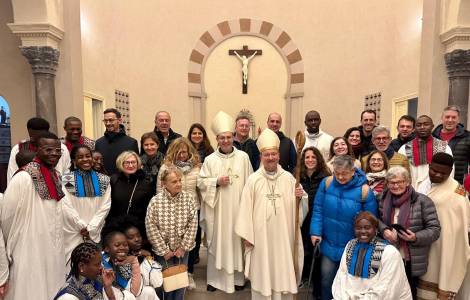
Tunis (Fides News Agency) – The annual General Assembly of the Pontifical Mission Societies (PMS) has just taken place in Rome, and Nicolas Lhernould returns with his heart and mind full of experiences, reflections, and encounters—including one with Pope Leo XIV—that enlivened the days of work during the assembly.
The Archbishop of Tunis also participated this year in the Assembly as National Director of the PMS in Tunisia, along with more than one hundred National Directors who came to Rome from all five continents.
His experience as a bishop in the land of St. Augustine, as clearly emerges in the following interview, also allows him to offer and share valuable insights for everyone on the very nature of the mission entrusted by Christ to his Church, for the salvation of all.
Archbishop Lhernould, you have long repeated that the Church, by its very nature and mission, cannot be self-centered. What do you mean by that?
NICOLAS LHERNOULD: The Church is a means instituted by Christ at bthe service of his mission, the mission of Christ, which consists in entering into a loving relationship with all human beings and revealing that love to everyone. The Church does not have its center of gravity in itself: its center is in God's loving relationship with the world. Throughout history, every time the Church shifts and becomes self-centered, it loses its vitality because it loses sight of the fundamental horizon for which it was instituted by Jesus.
Already in the early days of his pontificate, Pope Leo XIV had warned: let us not take Christ's mission away…
LHERNOULD: At the end of the Gospel of Matthew, Jesus asks the eleven apostles to make disciples of all nations, baptizing them “in the name of the Father and of the Son and of the Holy Spirit.” There is a missionary task, a “mandate” entrusted by Jesus to his followers, but there is no transfer of authority. The authority remains that of the one missionary, who is Jesus himself. We can be his collaborators. Collaborators of the one true missionary, who is Christ himself.
Did all of this emerge during the General Assembly of the Pontifical Mission Societies, recently held in Rome?
LHERNOULD:When I participate in the week of the General Assembly of the Pontifical Mission Societies, this is always clear to me. The PMS are an aspect of the “instrument of the Church” at the service of the relationship between God and the world, which is the heart of mission. When the Assembly ends, after having discussed projects, statutes, and so many important things to do, I always think of returning to the words of Saint Paul: “All things are yours, but you are Christ’s, and Christ is God’s.”
What can prevent self-referentiality even in gatherings like the PMS Assembly?
LHERNOULD: There are two complementary points that, in my opinion, we should never set against each other in a dialectical way. The first is the liveliness and joy proper to the Body of Christ, which is the Church. To live and share this joy, we have all the human, spiritual, and even theological tools at our disposal, especially after the Second Vatican Council, which revived the theology of communion of the Church Fathers to describe and share this communion, the communion proper to the Body of Christ.
Then there is another point, strongly emphasized in the teachings of Pope Francis: everything that pertains to and implies the Church's relationship with that which is external to her, With what is not the Church. It is in this context that the theme of fraternity arises.
The Church Fathers, in the context of their time, were not called to develop what we might today define as an “ecclesiology of fraternity,” because then this relationship with all realities that were not the Church was experienced differently than it is today. And today we can perceive with greater intensity that precisely the encounter with those who are not “us” reveals ourselves to us. It helps us to recognize our own identity, our own nature.
The first Christians themselves lived in a world where everyone else, all the others, were not Christians…
LHERNOULD: There is a passage in the Acts of the Apostles that speaks of the disciples of Jesus in Antioch, where it says that it was precisely there that those who followed Jesus received the name Christians. This means that they did not give themselves that name. They received it, and they received it in a non-Christian environment. It was others who called them Christians. They did not call themselves Christians.
And what does this suggest today?
LHERNOULD: It is an existential and also theological law: part of our Christian identity is revealed through our encounter with others, with those who are not Christians.
And does your situation in the countries of North Africa help and contribute…Does this dynamic somehow lead us to experience it?
LHERNOULD: Back in 1979, the bishops of North Africa wrote a beautiful joint pastoral letter entitled “The Meaning of our encounters.” Clearly, Revelation concluded with the death of the last apostle, but the face of Christ is revealed through the real encounter of his disciples with cultures and peoples. And there is something of the face of Christ that could not come to light, that could not be revealed to us, if this process of incarnation in peoples and cultures did not exist, a process that will continue until the Parousia, the glorious manifestation of Jesus Christ at the end of time.
And what paths can this mission, the one Christ entrusted to his Church, take in Tunisia and other North African countries?
LHERNOULD: I really like the definition of mission given by Christian de Chergé. He was the Prior of the monastic community of Tibhirine, the monks murdered in 1996 in Algeria and beatified in 2018. He said that mission is not conquest, mission is fragrance.
“There is more joy in giving than in receiving” (Acts 20:35). We share the gift we receive with others. And this is the fundamental dynamic of every missionary impulse. But if we pause for a moment and also give others the opportunity to experience this joy, the joy of giving, we too can receive what others want to share. In this way, we can open the way to a joy from which a curiosity can arise, the curiosity to touch the source of that joy, even without naming it, without calling it by name.
We can and must allow Christ himself the power to touch hearts in this gratuitous encounter with him in person. And we must also remain open to the experience of receiving, of receiving even the best of the other's culture, their questions before the Mystery and before God, their joys. And this is not passivity: it is a missionary act. It is part of the work of drawing near to the source of joy.
What images and stories in Sacred Scripture suggest this way of living the mission?
LHERNOULD: As members of the Churches of North Africa, we are often challenged and called into question by what we might call the paradigmatic icon of the Epiphany. In the Gospel of the Epiphany, Jesus has just been born; he doesn't speak, he doesn't do anything. Mary, too, remains silent. She simply opens the door. The Three Wise Men arrive, three strangers, and the mere fact of their willingness to welcome them leads them, in their own way, with their own culture, after their journey, to offer the best of what they have and what they are, with their gifts and their adoration.
The Three wise Men are an outsider, and they remain outsider. After having adored the Child Jesus, they return to their country, to their own things, to their own reality. But there was also a Revelation for them. The revelation is for everyone. Thus, in others, in those who are not “us,” there is something constitutive of the revelation of our own identity, and this aspect, in my opinion, must be taken into account; it is an important element when speaking of mission.
In some situations, it is not possible to carry out activities or promote works identified as missionary. In those contexts, can it be said that mission coincides with the simple confession of faith, the Confessio fidei?
LHERNOULD: When we speak of confession of faith, we immediately associate that expression with the commitment of the word, with the need to proclaim. The absolute confession of the Father's love, as the beginning of the Letter to the Hebrews puts it, is Jesus. Now, at the Epiphany, Jesus is unable to say anything. Jesus is there, he is a newborn, and he says nothing. Then there are thirty years of hidden life, which are also a confession. Jesus is the incarnate Word who has come to live among us. Therefore, we must reveal love not only by speaking, but by living. Charles de Foucauld expressed this beautifully. He said: I would like to live in such a way that people, seeing me live, will ask themselves about the origin of this love. We are called to the same expectation, to ask ourselves the same question.
I really like those passages in the Gospel where, when Jesus cannot speak because he is a child, or when nothing is said around him, we are like Joseph, like Mary at the Epiphany. It is not the “whole” of the mission, but it calls us to recognize that confession is an incarnation of the being of Christ Jesus among us.
Is this how the love of Jesus Christ is confessed for Muslims as well?
LHERNOULD: We know that Muslims will never, or almost never, read a Gospel. But if a person's life is an open page of the Gospel, even with its frailties, even with weaknesses and sin, there is something of Jesus that can truly be touched.
You were Bishop of Hippo, where Pope Provost followed in the footsteps of St. Augustine, so dear to him…
LHERNOULD: I was bishop for four and a half years in the diocese of Constantine and Hippo. And it is true that I learned to be a bishop, so to speak, by following in the footsteps of Augustine. In a certain sense, due to the shared and prevailing perception, the Bishop of Hippo remains himself, remains Augustine, sixteen centuries later. He continues to be greatly loved and respected, even by Algerians. It is beautiful that the pontificate of Pope Leo X has also had the effect of rekindling not only the memory of Augustine, but also his spiritual and missionary relevance.
As a bishop and as National Director of the Pontifical Mission Societies, what has impressed and helped you most about St. Augustine?
LHERNOULD: I am often asked how to begin approaching Augustine. Many recommend reading his Confessions. I, on the other hand, suggest reading his treatise on the First Letter of John. Because there we find the heart of being Christian on mission with others: “By the love you have for one another, everyone will know that you are my disciples” (Jn 13:35), Jesus says in the Gospel of John.
What does Saint Augustine suggest for the mission of the Church in the present time?
LHERNOULD: What strikes me most is perhaps the aspect he wrote about least: his feeling personally loved by God. The source of all his work is this personal experience of an intimate encounter with Jesus.
For me, the primary horizons of mission are internal: they are about being able to transmit the joy of being called, and also the lived joy of this intimate encounter with God, which then translates into being in the world, in the family, in society, even in the words we can share with others to express this familiarity.
A true encounter with the person of Jesus is the only thing capable of transforming one's entire life into joy.
Therefore, it is not like a proposal offered to be selected from a variety of options. Nor is it a choice, an option toward which we would ever want or be able to force anyone. We can only say: this joy, which is offered freely to everyone, gives me life and transforms my life. And this testimony, as Saint Bernadette would say in Lourdes, I am not here to "make you believe it," but to tell you.
Does the situation in some North African countries make it easier for you to grasp these aspects of the mission, which are interesting for everyone?
LHERNOULD: Mission is often given a somewhat narrow definition, identifying it only with the proclamation of the kerygma. However, the Good News is not just the kerygma understood as the announcement of the Paschal Mystery, of the passion, death, and Resurrection of Jesus. From the beginning of the Gospel, Jesus already sends his followers to proclaim the Good News, and at that time he had not yet died nor risen. Therefore, the Good News involves a whole process that begins with the Incarnation, from the birth of Jesus to Pentecost. The revelation of new life in Jesus begins with his birth and continues with the silent witness of his first thirty years. Any kerygmatic proclamation can never forget the reality of this incarnation lived in silence.
At the Pontifical Mission Societies Assembly, you shared your testimony as a bishop of a small Church with limited resources, reiterating that the poorer we are, the more we can recognize the source of our mission. Isn't there a risk of falling into the rhetoric of "few but good"?
LHERNOULD: What I meant to say is that there is no less experience of catholicity if we are 300 or if we are three million. There were eleven apostles after Jesus' Resurrection. In a pastoral letter I wrote while I was in Constantine, I already mentioned this, saying that we are not called to efficiency, which quantifies, but to fruitfulness, which generates.
The catholicity of the Church is not a static characteristic, but rather mission. It is true that we rejoice when we are many, but the authenticity and effectiveness of missionary action are not measured by statistics. It springs from a fruitfulness that loves.
When structures are lacking, when resources and the works that allow us to do many things are lacking, even living and embracing this condition is missionary. It helps us to recognize that mission is first and foremost about our loving relationship with the Lord and with others: “He appointed the Twelve,” says Mark, “so that they might first of all be with him”; and to send them out to preach.’ The first missionary call is this intimacy of the missionary with Christ, which extends into a living proclamation of love. It is also a communal endeavour. As we have already said: "By the love you have for one another, everyone will know that you are my disciples" (Jn 13:35).
How is this fruitfulness perceived in the meetings of the Pontifical Mission Societies?
LHERNOULD: I always find it beautiful that, during the Assembly of the Pontifical Mission Societies, everything is illuminated by the shared experiences and testimonies from all regions and contexts. There is no anxiety to reduce everything to standard categories. There is a complementarity of different experiences, inherent in the missionary process, which is the process of the whole Church. And also, living one's own communion in diversity, as happens in the Assemblies of the Pontifical Mission Societies, is in itself a powerful missionary act.
What allows us to overcome the risk of fragmentation and dispersion? Are corporate "team-building" courses necessary?
LHERNOULD: In the Assembly of the Pontifical Mission Societies, we experience that, in fraternity, diversity is lived as a richness. Diversity remains; things are not approached in the same way. But if we look at the first College of Apostles, from a human perspective, things couldn't have worked. There were such different personalities, even opposed to each other. However, walking with Christ, embracing his words, and allowing ourselves to be guided step by step by the power of the Spirit, was what created communion in diversity. Already at Pentecost, the Church speaks all the languages of the earth. And St. Augustine emphasizes that the one who speaks all languages is not the individual apostle, but the entire Church, with all its diversity.
And how do the words of Pope Leo XIV support and encourage this path?
LHERNOULD: In last year's audience, Leo XIV emphasized communion and universality as distinctive features of the Pontifical Mission Societies. It immediately occurred to me that his suggestions and emphases were very “Augustinian.” This year too, the title of his message for the 100th World Mission Day is “One in Christ, united in mission,” directly echoing his Augustinian episcopal motto. Pope Leo XIV reminds us that communion is not the result of our own effort, an architecture we have to build, but rather the fruit of the Holy Spirit. Communion is experienced among diverse people because, in different ways, the witness of Christ Jesus himself is manifested in the Spirit.
(Fides News Agency, 8/6/2026)



 THE CHURCH OF THE SHEAVES CONFERENCE - Listening the Continents: Gifts, Challenges and New Missionary Pathways
 "Gift exchange between the Churches requires conversion": Fr. Stan Chu Ilo on the "Church of the Sheaves"
 100th WORLD MISSION SUNDAY - Pope Leo XIV: May the Church always remain faithful to the mandate of the Risen Lord
 New episcopal ordination in China: Ignatius Ding Zuyao ordained Bishop of Haimen