
Information service of the Pontifical Mission Societies since 1927
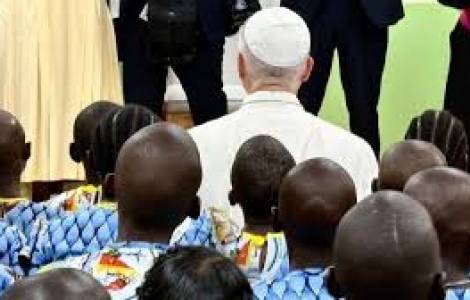
VaticanMedia
by Gianni Valente
Rome (Fides News Agency) – “Move aside so that Christ may remain, to make oneself small so that he may be known and glorified.” With these words, the day after his election as Bishop of Rome, Leo XIV reminded the cardinals who had elected him of what he called “an indispensable commitment for all those in the Church who exercise a ministry of authority.”
At the end of the first year of his pontificate, these words aptly illuminate one of the defining characteristics of his magisterium as the successor of Peter: its missionary aspect.
In both Leo XIV and Pope Francis, references to the missionary nature of the Church and the call for a renewed missionary spirit can be found in homilies and catecheses, in speeches and messages.
Pope Leo XIV emphatically and consistently reminds us of the fundamental dynamics that shape the apostolic mission entrusted to the Church. He recognizes and describes the contexts and conditions under which the apostolic mission is to unfold in the present day. Specifically, he identifies the urgent practical needs and priorities that must be addressed so that “missionary calls” do not degenerate into rhetorical abstractions that burden the lives of the baptized.
The Attraction of Christ
Pope Leo XIV reminds us: “The mission is Jesus. He is Risen — thus, he is living and he precedes us. None of us is called to substitute him.” (Holy Mass with presbyteral ordinations, St. Peter's Basilica, May 31, 2025).
The Bishop of Rome repeatedly emphasizes that missionary zeal does not arise spontaneously, but can only unfold freely in an encounter with Christ. Thus, the encounters of the first disciples with the Risen Jesus forever demonstrate the simple yet mysterious dynamic through which the experience of salvation can be passed from heart to heart: "After meeting Jesus, Andrew could not help but share with his brother what he had found." (Video message to the participants of the youth meeting "SEEK26," January 2, 2026).
“It is the Holy Spirit,” Pope Leo recalled, “that sends us to continue the work of Christ in the world’s peripheries, marked at times by war, injustice and suffering.” (Mass for the Jubilee of the Missionary World and Migrants, October 5, 2025).
Repeating an expression dear to Benedict XVI and Pope Francis, the current Bishop of Rome reaffirms that one cannot become a Christian through cultural pressure, proselytism, or marketing strategies, but solely through "attraction". What Saint Augustine called "Delectatio Victrix," the victorious delight. "In fact, it is not the Church that attracts, but Christ; and if a Christian or an ecclesial community attracts, it is because through that “channel” flows the lifeblood of Charity that cascades from the Heart of the Savior." For: "We belong to him, we are his community, and he can continue to draw others to himself through us." "The mission of the disciples and of the whole Church is the continuation of Christ's mission through the Holy Spirit." (Address at the opening of the Extraordinary Consistory on Mission and Synodality, January 7, 2026).
The Mission of the “Young Churches”
In his Magisterium, Leo XIV—far from rigid abstractions—realistically identifies the conditions and contexts in which one can bear witness to Christ today. The Pope drew attention to the story of Blessed Isidore Bakanja, the young patron saint of the Congolese laity, who was tortured and killed by a European landowner during the colonial era, to remind us that today “the ancient Churches of the North of the world receive this witness from young Churches, which urges us to walk together towards the Kingdom of God,” and “Africa, in particular, asks for this conversion, and it does so by giving us many young witnesses of faith” (Jubilee Audience, November 8, 2025).
Pope Leo XIV observed that a “new missionary age” opens up in the history of the Church and emphasizes that mission today is no longer solely associated with the word “depart”, the going out to distant lands that did not know the Gospel or were experiencing poverty, today the frontiers of the missions are no longer geographical, because poverty, suffering and the desire for a greater hope have made their way to us.” Therefore, it is necessary “to seek a renewed missionary cooperation among the Churches” and “in the communities of ancient Christian tradition, such as those of the West, the presence of many brothers and sisters from the world’s South should be welcomed as an opportunity, through an exchange that renews the face of the Church” (Jubilee Mass for the Jubilee of the Missionary World, October 5, 2025).
With the same Christian realism, the Successor of Peter expresses his gratitude to “today’s ad gentes missionaries,” because despite adversity and human limitations, “they continue to give themselves joyfully, because they know that Christ himself, and his Gospel, are the greatest treasures we can offer,” and at the same time emphasizes: “The world still needs these courageous witnesses of Christ, and ecclesial communities still need new missionary vocations.” (Message for the 100th World Mission Day, January 25, 2026).
Inculturation does not “sacralize” any culture.
All missionary who depart to other lands, as Leo XIV stated, “are called to live with respect within the culture they encounter, directing to the good all that is found true and worthy, and bringing there the prophetic message of the Gospel.” (Holy Mass for the Jubilee of the Missionary World, October 5, 2026).
The Pope repeatedly emphasizes that so-called “inculturation” is “an intrinsic requirement of the Church’s mission”: Inculturating the Gospel means “following the same path that God has travelled” and “entering with respect and love into the concrete history of peoples so that Christ can be truly known, loved and welcomed from within their own human and cultural experience.” At the same time, Pope Leo emphasized that inculturation “does not equate to a sacralization of cultures or their adoption as a decisive interpretative framework for the Gospel message, nor can it be reduced to a relativistic accommodation or a superficial adaptation of the Christian message, since no culture, however valuable it may be, can simply be identified with Revelation or become the ultimate criterion of faith. To legitimize everything that is culturally given or to justify practices, worldviews or structures that contradict the Gospel and the dignity of the person would be to ignore that every culture — like every human reality — must be enlightened and transformed by the grace that flows from the Paschal mystery of Christ” (Message to the Pastoral Theological Congress on the Event of Guadalupe, February 5, 2026).
Relaunching the suggestions of the Apostolic Exhortation “Evangelii Gaudium”
In his first year as Pope, Leo XIV did not develop any new theories or strategies that he might have enriched with his many years of personal experience in Peru, far from his homeland. Instead, Pope Leo chose to revisit and highlight the key themes and insights of the missionary impulses of his predecessors as Bishops of Rome.
In his recent letter to the Cardinals (April 12, 2026), Leo XIV reaffirmed the contributions of members of the College of Cardinals who, at the Extraordinary Consistory in January, had noted that Pope Francis's Apostolic Exhortation "Evangelii Gaudium" continues to be "a significant point of reference in ensuring that such boldness is not weighed down or stifled by organizational excesses."
Among the practical suggestions Leo XIV reiterated in his letter to the Cardinals, he recalled the need to "relaunch Evangelii Gaudium through an honest assessment of what has actually been embraced over the years and what, by contrast, remains unfamiliar or unimplemented." The Pope emphasized the need to pay particular attention to "the necessary reforms of the processes of Christian initiation" and "to the need to reassess the effectiveness of ecclesial communication, including at the level of the Holy See, from a more explicitly missionary perspective."
“The small flock and the grain of incense”
In his missionary teaching, Leo XIV, in the first year of his pontificate, also described specific contexts in which the apostolic work of ecclesial communities takes place. He affirmed that even though the Church recognizes itself as a “minority,” she is called “to live with confident courage, as a small flock bringing hope to all, mindful that the aim of mission is not its own survival, but the communication of the love with which God loves the world” (Letter to the Cardinals, April 12, 2026).
Among the most evocative images chosen by the successor of Peter to describe the mission entrusted to the Church is the one he presented to the small Church in Algeria: “Your presence in this country is like incense: a glowing grain that spreads fragrance because it gives glory to the Lord and joy and comfort to so many brothers and sisters. This incense is a small, precious element that does not draw attention to itself, but invites us to turn our hearts to God, encouraging one another to persevere amid the difficulties of the present time.” (Homily in the Augustine Basilica, Annaba, April 14, 2026). (Fides News Agency, 7/5/2026)



 POPE IN FRANCE/I - Bishop Guillet: This is how the “Acts of the Apostles” is coming alive in Saint-Denis
 AMERICA/PERU - Edgard Rimaycuna, secretary to Pope Leo XIV, brings the Pope's blessing to Chiclayo
 “Saints have a past and sinners have a future.” Chinese Catholics celebrate Saints Peter and Paul, Patrons of the Church of Rome
 The 2026 General Assembly of the Pontifical Mission Societies begins
 EUROPE/FRANCE - The “Extended Sanctuary,” a missionary pilgrimage in the footsteps of Saint John Eudes
 ASIA/VIETNAM - 160,000 people flock to the 32nd Marian Congress-Pilgrimage of La Vang
 In Dar es Salaam, African Liturgists call for an end to the “folklorization” and “theatricalization” of inculturation
 Papua New Guinea, the miracle of ecclesial unity in the Country of 800 languages
 “Without Him we can do nothing.” The teaching of Pope Francis on mission
 BRICS+ Is A Polyhedron, Pope Francis’s Favorite Image
 Hawaii, 200 years of Catholic mission. It takes a seed to grow a tree