
Information service of the Pontifical Mission Societies since 1927
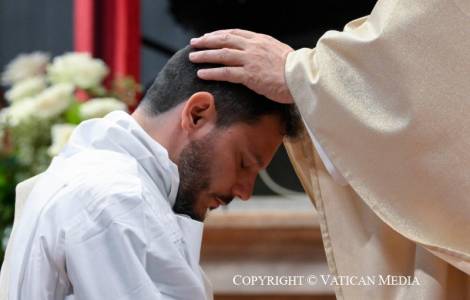
Vatican City (Fides News Agency) – Today more than ever, “especially when statistics seem to indicate a divide between people and the Church,” the primary mission of men called to the priesthood is to “keep the door open” that leads to the Mystery of salvation, showing it to everyone “without using too many words.” April 26, the fourth Sunday of Easter, is “Good Shepherd Sunday.” This is the day on which the World Day of Prayer for Priestly and Religious Vocations has been celebrated for 63 years.
In St. Peter’s Basilica, Pope Leo XIV presided over the solemn Eucharistic liturgy and ordained ten new priests, eight of whom were for the Diocese of Rome. In his homily, he also drew inspiration from the passage in the Gospel of John read during the liturgy to evoke the open and vast horizon, like the world itself, within which the "priest’s service" is situated—a "ministry of communion" offered to share with all "life in abundance" that "comes to us in a deeply personal encounter" with Christ. In his homily, addressing the new priests in particular, the Bishop of Rome recalled three "secrets" of the "priest's life," offering insights into the scope and nature of the mission to which they are called.
"The deeper your bond with Christ," the Holy Father reminded them, explaining the first "secret" of the priest's life, "the more radical your belonging to all of humanity. There is no opposition, nor competition, between heaven and earth; in Jesus they are united forever."
Reality,” adds Pope Prevost, referring to the second “secret,” “should not frighten us.” Today, “the need for security makes people aggressive, causes communities to close in on themselves and leads people to seek out enemies and scapegoats.” Whereas “your security,” the Bishop of Rome exhorts, addressing the ordinands, “your security should not lie in the role you hold, but in the life, death and resurrection of Jesus as well as in your participation, along with your people, in the story of salvation.”
The communities in which the new priests will exercise their ministry, the Pope reminds them, “are places where the Risen Lord is already present, and many have already followed him commendably. You will recognize his wounds and distinguish his voice. You will encounter people who will direct you towards him. These communities,” adds the Successor of Peter, “will also help you to become saints. For your part, help them to walk together, following Jesus, the Good Shepherd, so that they may become places — gardens — of life that rise anew and share themselves with others.”
Pope Prevost does not ask priests for complex plans or execissive pastoral activity. Rather, he reminds them that “facilitating encounters, helping to bring together those who would otherwise never meet, and conciliating division is one and the same as celebrating the Eucharist and Reconciliation. Coming together always means planting the Church anew.” He then evokes the passage from the Gospel according to John where Jesus says of himself: “I am the gate.” By introducing others to the faith—he adds, addressing the ordinands—“you will rekindle your own. Together with the baptized faithful, you will cross the threshold of the mystery every day — the threshold bearing the face and name of Jesus.” Never hide this holy door. Do not block it; do not be an obstacle to those who wish to enter.” In his homily, Pope Leo evoked the “bitter rebuke” that Jesus, in the same Gospel, addresses to those who “have hidden the key to a passage that was meant to be open to all.”
While “today more than ever, especially when statistics seem to indicate a divide between people and the Church, keep the door open! Let people in, and be prepared to go out.” This is precisely the third “secret” of the “priest's life” that the Successor of Peter reminds ordinands and all priests of: “You,” he says, “are a channel, not a filter.” Regarding belonging to the Church and the journey in faith – the Holy Father adds – “Many believe they already know what lies beyond the threshold. They carry memories with them, perhaps from a distant past. Often, there is something within them that is alive and has not died out; this draws them in. Other times, however, there is something else within them that still bleeds and repels them. The Lord knows, and he waits.”
Meanwhile priests are called to be “the reflection of his patience and tenderness. You belong to everyone and are for everyone.” “The primary concern of every priestly mission,” Leo XIV reminds us in the conclusion of his homily, “is to keep the threshold open and direct others to it, without using too many words.” A mission entirely woven under the sign of freedom and gratuitousness. In contrast to the human strategies that aim to forcibly group people together, pushing them into enclosures with no way out. “There are communities that suffocate; some groups are easy to enter but are almost impossible to leave,” acknowledges Pope Prevost. But in the Church, in the community of Christ’s disciples, it doesn’t work that way: “Whoever is saved,” says Jesus, “can “come in and go out and find pasture.” We all seek shelter, rest and care. The Church’s doors are open, but not to cut us off from life: life does not end in a parish, in an association, in a movement, in a group. Whoever is saved can “go out and find pasture.”
Priests, too, are called to “go out” and discover culture, people and life. To marvel “at the things that God makes grow without our having sown them.” “The people you will serve as priests — lay faithful and families, young and old, children and the sick —“warns the Bishop of Rome, inhabit pastures that you must come to know. At times it will seem to you that you lack the necessary maps. But the Good Shepherd has them; listen to his very familiar voice.” (GV) (Fides News Agency, 26/4/2026)



 AMERICA/PERU - Edgard Rimaycuna, secretary to Pope Leo XIV, brings the Pope's blessing to Chiclayo
 The Manual of Latin American Ecclesial Communities to address the addiction crisis: A story of Communion
 ASIA/CHINA - Francis Xavier Duan Yongkun ordained Coadjutor Bishop of Bameng
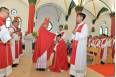 ASIA/CHINA - Father Joseph Chang Yanfeng ordained Bishop of Chifeng
 AMERICA/PERU - “In persona Christi Capitis”: Latin American Churches reflect on priestly identity in the face of new pastoral emergencies
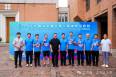 ASIA/CHINA - “Running for the Lord”: second edition of the “Synodal Half Marathon” of the Archdiocese of Beijing
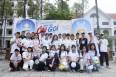 "Here I am; send me." Priestly and religious vocations in Vietnam amid signs of decline and new vocational paths