
Information service of the Pontifical Mission Societies since 1927
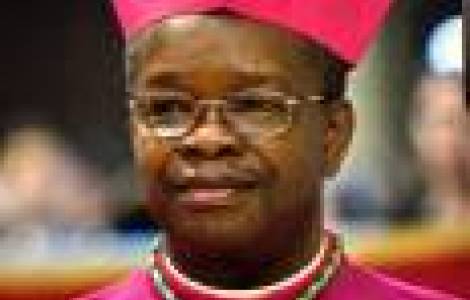
by Gianni Valente
Rome (Agenzia Fides) - The Infant Jesus found refuge in Egypt, together with Joseph and Mary, to escape Herod’s threat. And perhaps even today the African continent, though wounded by wars, tribalism and ‘inculturated’ neo-colonialism, could represent a paradoxical place of refuge for what comes from Jesus, whilst in the post-Christian West everything bearing the name of Christ is often ignored, opposed or distorted.
The suggestion put forward by Nigerian Archbishop Fortunatus Nwachukwu, Secretary of the Dicastery for Evangelization, on the eve of the Apostolic Visit that will take Pope Leo XIV to Algeria, Cameroon, Angola and Equatorial Guinea, is striking.
A four-stage journey – notes the Secretary of the Missionary Dicastery in an interview with Fides– which takes the Successor of Peter amidst the treasures and open wounds of the ecclesial communities and peoples in the countries visited. At a time when wars overshadow other wars, in Africa and across the world.
As a Nigerian, do you have any personal expectations regarding Pope Leo XIV’s visit to four African countries?
FORTUNATUS NWACHUKWU: As a Nigerian, my hope is to see the Pope visit my country too. When Father Robert Francis Prevost became General of the Augustinian Order, the first African country he visited was Nigeria. The Nigerian bishops recently made their ad limina visits to Rome, and they also invited Pope Leo to visit the country. We hope that Nigeria too may, in the near future, have the blessing of welcoming the Pope. Because the Pope’s visit provides a special impetus, sparking enthusiasm even during the preparation and anticipation phase. It becomes an opportunity for mental conversion, bringing out the desire to improve things not only in the dimension of faith, but also in the broader sphere of social life.
Is there a “common thread” linking the visits to the four countries?
NWACHUKWU: This impetus, this ‘tonic’ of the Pope’s visit, touches four very different countries, yet they share the fact that they are experiencing a crucial moment in their history.
Algeria, after so many years of crisis and internal tensions, is being reborn and is rediscovering peace and tranquillity. The Pope’s visit is symbolized by two doves drawing water from the source, and it highlights the need to strengthen this communion, this fraternal solidarity that would do the country good. The same spirit of solidarity and reconciliation would be most welcome in Cameroon, a country long torn apart by tensions and conflicts. The Pope’s visit may remind the people and governments that we have something in common: for Christians, it is faith in Jesus Christ, and for Muslims, it is the shared fact that we are all believers.
And what about the other countries?
NWACHUKWU: Angola has also emerged from several years of internal conflict and is rebuilding itself. It is a major producer of crude oil, and whilst this could be a blessing, unfortunately it also gives rise to a great deal of corruption in the management of resources. In Equatorial Guinea, too, crude oil production has become the main source of revenue. And those in power are called upon to use these resources for the common good rather than allowing them to end up in private pockets.
In the West, there are those who strive to outline alleged ‘strategic objectives’ for the Papal Visit, and there is vague talk of a ‘trip to Africa’…
NWACHUKWU: The temptation in the West is to lump the four countries together as if they were a single country. People speak of a “Trip to Africa”, whereas if the Pope were to visit Argentina or Peru, no one would simply say that the Pope had gone “to America”. Among the four countries there are similarities and differences that cannot be treated as identical. I would point out that the languages spoken in the four countries visited on the trip are those which, together with local languages and dialects, are spoken throughout Africa: Arabic, French, English, Spanish and Portuguese.
What gifts and riches can the church communities in these four countries share with the universal Church?
NWACHUKWU: The visit to Algeria will remind the universal Church of the need for dialogue, especially dialogue with Muslims. It will remind all Christian communities living amongst Muslims that they must be supported in their urgent need to live in an atmosphere of dialogue and mutual acceptance, so that they may continue to live and flourish. I lived in Algeria as secretary of the Nunciature, and in the light of that experience I wish to emphasize that we need to highlight the importance of inter-religious dialogue and dialogue with Islam, also for the good of the ‘little flock’ in Algeria.
An important part of the visit to Algeria will be the visit to Annaba, the ancient Hippo, where Saint Augustine was Bishop…
NWACHUKWU: This, too, will help remind us that the Church flourished in Algeria and North Africa in the early centuries. But even in the Gospel there is a strong link between the Holy Land, the History of Salvation and North Africa. It is Simon of Cyrene who helps Jesus carry the cross, and Cyrene was in what is now Libya. Mary and Joseph flee to Africa, going to Egypt to save the infant Jesus from Herod. And perhaps something similar is happening now…
In what way?
NWACHUKWU: It is a thought that has struck me ever since I was a doctoral student at the Pontifical Biblical Institute. When I was studying Sacred Scripture, I saw that Africa had offered refuge to the life of the infant Jesus, which was threatened by Herod. It had been a place of aid and protection. Then, once the danger had passed, Jesus returned with Mary and Joseph to the Holy Land. Perhaps even today, Christianity—the life that flows from Jesus—is once again under threat in the post-Christian West, where many people seem to harbour an inexplicable aversion towards us and everything that bears the name of Christ. And so, in this situation of pressure from a threatening ideology, who knows – I wondered and I still wonder – whether this might not be another moment in which Africa can once again offer a kind of refuge for what comes from Jesus, just as it did when Jesus was a child. This might also help us to understand what the current growth of Christianity in sub-Saharan Africa suggests. In Cameroon, Angola and Equatorial Guinea, too, the Catholic Church and other Churches and ecclesial communities are growing.
When people refer to this growth, they sometimes speak of it as a self-generated phenomenon, without even mentioning the work of the missionaries…
NWACHUKWU: When the Lord wishes to prepare a place of refuge, He always does so in a unique and surprising way. In this case, the Lord began to prepare a place of refuge through the missionaries as well. Those who gave—and continue to give even today—their youth, who left behind a more comfortable life and their loved ones, set out for unknown lands where death loomed and incurable diseases prevailed, and many sacrificed their very lives. We, with all our skills and eloquence, no longer have the courage, the faith, or the passion that leads one to sacrifice one’s own life to proclaim the Gospel.
What, then, are the open wounds, the points of suffering, within the Churches of the sub-Saharan countries that Pope Leo will visit?
NWACHUKWU: Some of these wounds are linked to tribalism and ethnocentrism, and take the form of isolation and self-absorption. I call it the ‘selfie mentality’. A mentality that is also expressed today in the trend of taking photos by turning one’s mobile phone towards oneself. An introversion which, in a way, is already mentioned in the first book of the Bible…
Where does it mention it?
NWACHUKWU: In Genesis we see that God created man and woman in his own image and likeness. Man was meant to be like a mirror, a mirror or a camera focused on God, capturing and reproducing God’s image and likeness. In the original state of creation, man and woman were not turned in on themselves; they did not look at one another, so much so that they did not even realize they were naked, and they felt no shame. With Sin, the situation is reversed; man and woman turn in on themselves. The camera lens turns in on themselves, just as happens now with ‘selfies’ taken with mobile phones. They are at the centre, and only then do they realize their nakedness; they begin to feel ashamed, to divide themselves and to blame one another for their sins. It is from there that we entered the ‘realm of the selfie’; it is from there that divisions, tribalism and fratricidal wars arise – from Cain and Abel to the present day, to the wars in Ukraine and Iran, to the genocide in Rwanda. All forms of tribalism and ethnocentrism, which also influence the life of church communities, stem from there. And they can only be overcome if our encounter with Jesus reopens our eyes and frees our gaze from self-absorption. As happened to the disciples of Emmaus, in chapter 24 of the Gospel according to Luke: when Jesus broke bread before the two disciples – as the Gospel tells us. Only then ‘were their eyes opened’. Only then did they cease to look at themselves, but recognized Jesus.
In the countries the Pope will visit, the Church’s mission has been intertwined with colonialism and the processes of decolonization. And now?
NWACHUKWU: I am tempted to say that colonialism is a truly diabolical thing, which treats people and nations as tools, with the sole aim of reducing those very people and nations to a state of submission in order to exploit them. The root of colonialism is also what I would call the ‘selfie culture’. The colonialist sees only himself; his interests become the measure of all things. And others—peoples and individuals—are merely tools for pursuing one’s own interests. In Africa, after enduring colonialism, we entered the era of independence. Africans were given, at least in part, the opportunity to lead their own countries. Are they doing a good job of it? I would say that we can only blame the West for Africa’s current ills to a certain extent. We cannot continue this game of always accusing others, of always pointing the finger elsewhere.
We have seen examples of African governments that have taken the situation in hand and started to change things in their own countries. Whilst, unfortunately, there are leaders who wield their power with arrogance, and almost apply the very practices of colonialism in an ‘inculturated’ form, adapting them to nepotism and tribalism. They favour their own families and ethnic groups, aiming to eradicate other ethnic groups.
Thus, when Western companies come to Africa to exploit the mines, they always do so by involving local people and groups who often do not have the country’s best interests at heart, but only their own pockets. Who are we to blame when there is slave labour or human trafficking? Sometimes the victims of trafficking are handed over to traffickers by their own relatives and acquaintances.
The Pope is leaving Rome and flying to Africa at a time of war. How are the conflicts that dominate the world’s attention viewed and experienced in African countries?
NWACHUKWU: The Pope’s trip may also draw attention to Africa’s forgotten wars.
In the West, there is a perception that the only wars currently taking place are those in Iran, Lebanon and Ukraine. Yet there are conflicts in Myanmar, and the one between Pakistan and Afghanistan. There has been a civil war in Cameroon for years, and nobody talks about it. There is no mention of Christians and Muslims being kidnapped or slaughtered in Nigeria. And then there are wars and violence in South Sudan, or in the Horn of Africa… The number of people killed, wounded and displaced in these conflicts is shocking. And the Pope’s visit may bring all this to the world’s attention. (Agenzia Fides, 13/4/2026)



 Leo XIV to the John Paul I Vatican Foundation Conference: peace is a daily Mission
 VATICAN - Cardinal Luis Antonio Tagle is the new Dean of the Sacred College of Cardinals
 POPE IN FRANCE/XI - Leo XIV in Metz: Europe seeks peace in the "Lantern of the Good Lord"
 THE POPE IN FRANCE/X - In Lourdes, where the vulnerable bring light
 POPE IN FRANCE/II - Behind the figures: the fragmented and “indecipherable” expectations that will greet Leo XIV
 Cardinal Aveline, Archbishop de Moulins-Beaufort, and missionary renewal in France
 Bishop Martinelli at the Inter-Christian Symposium in Thessaloniki: Migrants have made the Arabian Peninsula a “Laboratory of an Intercultural Church”
 The Centenary of the consecration of Six Chinese Bishops and the Provisional Agreement between the Holy See and the People’s Republic of China
 AFRICA/MALAWI - Archbishop Nwachukwu at the Jubilee marking 125 years of the Gospel in Malawi. Two new priests for a Church called to set out anew on mission
 VATICAN - Tribalism and the Church, Archbishop Nwachukwu to new bishops: “A bishop is not bishop of one group or another; he is bishop of all”
 AMERICA/CHILE - Chilean Church celebrates Our Lady of Carmel, Queen and Mother of Chile, on the centenary of her coronation
 LEO XIV IN AFRICA - Pope in Equatorial Guinea: “The Church’s social teaching offers guidance to all who seek peace and justice”