
Information service of the Pontifical Mission Societies since 1927
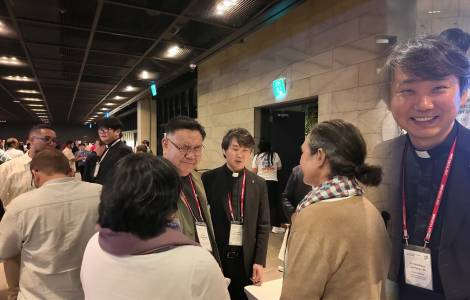
Ahead of World Youth Day (WYD) “Seoul 2027”, Fides News Agency is publishing a series of articles on South Korea, exploring its history, martyrs, young people and their experiences through interviews and visits across the “Land of the Morning Calm”.
§§§
by Pascale Rizk
Seoul (Fides News Agency) – “Our mission goes beyond simply promoting an event. Through our work, we hope to encourage young people to prepare spiritually for the pilgrimage and to feel part of the universal Church even before they arrive in Seoul.”
Father Domenic Lee Jaehyup, Deputy Director of the Communications Division, describes in these words the role of the World Youth Day Communications Committee, which is preparing for the event to be held in Seoul in August 2027.
“Our main responsibility,” he explains to Fides News Agency from his office in Seoul’s Myeong-dong district, “is to share the message of WYD Seoul 2027 through various media channels and provide information about the preparations. We also work closely with international Catholic media and media outlets of the Holy See to ensure that accurate and timely information reaches people around the world,” adds the Seoul diocesan priest.
Many young Catholics in Korea have never taken part in World Youth Day and have little idea of what is being prepared for Seoul. “Since a large number of young people from all over the world will come to Korea in 2027, we are preparing various promotional activities and awareness campaigns. Our aim is to minimize disruption to the daily lives of local residents and ensure that visiting young pilgrims receive a warm welcome and hospitality,” Lee explains.
On 8 October, the “WYD 2027” app for pilgrims was launched. It provides practical information, advice on Korean etiquette, basic greetings in Korean and pilgrimage routes in Seoul. The app is designed to help visitors find their way around and communicate in a country whose language uses Hangeul, the Korean alphabet created by order of King Sejong between 1443 and 1446.
Speaking about live coverage of World Youth Day events, Father Domenic explains the “WYD Now” initiative, developed together with the Catholic Peace Broadcasting Corporation (CPBC) and in cooperation with host broadcaster KBS (Korean Broadcasting System). The aim is to prepare international broadcasting and media coverage of WYD Seoul 2027.
An agreement with the public broadcaster was signed on 29 June. “Further details about media accreditation will be available on the official website, https://wydseoul.org/en,” Lee explains, adding that more information will be released in the coming months.
According to the deputy director of the committee, World Youth Day would not be possible without the dedication of volunteers, who do more than simply help organize the event: they are “its very heart”. More important than technical skills is their understanding of “the meaning and mission of World Youth Day” and their “willingness to serve others”. Practical communication skills are also needed, including media relations, press centre work, photography, video production, social media, translation and interpreting.
Lee also stresses the importance of three qualities: “teamwork, flexibility and cultural sensitivity”. These are essential when working with journalists from many different countries and when “responding calmly to unexpected situations.” Above all, he hopes that volunteers will bring “a genuine spirit of hospitality and an open heart”, so that young pilgrims feel “truly welcomed, appreciated and at home in Korea”.
In Korea, communication is also an art deeply rooted in a culture that values harmony, respect and what remains unspoken. At its heart lies nunchi (눈치), the ability to “read the atmosphere”: to understand the mood and non-verbal signals of others and adapt one's behaviour accordingly.
Language itself reflects the country's social structure. The way people speak changes according to the age and social position of the person they are addressing, ranging from the formal jondaetmal (존댓말) to the informal banmal (반말).
The communication strategy for WYD has also taken this cultural context into account. In November, the event's mascots, Hobi and Cobi, were introduced. They recall characters such as Hodori, the famous mascot of the 1988 Seoul Olympic Games. Two promotional videos were also released, addressing issues that are particularly relevant to Korean society.
The first video, “쫄지 마” (“Don't Be Afraid”), encourages young people not to fear failure. The second, “그런 대회 아닙니다” (“It's not that kind of competition”), plays on the Korean word ‘daehoe’, which is associated with competitions. The message presents WYD 2027 as an opportunity for young people to free themselves from the intense pressure to compete and succeed, a pressure that weighs heavily on many young people in Korean society.
(Fides News Agency, 25/11/2026)



 Hanoi, 400 years since the arrival of Alexandre de Rhodes (“Đắc Lộ”): language, stone and memory
 ASIA/CHINA - New Bishop of Xiamen: “Communion and Mission are at the heart of Church Life”
 POPE LEO XIV IN PERU/IV - “Jesus, I trust in you”: The Pope embraces Peru’s young people
 Pope Leo XIV to young people in Argentina: “No one has fallen so low that Christ cannot raise them up”
 ASIA/SOUTH KOREA - The journey toward WYD 2027 crosses paths with the Church’s social doctrine
 ASIA/SOUTH KOREA - Catholic Culture Fair in Seoul serves as a “trial run” ahead of World Youth Day 2027