
Information service of the Pontifical Mission Societies since 1927
by Marie-Lucile Kubacki
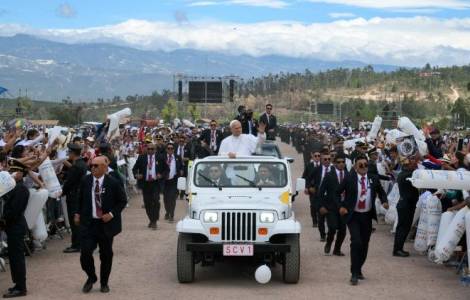
Chiclayo (Fides News Agency) – A crown placed on the head of the Virgin Mary in the cathedral where he took his first steps as a bishop, followed by a helicopter flight to the Andean highlands of the Cajamarca region, where he celebrated Mass with farming communities who had travelled from afar, on foot and along difficult roads. On Saturday, November 14, the ninth day of his Apostolic Journey to Uruguay, Argentina and Peru (November 6–17), Pope Leo XIV experienced one of the most personal days of his pilgrimage, in the Diocese of Chiclayo, which he led as bishop until 2023.
A return to “his” cathedral
Early in the morning, in the Cathedral of Saint Mary, the Pope presided over the coronation of the image of the Immaculate Virgin Mary.
“With a heart filled with joy, I give thanks to God for being here with you today to celebrate our faith as we have so often done, and in the same cathedral,” he said at the beginning of the ceremony, visibly moved and happy.
The cathedral, he recalled, had witnessed “the first steps” of his episcopal ministry. The Pope explained the meaning of the gesture: the crown is intended to symbolize “the tribute of gratitude and filial love,” offered by the Pope to the Mother of God, “together with you and the whole Church, as we acknowledge her as the loving Mother and Patroness of Chiclayo, exalted by God as Queen of heaven and earth”.
Commenting on the reading from Isaiah, Leo XIV spoke of the “darkness” that even today “seems to envelop us completely”: “the uncertainty of widespread violence” and “by the unspeakable suffering that continues to afflict so many of our brothers and sisters”.
His words touched on a pressing concern in a country where insecurity, extortion and organized crime have long been among the population’s main worries. Against this darkness, the Pope said, “God’s gift continues to shine before our eyes”: “a defenseless child is God’s answer to a humanity plunged into darkness, yet longing for unity and reconciliation”.
Devotion to the Immaculate Virgin, he stressed, “is part of the Christian roots that shape your identity and strengthen your faith”. He therefore encouraged the faithful to walk “as one family of God”, working towards “a world marked by love and compassion, forgiveness and the pursuit of justice”.
The most intimate moment was his personal prayer to the Virgin Mary: “At your side I learned to be the shepherd of Chiclayo. You accompanied me through its towns and cities. You taught me to meet its people and to be attentive to their needs, as you did at the Wedding Feast of Cana.”
He also entrusted to her “my life and my ministry as Successor of Peter”. Before leaving, he prayed with the assmbly, asking Mary to help them become “builders of peace and reconciliation, servants of the Kingdom of God and of our brothers and sisters”.
In the Andes, before the Señor del Costado
After the ceremony, the Pope travelled to the air base and flew by helicopter to Santa Cruz de Succhabamba, a town in the province of Santa Cruz, in the Cajamarca region, which belongs to the Diocese of Chiclayo.
Before Mass, he stopped at the parish church of the Immaculate Conception. He prayed before the Blessed Sacrament and then before the image of the Señor del Costado, which is deeply venerated in the area, and greeted several people with disabilities.
At around 11 a.m., he presided over the Eucharistic celebration in the town’s open-air square.
“We are in the mountain range of the Peruvian Andes”, “in a land with Andean roots, where the Inca Empire flourished and which is the cradle of a profound Christian faith”, he said in his homily, delivered in Spanish.
Many of the faithful came from rural communities, “leaving behind their families, farms and daily occupations”. Their journey, he said, “is not only a passage along difficult roads, but also a pilgrimage of faith.”
Drawing on the Third Letter of John and its invitation to welcome itinerant missionaries, the Pope recalled the missionaries who arrived in these mountains “five centuries ago”, “without provisions or letters of recommendation”. He referred to a long line of witnesses, “from Turibius of Mogrovejo to the Martyrs of Chimbote”.
Saint Turibius, Archbishop of Lima in the 16th century, travelled extensively throughout the vast territory of his diocese. This Saturday evening, the Pope will bring to a close the Jubilee Year dedicated to him.
The Martyrs of Chimbote are the Polish Franciscan friars Michał Tomaszek and Zbigniew Strzałkowski, and the Italian priest Alessandro Dordi, who were murdered by the Shining Path (Sendero Luminoso) in 1991 and beatified in 2015.
In these lands, the Pope said, faith had grown “quietly”, “far from applause”. Citing Saint Paul VI’s Evangelii nuntiandi and Pope Francis’ Evangelii gaudium, he described popular spirituality as “a powerful force for evangelization” and “offers a healthy antidote to the superficiality and consumerism that are so widespread today”.
The Pope expressed his gratitude to catechists who, “in the absence of priests and not without sacrifice, provide pastoral care for the communities”. They guide the celebrations of the Liturgy of the Word, prepare people for the sacraments and visit the sick.
“Without them, evangelization in these remote regions would have proven very difficult,” he said.
The widow who seeks justice
Reflecting on the parable of the widow and the judge (Lk 18:1-8), the Pope observed that the plea, “Grant me justice against my opponent”, sadly “is sadly still heard today, unanswered, on the lips of so many men and women”.
He then highlighted three specific challenges facing the region: “the suffering of those who are forced to leave their homeland in search of a better future for themselves and their families in the great coastal cities”; “the difficulties surrounding generational succession due to the declining birth rates that are emptying villages”; and “the challenge of equitably distributing the land’s resources”.
The Cajamarca region, where Santa Cruz is located, is indeed marked by mining activities and serious social and environmental conflicts.
“In the face of so many difficulties, we may be tempted to give in to discouragement, resentment or even violence. Yet this will never lead to progress and peace,” the Pope warned.
The widow teaches us that selfishness, injustice and evil “are not overcome by brutality, but by prayer, patience and perseverance in denouncing what is wrong”.
“Then, as happens at the summit of Cerro Cotorumi, through the cross we see the sky,” he said. “Where there is faith, there is prayer; and where there is prayer, there is the capacity to commit oneself to others.”
Leo XIV also praised “farmers, shopkeepers, small business owners” who strive “to provide people with dignified jobs”.
He referred to his encyclical Magnifica humanitas, dated 15 May 2026, on integral human development.
“When the soul wanders aimlessly, he is the way. When strength is lacking, he is your nourishment. When discouragement arises, it is he who rekindles hope,” the Pope concluded, invoking the blessing of the Señor del Costado upon those present.
At the end of the celebration, the Bishop of Chiclayo, Monsignor Edinson Edgardo Farfán Córdova, thanked the Pope on behalf of the diocese.
In the afternoon, the Pope returned to Chiclayo.
(Fides News Agency, 14/11/2026)



 LEO XIV IN PERU: Mission, Augustinian fraternity and the bond with his people, as recounted by Father Lam
 Pope Leo XIV to young people in Argentina: “No one has fallen so low that Christ cannot raise them up”
 700 participants enrolled in new online course in missiology and missionary spirituality in English, promoted by the Pontifical Missionary Union
 ASIA/MONGOLIA - From the letters of Giovanni da Montecorvino towards an ecumenical Bible: Ulaanbaatar marks 720 years of Scripture in Mongolian
 WYD Seoul 2027, Father Justin Choi Inbi: “We are preparing to welcome those who will come, without forgetting the young people who are always with us”
 POPE IN FRANCE/II - Behind the figures: the fragmented and “indecipherable” expectations that will greet Leo XIV
 ASIA/VIETNAM - 160,000 people flock to the 32nd Marian Congress-Pilgrimage of La Vang