
Information service of the Pontifical Mission Societies since 1927
by Marie-Lucile Kubacki
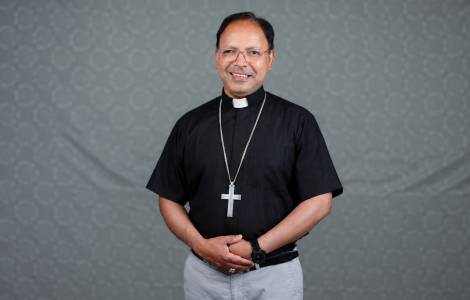
Darjeeling (Fides News Agency) – When Pope Leo XIV appointed Fr. Edward Baretto coadjutor bishop of Darjeeling on 29 November 2025, he confirmed a journey spanning four decades and the length of the Indian subcontinent: from a Catholic family of modest means in Karnataka's Mangalore diocese to the tea-covered hills where India meets Bhutan and Sikkim.
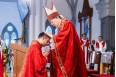
Ordained bishop on 21 January 2026 in Kalimpong before the Apostolic Nuncio to India and Nepal, Leopoldo Girelli, he now works alongside Bishop Stephen Lepcha in service of a diocese he has contributed to, in almost every role, since he was a teenager.
"We were eight brothers in the family, and we were very poor" he tells Fides, recalling of his childhood in Alampuri, near Mangalore, "Even so, I managed to complete my schooling, though with much difficulty." His father fell ill with cancer while Edward was still in primary school, forcing him to help at home while his mother went out to work. "Even if I had not lost that time, my family would not have been able to afford to send me to school," he adds, reflecting on a path forged by grace and dedication, where nothing was taken for granted or owed to privilege.
That vocation took him far from home. In 1982, at seventeen, he entered the John XXIII Minor Seminary in Darjeeling, nearly 2,500 kilometers from his native south. He later studied at Morning Star Regional Seminary in Calcutta, earned a master's in philosophy in Pune and a licentiate in canon law in Bangalore, after his priestly ordination for Darjeeling in 1993.
The move from the tropical south to the Himalayan north was not effortless. "Once you know the language, that is the key to entering into a community," he says of his first years in the hills. "After that, things became much easier for me." He turned to the villages for Christmas ministry, and to music as a bridge into local life : "that was appreciated too, and that is how I settled in quickly." That pattern of integration recurred throughout his ministry: assistant director of the minor seminary, professor at Morning Star, parish priest in Kalimpong, judicial vicar, and, most recently, director of the Divya Vani Pastoral Centre.
Today that diocese counts some 35,000 Catholics, "that is all," he notes without emphasis, spread across a territory of over 9,500 square kilometers covering the Darjeeling hills, Sikkim and the Kingdom of Bhutan. A little flock, yet one that has built, in his telling, an unusually settled coexistence with its neighbors. "Regarding religious harmony we do not have much of a problem, unlike other parts of India, where you must have heard about conflicts," he says. "We live in harmony, and among Christians the harmony is excellent so far. We take part in each other's programs, and when we meet, it is very good." He cites concrete initiatives : "I organized an interreligious dialogue and invited many people. It went very well, everyone came, we organized a dinner for them, and there was an exchange of views" as proof that dialogue, for him, is a concrete realty of encounters and time spent together.
Much of his pastoral life has unfolded among the region's tea-garden communities, whose Catholic presence dates to nineteenth-century labor migration from Chotanagpur. "People here are mostly employed on the tea gardens," he observes. "Tea-garden workers do not own land, they are simply employed by the gardens. Housing is very difficult for tea-garden families."
When asked about a story that shaped his approach to mission, he recalls celebrating an interfaith marriage between a Catholic man and a Hindu woman. Sensing that the bride and her family were ill at ease, he explained that he was not there to force anyone and deeply respected their tradition. Relieved, the bride began attending church regularly before eventually asking to be baptized. "She thanked me for leaving him free and not putting her under pressure," the bishop says. "That is what truly allowed her to find his own way."
On mixed marriages, which are common in a region where Catholics are few in number, even among Christians, he favors a gentle and respectful approach. Baptizing anyone without genuine consent, he notes, "would be against the civil constitution, and also against the Church's own teaching, because it would impose our religion on someone. It is not a matter of refusing them : if they want to come, they are free to come."
By virtue of his diocese's geography, Bishop Baretto also carries responsibility for Bhutan's small Catholic community, with one native priest, a singular story rooted in the country's royal family itself, in this kingdom officially bouddhist. "There were Jesuit missionaries in Bhutan, invited by the king," he recounts, "many members of the royal family studied in Darjeeling, mostly under the Jesuits" The story is interesting. In the mid-20th century, St. Joseph's School in Darjeeling, better known as North Point, established itself as a premier educational hub for Himalayan elites under the direction of the Jesuits. Several generations of Bhutan's Wangchuck royal dynasty and bhutanese members of the aristocracy were educated there, beginning with the country's third monarch, Jigme Dorji Wangchuck, who was himself a former student of the school and who launched a modernization of his country's education system starting in 1961. It was in this context that, in 1963, Bhutan's Prime Minister Jigme Palden Dorji, the king's brother-in-law, invited the Darjeeling Jesuit missionaries to develop education in Bhutan.
“From that time until the Jesuits left Bhutan in 1989, many Darjeeling Jesuits worked in three places to develop education in Bhutan especially Fr William Mackey who lived there until his death in October 1995 and Fr Gerard Leclaire who set up the first college in the country and Fr John Coffey who pioneered in Punakha, the summer capital of Bhutan, relates the official website “Darjeeling Jesuits of North Bengal. “After the death of Fr Mackey, the pastoral ministry in the kingdom suffered for lack of a Catholic missionary in the kingdom, it relates. However, Bhutan, being under the care of the Diocese of Darjeeling, someone from there has been coming periodically to give mass to this Catholic community - considered as an old group of Christian believers in the kingdom, whose many of them had accepted the Catholic faith when they or their parents were in Darjeeling (India).” Father Kinley Tshering, the first and only native Catholic priest from Bhutan, with buddhist origins, embodies this story and constitutes a bridge in his flesh. Sent as a child to St. Joseph’s School in Darjeeling, and later encouraged to pursue his calling by Mother Teresa during a flight where he happened to be seated right next to her, he joined the Society of Jesus and was ordained in 1995. “He now exercises through a beautiful ministry of presence," explains Bishop Edward Baretto.
Reflecting on his own repeated uprootings, from south to north, from parish to tribunal to seminary, Bishop Baretto distills a conviction that seems to have guided his ministry: "You cannot force anything, you know, you have to embrace the vocation. We should not force anybody in matters of faith. We are meant to live it, and pray." It is the same quiet, patient logic that carried a son from a Karnataka village to the leadership of a Himalayan Church wedged between India, Sikkim and Bhutan. (Fides News Agency, 7/10/2026)



 From a French pioneer of the American frontier to Pope Leo XIV: Sister Lyn Osiek's long missionary journey
 THE CHURCH OF THE SHEAVES CONFERENCE - Listening the Continents: Gifts, Challenges and New Missionary Pathways
 100 YEARS SINCE THE ORDINATIONS OF THE FIRST SIX CHINESE BISHOPS - Bishop Joseph Hu Ruoshan and the Diocese of Taizhou
 New episcopal ordination in China: Ignatius Ding Zuyao ordained Bishop of Haimen
 "Gift exchange between the Churches requires conversion": Fr. Stan Chu Ilo on the "Church of the Sheaves"