
Information service of the Pontifical Mission Societies since 1927
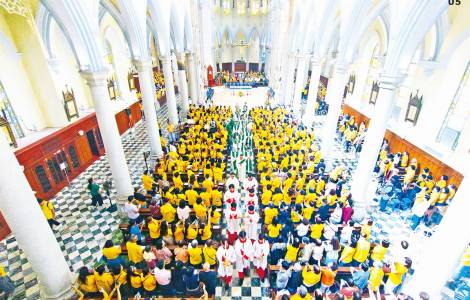
photo The Sunday Examiner
by Marta Zhao
Hong Kong (Fides News Agency) – In December 1948, the Catholic association Legio Mariae, founded in Dublin on September 7, 1921, on the eve of the Feast of the Nativity of the Blessed Virgin Mary, was officially established in Hong Kong. Today, 105 years after its foundation, the Legion of Mary in Hong Kong has approximately 6,000 members, divided into two categories: active members and auxiliary members. They are united by Marian devotion, expressed through prayer, formation and apostolic service.
To mark the 105th anniversary of its foundation, the Hong Kong Comitium of the Legion of Mary celebrated a solemn Eucharist of thanksgiving at the Cathedral of the Immaculate Conception. The celebration was presided over by Cardinal Stephen Chow Sau-yan, Bishop of the Diocese of Hong Kong, and concelebrated by 24 priests, with five deacons assisting at the liturgy.
According to Kung Kao Po, the weekly newspaper of the Diocese of Hong Kong, members of the Legion of Mary gathered to give thanks to the Lord and to celebrate together the graces they have received.
In an increasingly secularized society, the Legion of Mary’s disciplined structure can help young people find their way along the path of faith towards holiness, while encouraging them to bear witness to the gifts of grace they have received among their friends and acquaintances.
In Hong Kong, members of the Legion of Mary visit the elderly and people who live alone, carry out apostolic work in local communities, work with children and young people, accompany people on their journey of faith and pray for them.
Marian spirituality of the Legion
The Legion of Mary is an association of Catholic lay people and a school of Catholic apostolate that lives and spreads the faith under the guidance and following the example of the Virgin Mary. Mary’s “Fiat”, her obedience and her humility are distinctive features of Legion spirituality.
The association was founded in Dublin on September 7, 1921, on the eve of the Feast of the Nativity of Mary, by Frank Duff together with a small group of lay people. The name “Legion” refers to the ancient Roman army, expressing discipline, fraternity, commitment and readiness to serve.
The Legion of Mary primarily distinguishes between active members and auxiliary members. Members meet regularly for prayer, spiritual formation and other activities. Their charitable work includes visiting the elderly, the sick and those who live alone; accompanying those who wish to draw closer to the Church; helping people prepare for Baptism or on their journey towards the Catholic faith; collaboration in parish activities; carrying out apostolate among those who are distant from the Church; and praying for individuals and difficult situations.
It is therefore not simply a group devoted to praying the Rosary: prayer is joined to concrete apostolic action.
The Legion of Mary in China
The Legion of Mary's relationship with China has been shaped by changes in the national and international geopolitical context, as well as by the political and religious developments experienced by the local Catholic Church.
The association arrived in China around the 1930s, thanks to a prominent figure, Father Aedan McGrath, an Irish priest of the Missionary Society of St. Columban. With the support of Archbishop Antonio Riberi, then Apostolic Delegate of the Holy See in China, McGrath actively worked to establish Legion of Mary groups in different parts of the country.
Around 1948, Shanghai became one of the Legion’s main centers, and the movement quickly spread to cities such as Tianjin, Guangzhou, Guilin and Chongqing. Between 1948 and 1951, Fr McGrath contributed to the establishment of approximately 2,000 praesidia (local Legion groups) in mainland China, many of them in schools.
The Legion of Mary experienced significant growth in China. After 1949, however, the presence of an organization using the term “Legion”, literally referring to an army, became a particularly sensitive issue in the new political context. The Legion emphasized fidelity to the Church and the Pope, evangelization, formation and the unity of Catholic lay people, as well as bearing witness of faith in society.
In 1951, the authorities in Shanghai officially banned the Legion of Mary. Subsequently, its organizations were also dissolved in other parts of mainland China. Numerous members were subjected to arrest, interrogation and detention and, in some cases, lengthy periods of forced labour. Father McGrath was also arrested: he remained detained in Shanghai for more than two years and was released in 1954.
The history of the Legion of Mary in China, therefore, is not simply the story of a Catholic association devoted to the Blessed Virgin Mary. In the 1950s, it also became part of the history of Chinese Catholics seeking to remain faithful to their ecclesial identity and their faith.
The ban imposed in the 1950s does not necessarily mean, however, that there are no individuals or communities in China today who have maintained a connection with the Legion’s tradition and spirituality. This treasure of faith, passed on from person to person, has been safeguarded through the grace of Christ.
In Hong Kong and Taiwan, the Legion has continued to develop publicly and today has a stable, organized and active structure. These communities represent a continuity in the history of the Legion throughout the Chinese world.
(Fides news Agency, 16/9/2026)



 In Malawi, a whole stadium celebrates 100 years of World Mission Sunday: “United in Christ, united in mission”
 ASIA/INDIA - From south India's coastal plains to the Himalayan foothills: the missionary path of Bishop Edward Baretto of Darjeeling
 THE POPE IN FRANCE/X - In Lourdes, where the vulnerable bring light
 POPE IN FRANCE/V - The (silent) mission of Lourdes: “God’s charity does not heal those who have no wounds”
 ASIA/PHILIPPINES - Mindanao: “Emmaus College” aims to promote spirituality of dialogue
 VATICAN - Pope Francis to Movements and new ecclesial communities: humility and gratuitousness so as not to suffocate the gifts of the Spirit
 ASIA/INDIA - Association of Lay Catholics: "In the new year, the commitment to free society from hatred and discrimination"
 ASIA/INDIA - Anti-conversion laws: Catholics promote protection of freedom of conscience based on the constitution