
Information service of the Pontifical Mission Societies since 1927
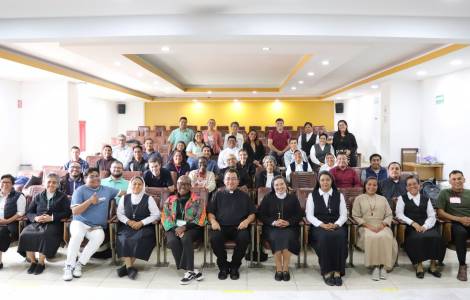
Mexico City (Fides News Agency) – "It is not the Church that has a mission; rather, it is God's mission that has a Church." This was the central theme of the reflection offered by Father John Kennedy Joseph, SVD, a Divine Word missionary, lecturer at several higher education institutions in Mexico and specialist in ecclesiology and pastoral care, during the 48th edition of the Latin American Mission Animation Course (CLAEM), one of Latin America's leading missionary formation programs.
Held from June 28 to July 24, the course offers participants a theological and pastoral exploration of the “Missio Dei” the Trinitarian initiative of God the Father, Son and Holy Spirit, who sends the Church to participate, as the sacrament of the Kingdom, in His work of reconciliation, justice and salvation throughout history.
A biblical and theological journey
Organized in Mexico City by the Pontifical Mission Societies in collaboration with the Intercontinental Institute of Missiology, CLAEM brings together diocesan mission directors, priests, men and women religious, seminarians and lay people engaged in missionary animation for four weeks of biblical, theological and pastoral formation.
The reflection on the Missio Dei begins with the great pages of the Old Testament: From Abraham's call and the liberation of the people of Israel from Egypt to the figure of the Servant of the Lord and the prophetic ministry, mission is presented as the common thread running through the whole of Scripture, preparing for the full revelation of God's plan of salvation in Jesus Christ.
During the first week, led by Sister María del Socorro Becerra Molina, HMSP, participants revisited the history of salvation as God's mercy, a God who sees human suffering, hears the cry of the poor and descends to set His people free. The sessions also highlighted the Holy Spirit as the true protagonist of evangelization, beginning with Pentecost and the Acts of the Apostles.
Mission as "the historical expression of trinitarian love"
During the second week, Father John Kennedy Joseph devoted a series of lectures to the ecclesiology of mission, highlighting that "it is not the Church that has a mission; it is God's mission that has a Church."
From this perspective, the Church's mission flows from Christ's own mission, who in turn was sent by the Father, and unfolds in the power of the Holy Spirit. "Every Christian mission is therefore Trinitarian," the speaker explained. "It has its origin in the Father, its form in Christ and its power in the Holy Spirit."
Far removed from any logic of conquest or religious propaganda, the Missio Dei, Father Kennedy said, is "the historical expression of Trinitarian love." God creates, calls, liberates, forgives, heals and reconciles, while the Church exists to serve and bear witness to this love in concrete historical contexts.
Missiology, centered on the Missio Dei, and the ecclesiology of the People of God are therefore inseparably linked: mission as an initiative of the Triune God is embodied in the Church as a historical and sacramental people through whom God's love becomes visible within cultures, territories and the world's peripheries.
The people of God, territory and the seeds of the Kingdom
Father John Kennedy Joseph then re-examined the ecclesiological renewal of the Second Vatican Council in the light of the concept of the Missio Dei, emphasizing the category of the ‘People of God’.
In the light of the conciliar Constitution on the Church, ‘Lumen gentium’, he recalled that the Church is not defined first and foremost as a perfect society, but as a mystery of communion, a people called together by God and a sacrament of salvation, in which baptism establishes radical equality amongst all the faithful.
This people is understood as a visible and historical community, rooted in specific cultures, living within concrete territories, confronting real conflicts and discerning the signs of the times among concrete peoples. Territory, therefore, is not simply a geographical space but a place shaped by the life of the people who inhabit it, with their memory, suffering and hopes.
"Jesus did not proclaim the Church first of all; He proclaimed the Kingdom. The Church exists to serve the Kingdom."
That vocation, Father Kennedy stressed, is fulfilled by finding a way to walk together. Authentic synodality, therefore, is neither a methodological innovation nor a form of "team building," but the historically lived expression of the People of God: laity, women, young people, the poor, Indigenous peoples, migrants, victims, ordained ministers and consecrated men and women, all called to discern together what the Holy Spirit is asking of the Church in service of its mission.
It is the people of a "Church which goes forth," in the terminology developed by Pope Francis, reaching out to those on the margins and serving the Kingdom in societies marked by injustice, violence and ecological crises.
For Father Kennedy, the Kingdom remains the ultimate horizon of mission. Both God's gratuitous gift and a historical task, it becomes visible wherever life, justice, reconciliation, fraternity and peace flourish, especially among the poor and the excluded, in accordance with the major insights developed after the Second Vatican Council and by the Latin American Episcopal Conferences in Medellín (1968), Puebla (1979), Santo Domingo (1992) and Aparecida (2007). (MLK) (Fides News Agency, 15/7/2026)



 Bible and cultures: Christian identity as encounter
 The Heaven opened, the Bishop’s Mission, and the Grace of being a little flock