
Information service of the Pontifical Mission Societies since 1927
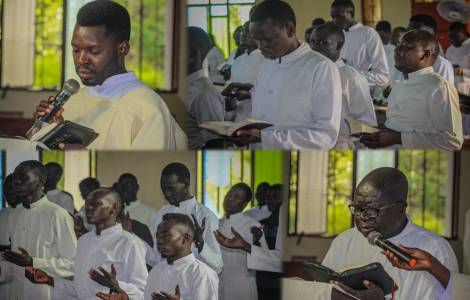
by Father Guy Bognon*
We are publishing an article by Father Guy Bognon, Secretary General of the Pontifical Mission Society of St. Peter the Apostle (POSPA), on the occasion of the 63rd World Day of Prayer for Vocations (Sunday, April 26, 2026).
***
Rome (Fides News Agency) – The World Day of Prayer for Vocations, established by Pope Paul VI and officially celebrated for the first time on Sunday, April 12, 1964, will be celebrated this year on April 26, the fourth Sunday of Easter, also known as ‘Good Shepherd Sunday.’
This special day of prayer for vocations is closely associated with the Pontifical Society of St. Peter the Apostle, which is dedicated exclusively to vocations to the priesthood and religious life in the territories under the jurisdiction of the Dicastery for Evangelization, Section for First Evangelization and New Particular Churches.
1. The World Day of Prayer for Vocations: What is it about?
Like many words stripped of their original meaning to appease consciences, the term "vocation" is increasingly understood only in its general sense as an inclination or a particular impulse a person feels toward a profession, activity, or way of life.
Consequently, there is a growing tendency to make this day a Day of Prayer for every stage of life, for every kind of vocation.
However, if we return to the context of Pope Paul VI's initiative, it becomes clear that it was not really about praying for people to feel or accept a vocation to become historians, writers, businesspeople, or painters, or for many young people to choose marriage to become husband and wife, mothers and fathers in society, since there was no shortage in these areas.
Although the term “Vocation” can also take on these meanings, the Church, in the context of a Day of Prayer for Vocations, understands it in its narrower sense as an inner movement through which a person feels called by God to the consecrated, priestly, and religious life. The primary aim of this Day was therefore to pray that many people, especially young people, would choose to become priests, men and women religious and thus proclaim Christ in the world with their whole lives.
In fact, the Pope’s first message on Saturday, April 11, 1964, on the occasion of the first World Day of Prayer for Vocations, began with the words: “so ask the master of the harvest to send out laborers for his Church” (cf. Mt 9:38). The reason for this appeal was clear: “When one casts a worried glance at the endless expanse of green fields awaiting priestly hands throughout the world, a heartfelt invocation of the Lord of the soul arises, in accordance with Christ’s recommendation.”
This appeal by the Pope, echoing Christ’s own words, stemmed from a troubling observation: the lack of shepherds and people who dedicate themselves wholeheartedly and with all their strength to the numerous pastoral needs of evangelization. It was precisely for this reason that this day was declared the “World Day of Prayer for Vocations to the Priesthood and Religious in that first message.”
(…)
This invitation to prayer is addressed to all members of the People of God, and the prayer is for all members of the People of God, so that each one, according to their abilities and role, may contribute to the emergence and flourishing of priestly and religious vocations. (...)
The prayer to which all members of the People of God are especially invited on Good Shepherd Sunday should be included in daily devotions, since the need for shepherds is felt everywhere and at all times in ever new ways. These prayers and devotions always bear fruit.
Through the formation of the local clergy by supporting diocesan and interdiocesan seminaries and religious education centers in mission territories, the Pontifical Mission Societies of St. Peter the Apostle are recording an annual increase in the number of seminarians and novices who choose the path to priesthood or religious life.
For example, if we consider the data for the 2023/24 academic year (778 seminaries with 82,859 seminarians) and the 2024/25 academic year (801 seminaries with 88,156 seminarians), there is a positive difference of 23 seminaries and 5,297 seminarians.
There are numerous explanations for this annual increase of seminaries and seminarians.
2. Some obvious reasons for the increase in priestly vocations
In general, and from a faith-based perspective, the increase in priestly and religious vocations is a tangible sign that the Lord hears the prayers of his people who turn to him in their needs, and at the same time, he assumes his share of the responsibility. As Saint Pope John Paul II stated in his Apostolic Exhortation Pastores dabo vobis: “God’s gift does not destroy human freedom, but rather awakens it, brings it to fruition, and demands it. Therefore, the Church’s total trust in unconditional fidelity to God’s promise goes hand in hand with the great responsibility of participating in the work of God, who calls us to contribute to the creation and maintenance of conditions under which the seed sown by God can take root and bear abundant fruit.” These conditions, to a certain extent, form the fertile ground that fosters priestly and religious vocations in some countries where human logic least expects it.
According to reports from seminary formators, the young people who enter the seminary often come from humble backgrounds and live in modest economic circumstances. Some of them have experienced poverty and, as a result, have developed a sensitivity to the suffering of the needy, the sick, the voiceless, the abandoned, and the humiliated. They feel a deep inner calling to dedicate their lives to serving those for whom no one else has time. Through experiencing difficult situations, they have acquired the capacity for silence, reflection, personal growth, spiritual life, and prayer. They are more open to God's quiet and gentle call, which calls them to serve others.
Places where there are many vocations are places where faith is lived passionately. Priests and religious primarily need Christians. These numerous vocations are the fruit of a vibrant faith, lived joyfully, without complexes or false shame, through the regular administration of the sacraments of baptism, communion, confirmation, reconciliation, and marriage according to the Church's rules.
Vocations arise in environments where the teachings of the Catholic Church are followed without selectively retaining only what is pleasing and comforting, and readily rejecting what is considered difficult, harsh, or outdated.
These are places where pastoral workers, priests, men and women religious easily communicate with young people through various pastoral projects and rigorous catechetical teaching; places where young people are assured that their experiences in the Church will not restrict their freedom, but rather enrich it and contribute to its full development.
These are parishes or dioceses where vocational ministry, without excessive intellectual and abstract complexity, is structured and organized within the simplicity of local realities, in order to accompany young people with devotion and love on their search for God's will for their lives. This highlights that even in these mission countries, where vocations are generally numerous, their decline or absence can be observed in parishes where priests pay little attention to young people and struggle to provide effective vocational ministry.
In conclusion, it should be noted that the regions and dioceses where minor seminaries still exist are experiencing a significant increase in priestly and other religious vocations. Their aim is “to assist the human and Christian growth of adolescents3, who manifest the seeds of a vocation to the ministerial priesthood. It develops, in a way appropriate to their age, that interior freedom by which they can make a response to the plan of God for their lives” (Ratio Fundamentalis Institutionis Sacerdotalis 2016, no. 18).
According to the Rectors, these Minor Seminaries are the most important source of candidates entering Preparatory Seminaries, Major Seminaries, Novitiates, and other educational institutions of religious orders.
In light of this increase in vocations, which necessitates the establishment of new seminaries, the Pontifical Mission Societies of St. Peter the Apostle see themselves as more deeply involved in their role and are constantly seeking ways and means to contribute to the formation of these young people who feel this special vocation to the consecrated life.
3. The Current role of the Pontifical Mission Societies of St. Peter (POSPA) in the area of Vocational formation
The formation of a young person who feels a divine vocation is not solely the responsibility of their family, let alone their home parish, but of the entire universal Church. Therefore, seminaries and religious formation centers need the generous support of all the faithful to enable candidates to receive the appropriate and necessary formation that will empower them to become pastors and missionaries of the Church. (...)
Without the support of the Pontifical Mission Societies of St. Peter the Apostle, which draws on the resources of the National Directions of the Pontifical Mission Societies, many seminaries would be forced to close today, and the establishment of new ones would be urgently needed. Establishing the necessary new seminaries would be difficult, if not impossible, and many young men with the potential for the priesthood would have to pursue a different path in life. In his Apostolic Letter commemorating the centenary of the Pontifical Mission Societies of St. Peter the Apostle in 1989, Pope John Paul II wrote: “The growth of the native clergy could be hampered by insufficient resources. Numerous bishops from mission territories testify that even today, many dioceses would have their hopes for a native clergy dashed without the assistance of the Pontifical Mission Societies of St. Peter the Apostle.” Decades later, these words of the Pope are more relevant than ever.
Based on current data, the Pontifical Mission Societies of St. Peter the Apostle granted regular subsidies for the 2024/25 academic year to the following institutions:
- 449 Minor Seminaries with a total of 53,405 seminarians, 84% of whom are in Africa and 16% in Asia.
141 Preparatory Seminaries with a total of 6,575 seminarians, of whom 77% are in Africa, 17% in Asia, 2% in the Americas, and 1% in Oceania.
211 Major Seminaries with a total of 23,312 seminarians, of whom 68% are in Africa, 21% in Asia, 1% in the Americas, and 1% in Oceania.
Alongside the ordinary subsidies for the day-to-day operation of seminaries, so-called Extraordinary Subsidies are also granted for construction projects or significant material improvements necessary for seminary life. Furthermore, to ensure the quality of candidate formation, ongoing formation sessions for seminary formators are promoted and supported in several countries. In line with this objective, scholarships are also made available at Catholic universities for the training of priests whom Episcopal Conferences assign to teaching and formation in seminaries. These scholarships are also extended to men and women religious of indigenous congregations of diocesan right, for the training of formators in their novitiates.
In addition to the seminaries where diocesan priests are trained, the Society of St. Peter the Apostle also cares for the novices of religious congregations present in mission territories,sending a modest annual contribution as an ordinary subsidy to the novitiates of religious congregations of both diocesan and pontifical right. According to the most recent data, it oversees 1,200 novitiates with a total of 7,845 novices, of whom 2,801 are men and 5,044 are women. Religious vocations are also numerous and are multiplying, especially in Africa and Asia.
It is important to note that despite the increasing vocations in mission territories, the harvest continues to grow, and the need for collaborators is becoming ever more pressing, especially in those Churches that are most in need of assistance at this time when mission is required everywhere. Every local Church is called by its vocation to consider and participate in the needs of the universal Church, and thus of all other churches, through prayer and dialogue. Whatever the need or urgency of the mission in its own territory, each Church should be able to take an interest in the lives of other Churches and to share its resources with them for the extension of the Body of Christ to the ends of the earth and until the end of time. (Fides News Agency, 25/4/2026)
*Society of Priests of Saint-Sulpice
Secretary General of the Pontifical Society of St. Peter the Apostle



 ASIA/CHINA - The Day of Prayer for Vocations celebrated with fervor by Chinese Catholic communities
 EUROPE/SPAIN - Spanish Pontifical Mission Societies celebrate the Day of Native Vocations
 Slovakia celebrates the memory of Veronika Racková, the nun and doctor killed 10 years ago in South Sudan
 ASIA/VIETNAM - A hidden treasure of faith and charity: the work of Vietnamese nuns among lepers
 Keeping the threshold of the Mystery open. Leo XIV reveals to the new priests the "secrets" of their mission
 EUROPE/AUSTRIA - Father Karl Wallner: "Faith grows together with the willingness to help others"
 AMERICA/UNITED STATES - The "World Mission Rosary" at the heart of the journey toward the beatification of Archbishop Fulton Sheen