
Information service of the Pontifical Mission Societies since 1927
CBCI
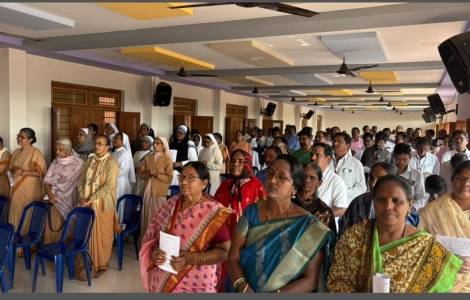
Bangalore (Agenzia Fides) - Christian faithful in India, as "proud citizens" and "authentic disciples" of Christ, contribute to India's growth, harmony, and unity, and cherish the freedom to practice their faith. However, "we witness rising inequality, ecological degradation, misinformation, polarization, and anxiety about identity and belonging," the Indian Bishops stated in the final statement of the 37th General Body Meeting of the Catholic Bishops’ Conference of India (CBCI), held from February 4 to 10 in Bangalore, on the theme "Faith and Nation: The Church's Witness to India's Constitutional Vision."
The text released today and sent to Fides states: "Genuine Christian living inspires us to be law-abiding citizens who promote peace and defend human rights. Fidelity to the Constitution of India flows from our Christian faith and our commitment to the common good, freedom of conscience, the dignity of every person, and the protection of India’s plural, secular, and democratic character. The socially uplifting initiatives of the Church spring from our deep rootedness in Christ and our faithfulness to the Constitutional values. We encourage all the faithful to continue participating actively in nation-building, guided by truth, compassion, and moral courage." " At a time when freedom and human rights are increasingly disregarded," the Bishops note, "we reaffirm our faith in the Constitution of India which envisions our country as “a sovereign socialist secular democratic republic” which secures to all its citizens “justice, liberty, equality, and fraternity” (Cf. Preamble to the Indian Constitution). Whenever Constitutional rights are unjustly restricted, particularly concerning the poor, the marginalised, the Dalit and tribal people, it is important to advocate for the protection of fundamental rights for all individuals, regardless of caste, creed, and language."
In particular, "the denial of rights to Dalit Christians continues for decades as an indirect form of discrimination, despite numerous appeals for equality and justice." Therefore, "we express our concerns about the denial of rights to the minorities, as such acts weaken the democratic fabric of our society. While maintaining our commitment to eliminate any type of discrimination existing in the ecclesial communities based on caste or language, we urge the Government to ensure that no citizen is denied of fundamental rights of equality and freedom."
The text makes an explicit request to civil authorities: "As many innocent individuals are incarcerated based on unfounded allegations of forceful religious conversions, we strongly demand the repealing of legislations which are inconsistent with religious freedom and right to privacy. Article 25 of the Constitution guarantees that, “all persons are equally entitled to freedom of conscience and the right to freely profess, practice, and propagate religion”. Let us remember the great example of Mahatma Gandhi whose entire life was for forming “an India in which the people shall feel that it is their country, in whose making they have an effective voice, an India in which there shall be no high class and low class of people."
Two points in the text are dedicated, respectively, to the commitment "to accompany youth through leadership formation, civic education, and ethical engagement and encourage them to participate actively in public life and democratic processes; and to the "option for the poor": The Bishops recall "the vital role of Christian educational and social institutions in forming conscience, and ethical leadership. Academic excellence must be inseparable from inclusivity, justice, and a preferential option for the poor." They state: "We uphold the vision set by Pope Leo XIV: Wherever access to education remains a privilege, the Church must push open doors and invent new pathways because to ‘lose the poor’ is to lose the very meaning of the school.”
Furthermore, "in a context of polarisation and mistrust, we maintain the Church’s calling to foster dialogue, reconciliation, and fraternity. The Christian faith has always inspired us to seek the way of forgiveness whenever we have been deprived of human dignity and rights. We take upon sustained inter-religious dialogue and civil-society engagement," the church leaders state.
"Rooted in Christ and faithful to the Constitution," the text concludes, "we recommit ourselves to be a Eucharistic presence in the heart of the nation, serving the common good with humility, courage, and wisdom, in solidarity with all people of goodwill, working for a just, inclusive, and fraternal India." (PA) (Agenzia Fides, 10/2/2026)



 ASIA/MALAYSIA - Malaysian Ambassador Assan: "Respect for international law, and the protection of human dignity is the path to peace in the Middle East and Southeast Asia"
 AMERICA/COLOMBIA - The results of the legislative elections reveal new trends ahead of the presidential elections