
Information service of the Pontifical Mission Societies since 1927
SVD
Mumbai (Agenzia Fides) - The Society of the Divine Word (SVD) missionaries are committed to walking alongside tribal people and tackling child marriage in the Indian state of Maharashtra, in central-western India. As Divine Word missionary Fr. John Singarayar SVD, anthropologist and sociologist, reports to Fides, "the Society of the Divine Word, through its Justice, Peace and Integrity of Creation Commission, has been addressing one of India's most persistent social ills in the Raigad district for over a decade: child marriage."
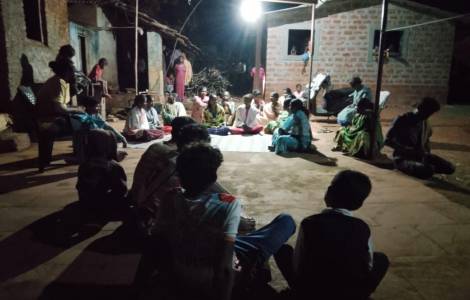
As Fr. Singarayar explains, the "Janseva Society," an initiative of the Justice, Peace, and Integrity of Creation commission (JPIC) of the Verbite Province of Mumbai, established in collaboration with the Archdiocese of Bombay, recently concluded a month-long door-to-door awareness campaign, that reached deep into areas where government services rarely penetrate and ancient customs often trump legal provisions.
The numbers are sobering. A recent study across twenty Katkari settlements in neighbouring Mangaon block found 111 boys and 81 girls married before the legal age among just 258 households. The Katkaris, designated as a Particularly Vulnerable Tribal Group, face crushing poverty compounded by landlessness and forced migration for work. Children’s education fractures and eventually stops, leaving adolescents vulnerable and families viewing early marriage as inevitable.
The caste issue comes into play: "We found settlements two kilometres from the nearest school, located in upper-caste villages where Katkari children feel unwelcome," Fr. John Singarayar SVD explained, who has worked in the region since the Janseva Mission began. "By twelve or thirteen, most children have abandoned education entirely. That is when the real vulnerability begins," he explains.
What sets the SVD mission’s approach apart is its commitment to accompaniment rather than judgement. Rooted in the Gospel vision of justice and compassion, the work seeks to make Christ present among the marginalised through genuine solidarity and systemic change. "We do not come as outsiders telling people what to do,” said Manisha Kapare, who is a Katkari herself and a campaign coordinator with Janseva Society. "We sit with families," he explains, "listen to their struggles, and help them see connections between early marriage and the suffering they already know—girls dying in childbirth, babies who do not survive, young couples trapped in impossible poverty."
SVD workers networked extensively with local officials and village leaders, building bridges between faith-based social action and local governance, thus making the campaign much more effective. "This is JPIC work in action," Fr. John Singarayar observes. "Justice means confronting structures that crush human dignity. Peace means creating conditions where families do not have to choose between survival and their children’s welfare. And the integrity of creation includes protecting childhood itself as sacred."
The month-long campaign covered eighteen hamlets, reaching over 100 families. Volunteers engaged elders, spoke separately with young people, and addressed mothers who often hold quiet influence over family decisions. They explained that legal marriage ages are not ‘arbitrary’ bureaucracy but safeguards built on medical evidence and human welfare.
The response exceeded expectations. Several village elders pledged to discourage child marriages within their communities. Three families postponed weddings they had been planning. Young girls who had never been asked about their own futures began voicing hopes to continue studying.
Janseva Society, officially inaugurated on 26 January 2013, represents the congregation’s long-term commitment to Tala Taluka’s most marginalised communities, combining pastoral care with social engagement. The Janseva Society plans to expand the campaign to neighbouring tribal areas while maintaining follow-up visits in covered hamlets and is also focused on education access, livelihood training, and women’s empowerment in tribal regions. (PA) (Agenzia Fides, 24/1/2026)



 AMERICA/CUBA - Caritas continues distributing humanitarian aid: “We cannot reach everyone, but we want to remain close to those most in need”
 LEO XIV IN SPAIN - The Pope in the port of Arguineguín: “Every individual that arrives asks us what remains of our humanity”
 AFRICA/MALAWI - Archbishop Nwachukwu at the Jubilee marking 125 years of the Gospel in Malawi. Two new priests for a Church called to set out anew on mission
 VATICAN - Tribalism and the Church, Archbishop Nwachukwu to new bishops: “A bishop is not bishop of one group or another; he is bishop of all”
 ASIA/VIETNAM - The Fragility of Marriage in Modern Society and the Courses of "Renewal in Married life" Organized Across Vietnamese Dioceses
 ASIA/PAKISTAN - Child marriage now illegal in Balochistan