
Information service of the Pontifical Mission Societies since 1927
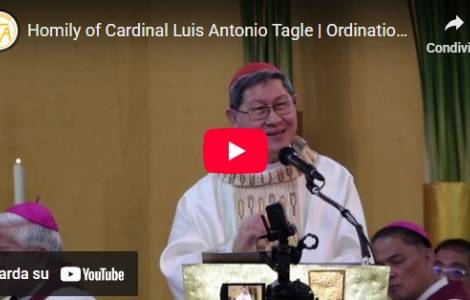
Manila (Agenzia Fides) – Bishops are successors of the Apostles. And the apostolic succession they receive at the moment of their episcopal ordination is a succession in the mission that Jesus himself entrusted to his Apostles before ascending to Heaven.
Cardinal Luis Antonio Gokim Tagle emphasized this point, highlighting the essential factors that characterize the unique nature of apostolic succession, recalling that the office and ministry of every bishop originates in the mission to proclaim salvation, which Christ himself entrusted to his Church.
The occasion to once again highlight the special character of the ministry of Bishops, the Successors of the Apostles, was the episcopal ordination of Samuel Naceno Agcaracar as Bishop of San Jose in Nueva Ecija, in the northern Philippines.
The episcopal ordination liturgy, presided over by Cardinal Tagle, Pro-Prefect of the Dicastery for Evangelization (Section for First Evangelization and New Particular Churches), was celebrated on Saturday, January 17.
"Many," Cardinal Tagle said in his homily, "ask what a bishop is. And we bishops also ask ourselves: who are we?"
To answer this question, the Cardinal drew inspiration from the Gospel reading chosen for the ordination liturgy: the end of the Gospel according to Matthew, where the risen Christ entrusts the eleven apostles he met in Galilee with the mission of teaching “Go, therefore, and make disciples of all nations, baptizing them in the name of the Father, and of the Son, and of the holy Spirit,” promising to be with them “always, until the end of the age.”
The Apostles, Cardinal Tagle explained, are people "sent" by Christ. And every Bishop is sent to continue the mission entrusted to the first Apostles.
Through Apostolic Succession, Bishops do not receive prestige or privileges per se, but rather the same mission entrusted by Christ to the first Apostles.
And the episcopal office, as the Pro-Prefect of the Missionary Dicastery commented, "is not a reward for good performance, nor a promotion to a more prestigious rank. It is a mission."
And just as the Apostles were "sent by Christ," so too must every Bishop, writes Leahna Villajos on the Radio Veritas Asia website, quoting the Cardinal, "live the tension between remaining with Jesus and being sent by Him. 'You remain by going, and you go still remaining with Jesus.'"
An authority to be exercised by embracing one's weaknesses
Bishops, in their mission, are also called to exercise their episcopal authority. But “we are not called to supplant the authority of Jesus,” Cardinal Tagle emphasized.
All authority remains with Christ. The same authority with which he worked through the weaknesses and limitations of the first apostles and made them missionaries.
"Embracing your weakness," Cardinal Tagle said, addressing the new Bishop Agcaracar, a member of the Society of the Divine Word (SVD Missionaries), "will not diminish your episcopal mission and authority." While "the bishop who cannot empathize with the weakness of others usurps the authority of Jesus."
Bishops for all nations
In the final part of his homily, Cardinal Tagle, recalling the end of the Gospel according to Matthew, recalled that Bishops, Successors of the Apostles, are called to "go and make disciples of all nations," and to exercise their local mission in the communion that unites the universal Church. (GV) (Agenzia Fides, 19/1/2026)



 Letter from the Dicastery for Evangelization to Cardinal Tagle “on the occasion of the death of his beloved father”
 Cardinal Tagle to the new Bishops of the new Churches: let us walk together in this time of “missionary conversion”
 The Course in Nemi: an open laboratory on the Bishops’ “missionary mandate”
 The Centenary of the consecration of Six Chinese Bishops and the Provisional Agreement between the Holy See and the People’s Republic of China
 ASIA/CHINA - The pastoral dynamism of the new Bishop of Chifeng
 AFRICA/MALAWI - Archbishop Nwachukwu at the Jubilee marking 125 years of the Gospel in Malawi. Two new priests for a Church called to set out anew on mission
 POPE IN FRANCE/VI - Leo XIV in Paris: A missionary topography