
Information service of the Pontifical Mission Societies since 1927
by Gianni Valente
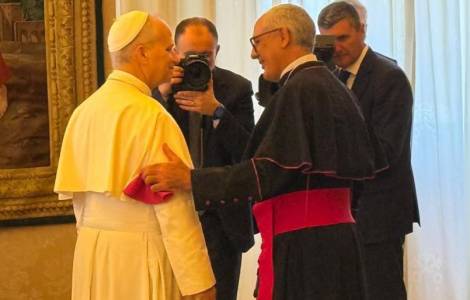
Rome (Agenzia Fides) – “To live ‘ad instar Apostolorum,’ that is, in the manner of the Apostles, with simplicity, courage and total openness to being led by the Lord.” This was the first piece of advice that Pope Leo XIV addressed to the Bishops of the Church in Peru, his “adopted Church,” received in Rome for their "ad limina Apostolorum" visit. This advice “appears in many of the writings of the first missionaries in America,” the Bishop of Rome explained in his address to the Peruvian prelates, received in audience on Friday, January 30.
The days spent in Rome by the Peruvian Bishops, as well as their various meetings with the Pontiff—who spent more than 22 years of his life in Peru, first as an Augustinian priest and then as a bishop—were marked by a strong missionary zeal. This characteristic was reinforced by the presence of the Bishops who lead the eight Apostolic Vicariates of the Peruvian Amazon.
“We are very proud that Pope Leo XIV received us and encouraged us to continue in the task of building the Amazonian Church,” Bishop Miguel Ángel Cadenas Cardo, Apostolic Vicar of Iquitos, told Fides. Of Spanish origin and also a member—like Pope Leo XIV—of the Order of Saint Augustine, Bishop Cadenas vividly describes the mission undertaken by the ecclesial communities in the Amazon ‘ad instar Apostolorum,’ in the manner of the Apostles.
You made the ad limina visit to the tombs of the Apostles in Rome after participating in the Ecclesial Assembly of the Peruvian Amazon. How does the experience of the Apostles illuminate your mission?
MIGUEL ANGEL CADENAS CARDO: At a certain point, Saint Paul went to Jerusalem to see the Apostles and confirm his mission among the pagans. Similarly, we recently held the second Assembly of the Vicariates in Peru, where more than 100 of us discussed the various aspects of the life of the Church. And now we have come to Rome for our ad limina visit to present ourselves to the Pope, confirm our faith, draw strength, and continue the work we have undertaken to ensure that Christian communities are rooted in the faith of Peter, which today is Pope Leo XIV.
During the meeting, did Pope Leo XIV offer you any guidance or point out priorities for the apostolic work in the Amazonian Vicariates of Peru?
CADENAS CARDO: The Pope's role is to confirm us in the faith and encourage the bishops to continue our evangelizing work. Pope Leo XIV listened to us this morning during the meeting with the entire Peruvian Episcopal Conference. On that occasion, I asked him for a word about the mission, and with great warmth, he emphasized the need not to abandon the mission and the missionaries, and to ask the entire Church in Peru to accompany and support the Apostolic Vicariates as well.
The Church of Rome's concern for the Amazonian communities was also expressed during Pope Francis's pontificate in the Synod on the Amazon and in the Apostolic Exhortation Querida Amazonia. In what way did Pope Leo XIV personally continue this preferential attention?
CADENAS CARDO: Certainly, the Amazon Synod was a very important event for the Church in the Amazon, which was convened and held during Pope Francis's pontificate. But Pope Leo XIV encourages us to continue along this path as well. In fact, on the morning of Friday, January 30, he received the entire Episcopal Conference, and in the afternoon we had requested a special audience for the Amazonian bishops. We spent 45 minutes talking with him about the various challenges and joys within the Amazonian Church. We are very proud that Pope Leo XIV received us and encouraged us to continue the task of forming the Amazonian Church, accompanying Christian communities, and maintaining our faith in Jesus Christ.
You are working on developing a unified pastoral plan. Where does this need arise, and what will the specific characteristics be?
CADENAS CARDO: One of the most important characteristics of the Amazon is its diversity. We see this in issues of biodiversity and socio-diversity. But the Church, since the time of the New Testament, has also been a Church in which diversity is evident. The communities addressed in the Letters of Peter or Paul are not the same as those addressed in the Gospel of John or the Gospel of Mark, to give just a few examples. Therefore, diversity exists within the Church, so much so what Pentecost brings about is that each person, speaking in their own language, recognizes Jesus as our Lord.
The Amazonian Church, recognizing this diversity, also needs to work together on some important aspects, given the scarcity of clergy, religious life, and overall lack of religious activity. Therefore, we need to focus on ministries that allow Christian communities to move forward. But we also have another commission on theology and liturgy, another on indigenous peoples, on youth, on education, and so on, addressing various topics that allow us, within the great diversity of the Church, to agree on how we will continue working in all the Apostolic Vicariates. It is an ongoing process of sharing all this heritage in order to foster evangelization.
At the Assembly of the Amazonian Vicariates, the proposal to create a “school of missiology” also arose. What purpose could such a school serve in the Amazon?
CADENAS CARDO: The proposal refers to a school of missiology that would allow missionaries arriving in the Amazon to learn basic principles so they can then serve as missionaries in this region. But I believe we should also go further, given that it is increasingly difficult for missionaries to arrive. We also need Amazonian missionaries to sustain the diverse Christian communities we have in our territories. Of the eight apostolic vicariates in Peru, the smallest covers 70,000 square kilometers, while the largest cover 150,000 square kilometers each. This means they are very large territories, vast, with many challenges, with the presence of indigenous peoples, with growing cities, and therefore, what we Amazonian bishops believe is that mission is an integral part of the life of the Church, and a school of missiology is always important, learning from the greats, for example, Saint Paul and many others.
You were born in Spain and, like Pope Prevost, belong to the Order of Saint Augustine. What particular emphasis characterizes the mission of the Augustinian community in Peru?
CADENAS CARDO: The charism of the Augustinians is precisely community, and the Church is above all a community. Therefore, the emphasis we Augustinians place is that evangelization is not the work of a single person, but of the entire Augustinian community and the entire Church. In this sense, a visit to Rome is very important to reaffirm our faith, the faith in which Pope Leo XIV sustains us, and to continue afterward in each of our spheres the essential task of proclaiming Jesus Christ and bearing witness to him. We must do so keeping in mind that we are not merely individuals, but a community. This also allows us greater discernment, because we must reach agreements, and we do not always think alike. But this task of discerning, of seeking God's will, is part of life in community and part of the life of the Church. As Augustinians, we are proud that Pope Leo XIV is part of our Order, and we want to put this charism, in which we have grown and continue to live, which is precisely that of community, at the service of the entire Church. (GV) (Agenzia Fides, 2/2/2026)



 AMERICA/VENEZUELA - Prayers and relief efforts by the Venezuelan ecclesial community in the wake of the earthquake tragedy
 Cardinal Chow: "Sinicization" requires reflection based on knowledge, not rejection based on ignorance
 Here's how Sweden is quietly rediscovering itself as a "land of mission"
 EXTRAORDINARY CONSISTORY - Leo XIV: "Mission is not one of the many tasks of the Church. It is the very reason for her existence"
 Sixth General Assembly of the Ecclesial Conference of the Amazon (CEAMA). “Something new is being born”
 AMERICA/COLOMBIA - Pope Leo XIV: May Jesus Christ be announced with clarity and immense charity among the inhabitants of the Amazon