
Information service of the Pontifical Mission Societies since 1927
by Pascale Rizk
Nagasaki (Agenzia Fides) - It was the year 1549 when Francis Xavier landed in Kagoshima. Although he was not the first European to set foot on Japanese soil, which had already been reached by traders, the Jesuit saint was the first to stay and proclaim Jesus and his Gospel to the inhabitants of that land. The fruits of his mission are still numerous today, as the Italian priest Andrea Falcinelli, an Italian priest of the Diocese of Senigallia, who shared his thoughts and memories of his trip to Japan with Fides.
In Japan, Catholics make up 0.3% of the population, while Christians make up 1%. It is in this context that the Italian nun Luigina Buti of the Canossian Sisters, born in Vaccarile in the Diocese of Senigallia, lives with her fellow nuns (one English, two Indonesian, and four Japanese) in Ōmuta, in the province of Fukuoka. Here they work at the private girls' middle and high school "Meiko Gakuen" in Ōmuta. The sisters of the Institute of the Canossian Daughters of Charity, founded in 1808 by Saint Magdalene of Canossa for education and service to the poor, continue their original mission by dedicating their lives to charity and education, the care of the elderly and the sick, and social justice throughout the world.
The school, run by the Canossian sisters, is well-known in the region and is attended by approximately 300 students. "Because school in Japan is not just a place of learning, but also includes many extracurricular activities that take up the entire day, it is not easy to establish church groups that offer paths and experiences of fraternity and sharing," explains Father Andrea, thus emphasizing the importance of Catholic schools in the region. Various women's and men's religious orders, as well as parishes, have dedicated themselves to working in Catholic schools in Japan and opened private schools and kindergartens to impart the experiences and life that flow from the Gospel to the younger generations.
An hour's drive from Ōmuta, in the small town of Kikuchi, lives the 70-year-old Xaverian missionary Father Silvano da Roit, born in Bergamo. He is not only a religion teacher at the same school and the nuns' confessor, but also the parish priest of a small parish of 87 faithful and a great connoisseur of various aspects of Japanese culture. He has written texts that can be found on the website of the Xaverian Fathers' Asian Studies Center. Among other things, he regularly visits prisoners and maintains correspondence with them.
Also dear to everyone's heart is the figure of Father Giuseppe Piazzino of the Pontifical Institute for Foreign Missions (PIME). He was ordained a priest on March 30, 1963, along with about a hundred other deacons in Milan Cathedral by Cardinal Giovanni Battista Montini. A year later, more than 60 years ago, he set off for Japan full of enthusiasm. A native of Pradalunga, Father Giuseppe, at 88, still serves as chaplain at Saint Mary's Hospital in Kurume, about 40 kilometers from Fukuoka.
Another PIME missionary, the Auxiliary Bishop of Tokyo, Andrea Lembo, has been on site for almost 20 years. "Meeting each of these missionaries has enriched my journey. The conversation with the bishop allowed me to hear another interesting missionary testimony, that of a more contemporary perspective, from someone in touch with young people and the metropolitan environment, who looks to the future of this Church without nostalgia for the past," reports Father Andrea.
Today, Father Falcinelli is vicar of the parishes of Serra de' Conti, Piticchio, Montale, and San Ginesio-Sant'Apollinare d'Arcevia in the Diocese of Senigallia, diocesan delegate for ecumenism and interreligious dialogue, and is continuing his doctoral studies with a dissertation on the patristic concept of the person in relation to theological inculturation in areas particularly marked by Buddhism. His trip to Japan, intended to promote exchange in the context of Far Eastern religiosity and spirituality, included visits to the martyrdom sites of the Japanese Jesuit saint Pietro Chibe and the Palermo priest Giovanni Battista Sidotti in Tokyo, as well as Buddhist and Shinto temples. He also visited the city of Hiroshima and its memorial to the victims of the atomic bomb dropped by the US Air Force at 8:16 a.m. on August 6, 1945, and Nagasaki, where another atomic bomb was dropped at 11:02 a.m. on August 9.
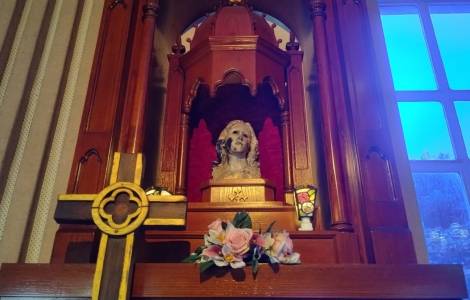
Historically, Nagasaki is the heart of Japanese Catholicism, and Christians there now make up about 4% of the population. Two places speak directly to the heart: The first is the new cathedral (built in imitation of the bombed cathedral), which houses a statue of the Virgin Mary marked by the atomic bomb. It was in front of this church that the Christians of Nagasaki prayed and found comfort and hope in the Virgin Mary, who bears the marks of their greatest and most gruesome wound. The second place is the small house built after the bombing by Paul Takashi Nagai (1908-1951), where he lived with his children. He called it Nyokodō, "a place of love for one's neighbor as for oneself."
Paul Nagai was a secular doctor who converted to Christianity in his youth and became ill from atomic radiation. On August 9, 1945, despite the pain of seeing his house and wife pulverized, he immediately set out to help those injured by the atomic devastation. A doctor who contracted leukemia because of caring for others, and who tirelessly continued to write, draw, and study while lying at his sickbed, grateful to be alive and to work. A man whose thoughts alleviated the suffering of an entire city and an entire people.
In Nagasaki, a thriving community developed during the "Christian Century," producing numerous martyrs and confessors of the faith in the decades of persecution that followed. Also enshrined in the memory of the Church in Japan is the date of March 17, 1865, when the "hidden Christians," after the long period of "national closure" ("sakoku") (1641-1853), revealed themselves to Father Bernard Petitjean of the Paris Foreign Mission, chaplain to Western merchants. During these two hundred years, no one outside Japan knew whether, given the violent persecutions, there were still Christians in the Land of the Rising Sun. It is said that when Pope Pius IX received the news, he burst into tears, and that with him, all of Europe was moved by the witness of Japanese Catholics who had preserved their faith for generations without the spiritual support of a priest. After identifying themselves, these Christians were subjected to the final violent repression. "The encounter with such marked cultural and geographical otherness makes me question what it means to be a 'people,' both in the singular and in the plural (there is not only 'the people,' but also 'the peoples'). The word seems to suggest that there is no other basis for an authentic people, one that is not exclusive but fraternal, than a common, original vocation from the Father." And that, in a certain way, the peoples also have a special historical vocation for the benefit of all others, in the light of the Holy Spirit and in the communion of the Church (ekklesia means "called-out ones")," concludes Father Andrea Falcinelli. (Agenzia Fides, 1/10/2025)



 POPE IN FRANCE/VI - Leo XIV in Paris: A missionary topography
 The Course in Nemi: an open laboratory on the Bishops’ “missionary mandate”
 EUROPE/ITALY - “All for One”: Missio Ragazzi launches new formation programme for 2026-2027
 AFRICA/MALAWI - Course for minor and major seminary formators promoted by the Pontifical Mission Societies
 The Church of the Sheaves: a missionary perspective presented to Newly Ordained Bishops
 ASIA/CHINA - Andrew Ding Yang ordained Archbishop of Chongqing
 ASIA/SOUTH KOREA - Catholic Culture Fair in Seoul serves as a “trial run” ahead of World Youth Day 2027
 Cardinals Vesco and Marengo: "At the school of the Acts of the Apostles, in the deserts of the world"
 Pope to Latin Catholic Bishops in the Arab Regions: “Do not be afraid of your smallness”
 Cardinal Vesco: in Algeria, Augustine is also a “universal brother”