
Information service of the Pontifical Mission Societies since 1927
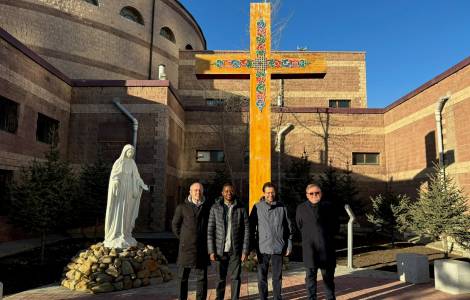
photo credit CCM
by Marie-Lucile Kubacki
Ulaanbaatar (Fides News Agency) – “I have an adequate knowledge of the Tartar language and script, which is the usual language of the Tartars, and now I have translated into that language and script the whole of the New Testament and the Psalter and have had it written in beautiful characters.” These lines were penned by the Franciscan Giovanni da Montecorvino in a letter sent to Europe from Khanbalik, present-day Beijing, in the early 14th century.
The text is included in the anthology “Mission to Asia”, edited by the historian Christopher Dawson. Having reached the city in 1294, the friar built a church there “with a bell tower and three bells” and reported having baptised “about 6,000 persons”. His account contains, writes Bible translator Bayarjargal Garamtseren in a history of Mongolian Bible translations published in 2009 in The Bible Translator, “the very first written mention” of a translation of the Scriptures into that language. In another letter, the Franciscan expresses his loneliness and his longing to receive even a single greeting from his fellow friars.
Centuries later, on the borders of the Russian Empire, Garamtseren explains, a new chapter opened. In 1815, the Gospel of Matthew was published in St Petersburg in Kalmyk, translated by the Moravian missionary Isaac Jacob Schmidt. Working with two Buryats, Nomtu and Badma, Schmidt subsequently produced a Mongolian New Testament, published in 1827.
In Selenginsk, Buryatia, London Missionary Society missionaries Edward Stallybrass and William Swan worked for years on biblical translation with the help of local collaborators, including learned lamas. The Old Testament was printed in 1840; a New Testament followed in London in 1846. Together, they constituted the first complete Bible in Mongolian. Its language sought a middle ground between everyday correspondence and the more difficult style of Buddhist scriptures, as the missionaries explained in 1833, in a passage quoted by the historian Charles Bawden.
In the modern era, a New Testament in Cyrillic appeared in 1990, followed, through a separate translation project, by a complete Bible in 2000.
It is this long history that Ulaanbaatar is commemorating on 12 and 13 November, with a conference marking two anniversaries chosen by the organisers: 720 years since the first translation of the Scriptures into Mongolian and 180 years since the publication of the first complete Mongolian Bible.
The conference is organised by the Mongolian Union Bible Society (MUBS), whose General Secretary is Bayarmagnai, together with departments at the National University of Mongolia and the Mongolian Academy of Sciences, and the National Library of Mongolia. The sessions were held on November 12 at the Chinggis Khaan National Museum. The conference moved to the conference hall of the National University of Mongolia Library on November 13. An exhibition on Bible translation is also on display at the BlueMon Center.
Catholic participants include Archbishop Flavio Pace, Secretary of the Dicastery for Promoting Christian Unity, and Father Jan J. Stefanów SVD, General Secretary of the Catholic Biblical Federation (CBF). They are being hosted by Cardinal Giorgio Marengo, Apostolic Prefect of Ulaanbaatar.
The Federation’s participation builds on contacts established in July 2025 in Ulaanbaatar. On that occasion, the Catholic Affinity Group of the United Bible Societies brought together its Catholic contacts from Asia in the Mongolian capital. “At first I only wanted to join online, but Cardinal Marengo insisted that I come in person,” says Father Stefanów. “I travelled from the United States to spend two days in Ulaanbaatar, and it was worth it: we established a contact with the Bible Society of Mongolia, and that meeting has borne fruit.”
In March 2026, a delegation from the Bible Society visited Rome. It asked the CBF to help arrange a meeting with Cardinal Koch and visits to the Vatican Apostolic Archive and the Vatican Library, in search of documents relating to the first translation of the Bible into Mongolian. The delegation was already preparing the conference for the two anniversaries.
In his contribution to the conference, Archbishop Pace addressed the Catholic understanding of divine revelation through the teachings of the First and Second Vatican Councils. He also presented manuscripts relating to the Bible and lectionaries from the Vatican Apostolic Library and the Ambrosian Library in Milan, opening up possibilities for further study and collaboration with the latter institution.
The Apostolic Prefecture’s programme combined the conference with opportunities to encounter the country’s social and religious life. “Cardinal Marengo prepared the visit very well,” observes Father Stefanów. “He let us see the social and religious reality of Mongolia up close: a family living in a ger, the cathedral, a home for children, a Buddhist monastery and its leaders.”
On the morning of Friday, November 13, Archbishop Pace also visited the House of Mercy, blessed by Pope Francis during his Apostolic Journey to Mongolia and established also thanks to the support of Catholic Mission Australia, the Australian Pontifical Mission Societies (see Fides, 12/7/2023).
He described it as “a very beautiful, very moving reality, in which the meaning of being Church as charity is truly expressed”. This charity, he explained, “is not simply doing good, but doing good by restoring people’s dignity”, through the way they are welcomed and helped. The visit also provided an opportunity to consider possible forms of collaboration.
Biblical work was at the heart of the discussions. The Catholic Church has collaborated with the Bible Society since the episcopate of Wenceslao Padilla, and in February 2024 the two institutions reached an agreement to translate the deuterocanonical books, which are not included in the edition based on the Protestant canon. A working meeting at the Prefecture on 11 November reviewed the progress of this translation, which is intended to make an ecumenical edition possible.
For Archbishop Pace, this cooperation also explains the significance of his presence at the conference: “Collaboration on the Bible is one of the areas in which ecumenism can be taken forward.” In Mongolia, he noted, translations are principally undertaken by evangelical or Protestant communities, while the Catholic Church is also involved and wishes to deepen its participation in this shared work.
Father Stefanów also says that the Federation will make its resources available for the formation of biblical scholars and local people. The discussions also addressed the development of biblical pastoral ministry in Mongolia. The Apostolic Prefecture has been a full member of the Federation for several years. The outlook already extends beyond Mongolia. Cardinal Marengo, president of the Bishops’ Conference of Central Asia, has invited the CBF General Secretary to return for the regional bishops’ meeting in Ulaanbaatar in 2027, to present the Federation’s work and its approach to biblical pastoral ministry. Outside Mongolia, the Federation currently has no members in Central Asia.
“It has been a very positive and very fruitful meeting,” concludes Father Stefanów. “We hope it will bear fruit in the development of biblical work in Mongolia and in all of Central Asia.” (Fides News Agency, 13/11/2026)



 Bible and cultures: Christian identity as encounter
 An "interactive" New Testament for Gen Z
 The feast of the Transfiguration of the Lord Jesus in a world disfigured by war
 Bishop Martinelli at the Inter-Christian Symposium in Thessaloniki: Migrants have made the Arabian Peninsula a “Laboratory of an Intercultural Church”
 POPE LEO XIV IN PERU/IV - “Jesus, I trust in you”: The Pope embraces Peru’s young people
 WYD Seoul 2027, Father Justin Choi Inbi: “We are preparing to welcome those who will come, without forgetting the young people who are always with us”