
Information service of the Pontifical Mission Societies since 1927
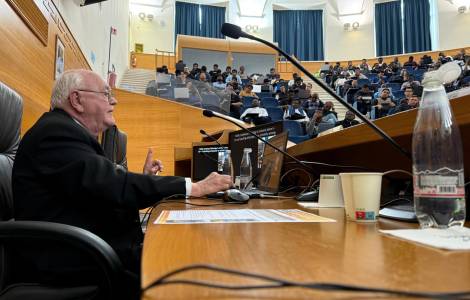
Stephen Bennett. Bevans, SVD, is an American Catholic theologian and missiologist, professor emeritus of mission and culture at Catholic Theological Union in Chicago, and one of the key architects of contemporary contextual theology. Author of the now classic Models of Contextual Theology and of numerous studies on mission as “prophetic dialogue,” he argues that “all theology is contextual” and that the Christian tradition is made up of local theologies in dialogue.
On the occasion of a study day on contextual theology held on 12 May at the Pontifical Urbaniana University in Rome, Professor Bevans gave an interview to the Fides News Agency. In it, he returns to Pope Francis’ apostolic constitution Ad theologiam promovendam, which he reads as a magisterial turning point toward a “fundamentally contextual” theology, rereads the history of theology from Nicaea to Vatican II as a succession of situated responses, and describes what he calls a “new catholicity,” in which experiences and categories coming from Asia, Africa, or from European and North American societies enter into a critical and fruitful dialogue.
Professor Bevans, You interpret Pope Francis’ Ad theologiam promovendam as a true magisterial turning point toward a “fundamentally contextual” theology. How do you understand this paradigm shift precisely, and in what way, in your view, does it go beyond the classical language of “inculturation”?
Some present inculturation as a kind of overarching framework of which contextual theology would be only one aspect. For my part, I would say exactly the opposite. Inculturation deals mainly with culture, which is certainly an essential dimension, but contextual theology is much broader.
What Pope Francis — and also Pope Leo XIV — highlight, it seems to me, is a shift toward a more comprehensive consideration of contexts, including their interdisciplinary dimensions. In this way we move beyond a sometimes slightly romantic understanding of culture, reduced to visible elements such as dance, food, or certain traditions.
Contextual theology also includes realities such as the experience of women, that of the poor, and contemporary political situations: a faith that unfolds in time, in history, in concrete contexts. These are not simply cultural elements, but they are essential for theological reflection. Consequently, every theology necessarily becomes contextual. When I preach, whether in Africa or in New York, I have to say something that makes sense to the concrete people who are listening to me today.
You state that “there is no such thing as theology, but only contextual theologies,” and that the Christian tradition is a series of local theologies. How do you respond to those who fear that this thesis weakens the unity of faith? Are these resistances and fears still strong today?
Yes, these resistances are very strong. And I notice that very often they arise from a poor knowledge of history.
If we look at the Council of Nicaea in 325, we see that it took a considerable risk: the Fathers of the Council decided to move beyond the Bible’s language alone — without abandoning the Bible — and to draw on the philosophy of their own time, in order to respond to questions that Scripture itself could not formulate in those terms. It was a radical and deeply contextual choice.
In the same way, Vatican II, with Gaudium et spes, marks a turning point by affirming that “nothing genuinely human” is foreign to Christians. This is a complete change compared with, for example, certain forms of the French spiritual tradition marked by fuga mundi, flight from the world, the idea that one must keep one’s distance from the world. Here the Council moves toward an attitude of taking on and embracing what is human.
In fact, the whole history of theology shows that it is shaped by particular contexts. Paradoxically, in this sense contextual theology is very traditional. Take the Council of Trent: there was almost a decision to authorize liturgies in local languages. But the Fathers said to themselves, “We cannot do that; that is what the Protestants do.” So they kept Latin. That decision is understandable only in that particular context. Otherwise we would probably have had vernacular liturgy for five hundred years. The choice can be explained only by the context of the time.
In your own journey, what was the decisive moment — or experience — that convinced you that contextualization was not merely a methodological option, but a theological imperative for the Church today?
I look back to two key experiences in my life. I also talk about them in the first chapter of my book on contextual theology, Models of Contextual Theology (1992, revised edition 2002, Orbis Books).
The first goes back to my student years here in Rome. I was giving a reflection for the First Sunday of Advent on Christ as the light of the world. I used the Beatles’ song Here Comes the Sun to speak about the light that Christ brings to the world. Among those present was an Indian. He said to me: “That’s very beautiful for you in America or in Europe. But for us in India the sun is an enemy: it is so hot that we have to protect ourselves from it.” At that moment I began to realize that people see the world differently, depending on their cultures and their experiences.
The second experience dates from my arrival in the Philippines, after my ordination and the completion of my licentiate at the Gregorian University. In the first days a friend asked me: “Steve, have you come to teach Roman theology or Filipino theology?” That question struck me deeply. I began to read about Filipino culture, about the country’s history, to immerse myself in that context. I understood how important that was.
I cannot say that I succeeded very well in elaborating a truly Filipino theology — I was young, I did not yet know very well how to do it — but for me it was a moment of conversion. I did not want to teach “Roman” theology. I wanted to teach a theology that made sense to the people I was addressing, so that they themselves could announce the Gospel in a meaningful way to the people among whom they lived.
You speak of a “new catholicity” in which local theologies enter into a critical and fruitful dialogue with one another. Do you have concrete examples of this kind of inter contextual dialogue? Is it already a reality, or is it still largely to be built?
It is perhaps still more of a dream than a fully structured reality, but I already see it taking shape at certain levels, including in my own life.
Often, when we speak of “universality” in theology, we actually mean “sameness” or “uniformity.” For example, we say, “We all recite the Creed, so it is universal.” In reality, what has happened is that European theology has not produced a truly universal theology, but has “universalized” a theology elaborated from a European point of view.
What I call a “new catholicity” is different from mere universality. For me it means being able to speak about my faith in categories that make sense in my own culture, while listening to others do the same in theirs and sometimes learning from their ways of seeing.
I have learned a great deal from Filipino theologians, and in particular from Jose de Mesa. He has worked extensively on a Filipino concept, loob, which denotes our deepest interiority. In the local language, to say that someone has a beautiful loob is to say that he or she has a beautiful interior self. Jose de Mesa makes this a starting point for speaking about God: God is this person who possesses a beautiful interiority, who reveals and gives Godself. I love this approach.
Another example is the African understanding of Ubuntu, very present in Southern Africa and in Oceania: “I am because we are.” It is a deeply relational vision of the person, very different from Western individualism. We can learn enormously from this, and it can enrich our theology. Conversely, these very communitarian cultures can also learn some positive aspects of our Western individualism. This is what inter contextual dialogue is: an exchange that enriches all partners.
Contextual theology is often associated with non Western contexts — countries where the Christian presence is recent or very much a minority, in the midst of other religions and traditions. Can it also help us to look differently at our historically Christian cultures?
Absolutely. This is another reason why I think contextual theology is broader than inculturation.
At times we tend to be romantic about “other” cultures, as if culture existed only elsewhere. I have had white American students who, after listening to Latinos or Africans, said to me: “Ah, I wish we had a culture too.” But we do! We simply have to identify it, own it, and work on it critically.
The same is true for postmodern culture and secular culture. There is much that is good there, true Gospel values, even if they are not named as such. We need to talk about them and discern where Gospel values are to be found in these so called “non religious” cultures. Grace can be found everywhere.
This has very concrete consequences, for example for preaching in secularized countries like Italy, Belgium, or the United States. Every time I preach — and I do so fairly regularly — I try to integrate what is happening in the world and to see how it connects with the biblical text of the day. I ask myself: are there cultural movements, words, contemporary debates that can shed light on this text?
I think that, often, we are afraid: afraid of saying things the wrong way, afraid of making mistakes. But we need to be creative. Sometimes we will make mistakes — and that is all right. What matters is to take context seriously whenever we do theology and to offer a theology that is truly alive. (ML) (Fides News Agency, 22/5/2026)



 The last homily of Ioannis Zizioulas
 Leo XIV, Saint Augustine, and the two Cities
 Father Costa: The Church in Mongolia is also a ‘laboratory’ of synodality and inculturation
 “The mission is Jesus”. Leo XIV and the first steps of his "missionary magisterium"
 "Like clay in the hand of the potter". Work on the "Positio" in the Cause for Canonization of Father Emiliano Tardif begins
 Poverty, education, access to water: a cry for help from the vicariates of the Peruvian region of Loreto
 AFRICA/SOUTH AFRICA - Catholic bishops denounce the increase in violence against migrants