Information service of the Pontifical Mission Societies since 1927
Diocese of Larantuka
by Paolo Affatato
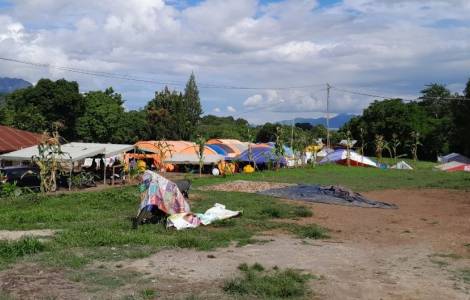
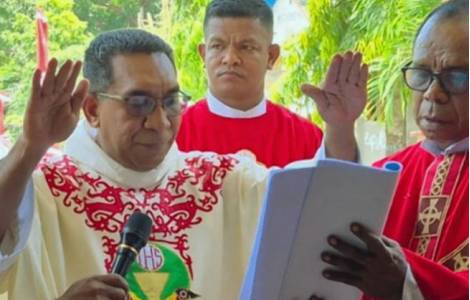
Larantuka (Fides News Agency) – “The situation in my diocese is still marked by suffering and uncertainty, but we are experiencing great solidarity, and this moves and encourages us.” Yohanes Hans Monteiro, who has been leading the Diocese of Larantuka – in the eastern part of the Indonesian island of Flores – for just a few months, describes to Fides the life of a community that, in recent weeks, has been accompanying a population still living with fear and uncertainty. The earthquake that struck Flores on 15 August, with a magnitude of 7.7, caused casualties and extensive damage in several areas of the island.
The Caritas Indonesia network and the local dioceses have launched a coordinated relief effort to assist the affected population.
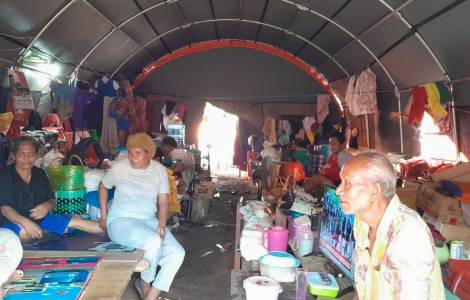
In Larantuka, the damage was relatively limited, but the situation remains precarious, also because the earthquake occurred in an area already affected by volcanic activity. “It is a disaster that came after a volcanic eruption in Larantuka two years ago,” the Bishop explains. “Some of the faithful had already been forced to flee to another place and are internally displaced. The volcano still poses a threat.”
The Church is seeking to accompany these internally displaced people through Caritas. “I am concerned about my people who are living in precarious conditions in this region,” Monteiro says. “In Flores, there is still fear after the earthquake; people are shaken.” Yet alongside the fear, the Bishop also sees an encouraging response of solidarity. “This earthquake has generated a great deal of solidarity. I have to say that the entire Indonesian people, through the civil authorities and Caritas, are helping us.”
The response, he adds, is not limited to his diocese. The Bishops of Flores are in contact with one another to coordinate assistance and support each other. “We are very united, and this strengthens us,” he says. This communion was experienced in a particularly tangible way in the wake of the tragedy at St Peter’s Interdiocesan Major Seminary in Maumere, which suffered serious damage and partial collapses. A young seminarian from the Diocese of Labuan Bajo died in hospital from injuries sustained in the earthquake. “We experienced this tragedy together and showed our closeness to one another,” Monteiro recounts. “We are united in prayer and in sharing material resources, so that together we can find solutions.” The local Church also feels “the closeness and support” of the Indonesian Bishops’ Conference.
Amid this emergency, the diocese is characterized by a strong Catholic presence and a remarkable flourishing of vocations to the priesthood and consecrated life. According to figures provided by the Bishop, Larantuka has around 250,000 Catholics, 55 parishes and approximately 150 priests, both diocesan and religious. The figures confirm the significant Catholic presence in the area.
“Our Church has many priests, from diocesan priests to priests belonging to religious congregations. This means that ours is a diocese blessed by the Lord with many vocations,” Monteiro observes. Formation for future priests also takes place at the interdiocesan seminary, a long-established institution on the island. “We are in the ‘Catholic heart of Indonesia’, and vocations are flourishing – we can use that word here in Flores – to nourish the Church not only in Indonesia, but throughout the world.”
It is a missionary vocation that reaches beyond the island’s borders. “From this country, from this region, many people go out into the world for evangelization,” he stresses. According to the Bishop, around a thousand priests and religious women originally from Flores are currently serving in missions and communities around the world, more than 300 of them from the Diocese of Larantuka alone. “These vocations are a special gift from God, but they are not ‘only for us’: they are a gift for the universal Church, for all the Churches of the world, wherever there is a need.”
Monteiro also interprets this history through the very name of the island. In the 16th century, he recalls, Portuguese navigators named the island Flores after being struck by its abundant floral vegetation. Dominican missionaries from Portugal arrived with them. “They sowed the Gospel, and the garden of Flores began to blossom, with the flowers of faith, hope and charity.”
That missionary history lives on today in a faith deeply rooted in the local culture. In Larantuka, popular devotion still bears traces of the presence of the Portuguese missionaries, particularly during the rites of Holy Week. “The people have a strong faith and express it through popular devotion and fraternal charity,” the Bishop says. Among the most deeply cherished traditions, handed down through the centuries, are pilgrimages and prayer at the Chapel of Tuan Ana, dedicated to the Passion of Christ, and at the Chapel of the Mother of God.
The transmission of the faith also takes place through ongoing catechesis. “The principal seasons of the liturgical year, Advent and Lent, are devoted to catechesis. Every year our catechists prepare a program with the priest and hold periods of catechesis in the villages and parishes.” Particular attention is given to young people. “We seek to encourage young people to read the Bible and to put the Gospel into practice in their daily lives. Many young people come to church, and the present of our community is built upon them, upon their faith and their charity. Young people are our hope.”
The Catholic Church carries out its mission within a society where, unlike in many other parts of Indonesia, Catholics constitute the majority. “More than 90% of the people are Catholic,” Monteiro says, noting that Muslims account for a small minority in the Larantuka area, around 2%.
For the Bishop, however, this situation does not alter the necessity or the primary path of dialogue: “Whether one is a minority or a majority, the approach is always dialogue, in order to build coexistence and fraternity.”
In Larantuka, he explains, interreligious dialogue does not consist in debating theological issues, but is rather a way of living together. “Dialogue does not mean so much ‘talking about God’, but living together, working together and building a harmonious society.” This is what he describes as a “dialogue of life, capable of generating hope even when reality is marked by difficulties.”
“We are very united within the ecclesial community, and we are building bridges of cooperation and unity in society,” the Bishop reiterates. In the island’s current situation, whilst fear and uncertainty are affecting people’s lives, faith does not heal the wounds, but encourages us not to face them alone.
(Fides News Agency, 2/10/2026)