
Information service of the Pontifical Mission Societies since 1927
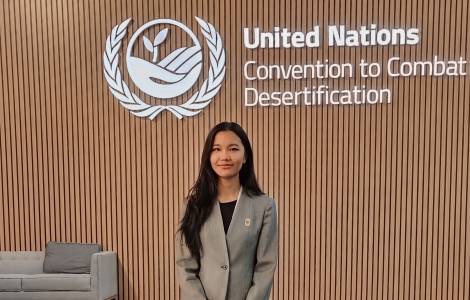
by Enkhjin Chuluunzag*
Ulaanbaatar (Fides News Agency) – At 26 years old, Enkhjin Chuluunzagd holds two Master's degrees in environmentalstudies and a Bachelor's degree in administration, obtained in Rome, the United States,and Mongolia, respectively. The young woman, who was part of the Holy See delegation to the United Nations Convention to Combat Desertification (UNCCD) COP17, held in Ulaanbaatar from August 17 to 28, speaks to Fides about her journey offaith and the development of her environmental awareness.
§§§
As a young Mongolian Catholic with a growing passion for sustainability and environmental issues, I had the great honour of attending UNCCD COP17 in Mongolia as a member of the Holy See delegation. Being there allowed me to see how three parts of my life come together in a very meaningful way: my faith, my identity as a Mongolian, and my concern for the environment.
I grew up in Mongolia with little knowledge of Christianity. Mongolia is a country where Buddhism has an important and deeply rooted history. Growing up in this environment, I had almost no personal understanding of Christ, the Catholic Church, or what it meant to have faith. The Catholic community in Mongolia is also very small, so the Church was not something I encountered often in my childhood. Yet, over time, I began to notice missionaries working among disadvantaged people in Mongolia. They cared for people with such humility and love, without seeking recognition or anything in return. I used to wonder: “Why do these foreigners care so deeply about people who are not their own family, their own community, or even their own country?” This sparked my first interest in the Church.
Later, the visit of Pope Francis to Mongolia deepened that curiosity. Seeing the Pope come to Mongolia made me realize that the Church pays attention even to the smallest communities that can easily be overlooked by the wider world. His willingness to come close, to listen, to accompany, and to love the smallest and most vulnerable communities deepened my respect for the Church. Slowly, that curiosity became a desire to know more: to understand the Church, to follow Christ, and to walk in faith. That journey eventually brought me to where I am today.
Mongolia is a country with extraordinary landscapes and a people who have developed a deep relationship with nature. We grow up knowing the importance of pasture, water, livestock, and the changing seasons. For generations, Mongolian people have learned to read the rhythms of nature, to adapt to extreme weather and to live in harmony with it. But today, those rhythms are becoming increasingly difficult to read.
Land degradation, drought and desertification are affecting the ecosystems and livelihoods on which many people depend. These challenges are increasingly visible in the lives of communities and in the condition of the land itself. In many regions,overgrazing, soil erosion and changing climate patterns are placing great pressure on pastoral livelihoods, making it harder for herder families to sustain their traditional wayof life. These environmental problems remind us that the care of Creation cannot be separated from the care of human beings.
This is one reason why COP17 is so meaningful for Mongolia. International cooperation and action give us not only an opportunity to address these challenges together, but also a sense of hope. Throughout the Convention, one message was repeated: the objectives we pursue are all ultimately connected to the well-being of humanity and to the protection of our common home. These two things cannot be discussed separately. When we speak about land, we are also speaking about the people who live there. When we speak about drought and desertification, we are speaking about communities struggling for water. When we speak about land degradation, we are speaking about access to food and poverty.
For this reason, environmental action must always keep the human person at its centre, while recognizing that human well-being itself depends upon a healthy relationship with Creation.
The Catholic Church, too, has long been concerned about desertification and its serious consequences for the people and communities affected by it. Through its humanitarian and development work, the Church has supported efforts to address these challenges, including sustainable agriculture and improving access to water. This commitment has also been expressed through initiatives such as the John Paul II Foundation for the Sahel, established in 1984 to support communities facing environmental and development challenges in the Sahel region.
The concern for desertification is also reflected in Laudato si’. Pope Francis emphasizes that human beings are deeply connected to the world around us, to the extent that the degradation of the land can be experienced almost as a physical illness. He also points to the limited progress made in protecting biodiversity and addressing desertification, reminding us that these challenges require greater and more sustained efforts.
Therefore, the Church’s contribution enriches environmental protection by bringing together care for the Creation and a deep concern for the world’s most vulnerable communities. Its reflection on the care of the natural world reminds us that the Creationis a gift from God, and that receiving a gift also means accepting responsibility for it. This understanding highlights responsibility, solidarity, and human dignity, while inviting us to reflect on the kind of relationship we choose to have with both the natural world and with one another. For me, this is where faith and environmental responsibility meet.
We may come from different traditions, cultures, and ways of understanding the world, but we share the same land, ultimately the same home, and therefore face many of the same challenges. The theme, “Restoring Land, Restoring Hope,” captures what I wish for Mongolia: that our efforts today will give future generations healthier land and a stronger reason to hope. I also hope that the Church will continue to contribute to this journey by caring for Creation, standing with the vulnerable, and building bridges across cultures and religions. Ultimately, I hope that the commitments made here will translate into meaningful action and that, together, we can restore not only our land, but also our hope for the future.
(Fides News Agency, 27/8/2026)
*Member of the Holy See delegation to the United Nations Convention to Combat Desertification (UNCCD) COP17, Ulaanbaatar, August 17–28, 2026.



 Defending land means defending life: Latin American Churches Stand alongside communities in mining conflicts
 AMERICA/COLOMBIA - Pope Leo XIV: May Jesus Christ be announced with clarity and immense charity among the inhabitants of the Amazon
 ASIA/PHILIPPINES - Catholic community mobilizes: Protection of creation and indigenous peoples in the Cordillera region
 ASIA/PHILIPPINES - Supreme Court declares large-scale mining legal: civil society promotes "environmental justice"
 In Malawi, a whole stadium celebrates 100 years of World Mission Sunday: “United in Christ, united in mission”
 Faith according to Joseph Ratzinger: “Like a child in his mother’s arms”
 ASIA/PHILIPPINES - Archbishop of Cebu: Celebrations for the Feast of Santo Niño should not be financed by sponsors linked to the gambling industry
 AMERICA/PERU - Apostolic Vicariate of Iquitos issues urgent appeal to curb spread of illegal mining in the Amazon
 Waste as a new form of colonialism in Africa and Asia