
Information service of the Pontifical Mission Societies since 1927
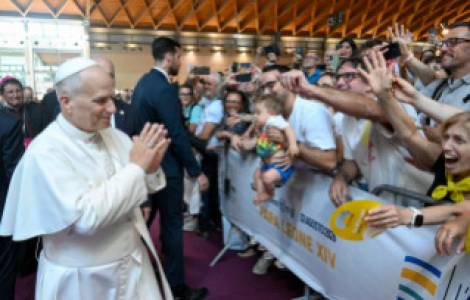
VaticanMedia
Rimini (Fides News Agency) – “The Church does not engage in proselytism. Instead, she grows by ‘attraction’.” Pope Leo XIV invoked this expression of Benedict XVI, repeatedly echoed by Pope Francis, to suggest that the apostolic mission entrusted by Christ to his Church is entirely entrusted to the attraction of Christ himself – on his continuing to draw the freedom and hearts of men and women throughout history.
He made the point in a speech delivered today at the Rimini Exhibition Centre during his participation in the 47th edition of the Meeting for Friendship among Peoples, the traditional end-of-August gathering held in the Romagna city and organized by members of the Communion and Liberation movement. Father Luigi Giussani, the Lombard priest who founded the movement, had already published a book in 1999 entitled “The Attraction of Jesus.”
The “realism of mercy” in an age of rearmament
The Pope referred to the title of the 2026 edition of the Meeting, taken from the final verse of Dante’s Divine Comedy: “That Love which moves the sun and the other stars.” That love, Leo XIV recalled, “has lost neither its vigor nor its intensity”, even though it often works in silence, far from the clamour generated by the violence and conflicts tearing the world apart.
The Meeting, the Pope recalled, was not established to become “a sort of enclave”. Rather, it has become “a crossroads for the Church and for society: an encounter that gives rise to further encounters and inspires new paths”.
In a world marked by conflicts, divisions and fears, Leo XIV highlighted the prophetic significance contained, almost half a century ago, in the event’s very name: *Meeting for Friendship Among Peoples*. Echoing St John Paul II, he stressed the importance of words such as “Meeting”, “Meeting of Friendship” and “Friendship Among Peoples”, that take on a particular meaning in these often dramatic hours in the history of the world.
Peace, he said, “is fostered and spread by people who love to encounter one another and are not afraid to engage with one another”. The Pope then pointed to the concept of “social friendship”, proposed by Pope Francis in his encyclical Fratelli Tutti, as “thepublic, dynamic and concrete expression of fraternity”.
Using words that clearly resonate with the wars troubling the world today, the Bishop of Rome recalled that “evil is not overcome by evil”. “Today, Catholic culture must counter the false realism that rearms minds, words and nations, with the realism of mercy which recognizes that there can be no enemies, and that everyone, even those who oppose us, is a brother or sister to be looked in the eye and encountered in truth,” he said. “Sin exists, of course,” he continued, “but stronger still is the redeeming love of Christ. That love commits us to purifying our thoughts, interests, habits, associations, plans and investments — indeed, every aspect of our lives – from all that the culture of power has tainted.”
The Pope therefore urged people to free “our lives from suspicion, culture from arrogance, education from ideology, work from the idolatry of profit, and technology and finance from the business of death” and to “disarm” technological development whenever it becomes invasive and destructive.
A treasure in earthen vessels
In his speech, the Pope quoted Father Giussani on several occasions, recalling the passion with which the Ambrosian priest rejoiced throughout his life at young people encountering Christ. “Let your Movement, your groups, your communities,” the Successor of Peter urged, addressing in particular the many young people in the audience and among the volunteers who animate the Meeting, “be a springboard from which you can dive into the whole of reality.”
The Pope also reminded them that “in love there is never coercion or indoctrination, nor manipulation, deception or recruitment. Love exists only in freedom, in genuine encounter and in the generous gift of self.”
In this context, the Pope presented mission as witness and attraction, reiterating that “truth can be encountered only in freedom”. Leo XIV repeated the formula already dear to his predecessors: “The Church does not engage in proselytism. Instead, she grows by ‘attraction’.” This dynamic does not ignore but embraces the fragility of Christ’s witnesses. “We must admit,” the Pope said, “that we carry this treasure ‘in earthen vessels’.” Yet “it is the Lord who always raises us up, both as individuals and as communities.”
The Pope’s visit to the exhibition on St Augustine, displayed in the pavilions hosting the Meeting, provided a significant prologue to the speech he delivered before the vast crowd. In his address, the Pope reiterated that grace – as the great Bishop of Hippo had already taught – attracts and moves human freedom without manipulating it. In the Pope’s words, the Christian proposal does not build an identity-based enclosure, but generates encounter and hope at the heart of history.
In the concluding part of his speech, the Pope called for the unity of the “community” through which Christ has reached and draws his disciples to himself.
Leo XIV then linked unity, synodality and mission. “We have rediscovered the synodal and missionary dimension of being the Church, which calls us, first and foremost, to learn to listen to one another,” he said, inviting people to listen to the Word of God, to other members of the Church and to those who seek the truth even though they do not belong to the ecclesial community. “Synodality is not the name of a process, but the very nature of a people who, through friendship and encounter with others, come to recognize that they belong to God alone.”
(GV) (Fides News Agency, 22/8/2026)



 VATICAN/MONGOLIA - Leo XIV receives Cardinal Marengo and the abbot of Gandan Monastery, the heart of Mongolian Buddhism
 From a French pioneer of the American frontier to Pope Leo XIV: Sister Lyn Osiek's long missionary journey
 "Like clay in the hand of the potter". Work on the "Positio" in the Cause for Canonization of Father Emiliano Tardif begins
 AMERICA/VENEZUELA - Gratitude for a missionary experience that changed one's vision on life
 THE CHURCH OF THE SHEAVES CONFERENCE - Listening the Continents: Gifts, Challenges and New Missionary Pathways
 ASIA/SOUTH KOREA - Second International Preparatory Conference for “WYD Seoul 2027” underway
 EUROPE/ROMANIA - Pontifical Society of the Holy Childhood: Jesus’ “torch” at the heart of missionary summer Camps
 VENEZUELA/COLOMBIA - When the earthquake has passed, brothers and sisters remain by the side of those who continue to suffer
 EUROPE/SLOVAKIA - The European Conference of the Pontifical Society of the Holy Childhood: creativity and new evangelization with children and adolescents