
Information service of the Pontifical Mission Societies since 1927
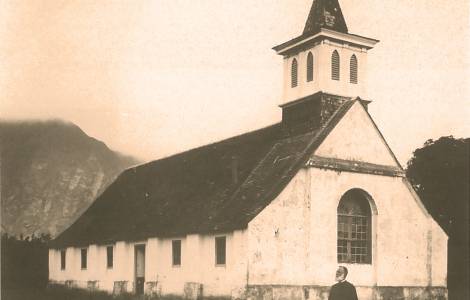
catholichawaii200.org
by Marie-Lucile Kubacki
Honolulu (Fides news Agency) – “The arrival of the first missionaries in Hawaii in 1827 was not the beginning of the journey. In a very real sense, although the people of Hawaii would not have known much beforehand of the arrival of the missionaries, God in his own way had also prepared the hearts of the people to receive the gospel of Jesus Christ.”
With these words, Bishop Clarence Richard “Larry” Silva of Honolulu opened the Jubilee Year on July 9, 2026, marking the bicentenary of the arrival of the first Catholic missionaries in Hawaii.
“They were,” the Bishop explained, “already a religious people with many stories similar to the stories of the Bible. They were a people who valued community and whose hearts were hospitable to the Holy Spirit. So their openness to the Catholic faith did not start with the arrival of the first Catholic missionaries. God had already prepared the ground for the planting of that great seed of the word of the true and living God. And so it has always been.”
The opening Eucharistic celebration of the Jubilee Year, presided over by Bishop Silva at the Cathedral of Our Lady of Peace, inaugurated a year-long journey of remembrance and conversion leading to July 2027, when the local Church will commemorate the 200th anniversary of the arrival of Father Alexis Bachelot, a religious of the Sacred Hearts of Jesus and the first Apostolic Prefect of the Sandwich Islands. Recalling that “God had already prepared the ground” in the hearts of a deeply religious people, the Bishop invited the faithful to view the history of evangelization as the patient work of the Holy Spirit, begun long before the visible arrival of missionaries.
Looking Back
At the beginning of the XIX century, the Kingdom of Hawaiii was undergoing profound religious and political transformation. The ancient system of taboos (kapu), which had long structured social, political, and religious life, was abolished by the rulers in 1819, one year before the arrival of the first Protestant missionaries. The Hawaiian people remained deeply religious, endowed with a cosmology and stories that shaped their worldview, but their traditional references had been shaken by this decision and by increasing contact with the ‘outside’ world through Western traders and sailors. It was in this context of profound cultural transformation that Christianity first took root.
In 1820, American Protestant missionaries from the American Board of Commissioners for Foreign Missions landed on Oʻahu shortly after the abolition of the kapu system. They established schools, trained catechists, translated the Scriptures, and accompanied the gradual conversion of the monarchy and the ruling elite, often working alongside Polynesian Christians who had already embraced the Gospel elsewhere on other Pacific islands. In an article in Christianity Today, "Tahitians First Came to Hawaiʻi in Power. They Later Returned with the Gospel."
Christopher Cook, scholar of Hawaii's missionary and monarchical era and author of a biography of Opus kahaia‑Henry Obookiah, the first baptized indigenous Hawaiian Christian, emphasizes that this dynamic was not solely the work of Anglo-Saxon missionaries: Tahitian couples, who were already Christians, also played a decisive role in introducing a Hawaiian queen to the Christian faith, a conversion that would profoundly influence the history of Christianity in the islands.
Against this backdrop, already transformed by the arrival of Protestant missionaries, a new era began in 1827 with the arrival of Catholicism in the archipelago.
That year, the French priest Alexis Jean-Augustin Bachelot, entrusted by Pope Leo XII with the mission of evangelizing the Hawaiian archipelago, arrived in Honolulu. Inspired by the missionary tradition of his community, he came to establish a lasting Catholic presence and to serve the local people.
Together with several confreres, Alexis Bachelot celebrated the first Masses in Hawaii and began building a small Christian community centered on the sacraments, catechesis, and prayer. He also produced several works in the Hawaiian language—including a grammar, catechisms, and a prayer book—demonstrating his deep appreciation for the local culture. Although difficulties forced him to leave the islands in 1831, he laid the foundations of the Sacred Hearts mission and of what would later become the Apostolic Vicariate, leaving a lasting legacy in the memory of the local Church.
Seeds of Prosopis and the seed of the Gospel
Like a parable from the Gospel, the missionary also helped transform the landscape of the islands. He had brought with him seeds of Prosopis, an evergreen tree common in South America, obtained from the Jardin du Roi in Paris, today's Jardin des Plantes, the fruit of the vast botanical collection networks of the 19th century.
Alexis Jean-Augustin Bachelot planted the seeds in Honolulu, and the species eventually spread widely throughout the archipelago.
Developing the metaphor of the seed, Bishop Larry Silva recalled that Father Bachelot wished to sow them “in this new mission field so that, just as the tree would take root and spread throughout the islands, so too would the Catholic faith.”
Today, Prosopis trees are found across much of the Diocese of Honolulu, which now comprises 66 parishes and 23 churches serving Catholics on the six inhabited islands of the archipelago.
The Bishop also placed the bicentenary within the broader horizon of the universal Church, which is preparing to celebrate in 2033 the 2000th anniversary of the most pivotal event in the history of the world: the death and resurrection of our Lord and Savior Jesus Christ. In the Bible, he commented, God Himself prepared for that event “by choosing the people of Israel to be his special messengers, sending prophets and working mighty deeds to move the hearts of his beloved people back to his love.” For this reason, missionary life is always rooted in prayer, the search for God's will, without which human effort risks remaining fruitless.
In light of this history of salvation, Bishop Silva invited Hawaii's Catholics to celebrate the bicentenary as a renewed call to mission.
“How is the way we live our faith today going to assure that it will continue to flourish and grow throughout these islands and throughout the world? How will the seed of the word of God be planted in hearts that do not know Jesus Christ unless we are the ones who plant that seed?” He urged the community not to focus first on structures or programs, but to keep their eyes fixed on Christ and to follow in the footsteps of the missionaries who came before them, offering—today and in the future—“fertile soil in which the Word of the living God, Jesus Christ our Lord, can take root and flourish.”
Bishop Larry Silva has led the Diocese of Hawaii for the past twenty years. On May 6, Pope Leo XIV accepted his resignation and appointed Jesuit Michael T. Castori as the new Bishop of Honolulu. His episcopal ordination and installation as the sixth Bishop of Honolulu will take place on Tuesday, July 28, at the Co-Cathedral of St. Theresa of the Child Jesus. (Fides News Agency, 14/7/2026)



 POPE IN FRANCE/V - The (silent) mission of Lourdes: “God’s charity does not heal those who have no wounds”
 Leo XIV to the new Bishops: Remain with Jesus, the “Good Shepherd,” to keep a missionary heart
 The Church of the Sheaves: a missionary perspective presented to Newly Ordained Bishops
 ASIA/CHINA - Andrew Ding Yang ordained Archbishop of Chongqing
 One hundred years later. The long journey of China’s first Bishops to receive Episcopal Ordination from the Successor of Peter
 Cardinal Tagle celebrates his father’s funeral Mass in Imus: “Eternal Life is to remain close to Jesus”
 VATICAN - Course for new Bishops: Bishop García Macías: Inculturation can become one of the most beautiful forms of Evangelization, “when it enables a people to recognize that Christ is no stranger to them”