Information service of the Pontifical Mission Societies since 1927
VaticanMedia
by Gianni Valente
Rome (Fides News Agency) – The first anniversary of the end of Pope Francis's earthly life coincides with the current Bishop of Rome's ongoing and remarkable apostolic journey, surrounded by the People of God whom Bergoglio so dearly loved. With stops in four African countries, he has been, and continues to be, welcomed by small communities and festive crowds in lands where the Christian message arrived in apostolic times, as well as in others where communities have flourished thanks to the work of missionaries in recent centuries.
This coincidence, though fortuitous, serves to deepen our gratitude for the mystery of the Church's journey through history, as well as our grateful memory of the Successor of Peter, who left this world on April 21, 2025, Easter Monday, after having blessed the world the previous day, Easter Sunday, from the central Loggia of St. Peter's Basilica.
In the mystery of the Church, nothing happens by chance. Even from the most ordinary circumstances, glimmers of light and consolation can emerge. A year after his earthly death, as the smokescreen of detractors and self-serving praise that shrouded the various stages of his pontificate dissipates, historical distance allows us to recognize more clearly the features and nuances of the essential words that Pope Bergoglio left in the heart of the Church during his time as Bishop of Rome.
As Successor of Peter, Pope Bergoglio reminded us in countless ways that faith is not born from the human heart, but is a free gift from Christ, capable of attracting men and women of all times and conditions. He also reiterated that the Church does not live by itself, but solely by the grace of Christ. In his daily teaching, in homilies, catechesis, and documents, he described in detail this constitutive dependence on grace, which marks a kind of genetic imprint of the Church’s journey through history.
He also insisted that any form of ecclesial introversion or self-referentiality represents a pathology. Christ, he emphasized, can always redeem his Church from the temptation to withdraw into itself, from the old and new clericalisms that beset it, constantly drawing it to himself and renewing it with his forgiveness.
Already in his brief address to the General Congregations in 2013, before the Conclave that elected him Bishop of Rome, Bergoglio evoked the “Mysterium Lunae,” an expression especially dear to him: the idea, developed by the Greek and Latin Fathers, according to which the Church does not shine with its own light, but would be an opaque and dark body if Christ did not illuminate it with his grace, as the sun illuminates the moon.
Precisely because it belongs to Christ and not to itself, the Church is missionary. It cannot close in on itself, nor promote itself, nor proclaim itself. It can only refer to something other than itself. It can only refer to the grace and work of the Risen Christ, who gives life and illuminates it, like the sun to the moon.
Missionary conversion was the underlying theme of Pope Francis's pontificate.
The impetus and demand for a renewed missionary spirit became the constant heartbeat of his magisterium, the guiding thread of his Petrine ministry. A thread that continues today in the teaching of the current Successor of Peter, in continuity with Francis, beyond differences in emphasis or temperament and the sterile discussions about supposed “discontinuities” between pontificates. When he had already left for his first trip to Africa, Pope Leo XIV published a letter sent on April 12 to the Cardinals, reiterating the reflections of the January consistory on the missionary perspectives proposed by Francis in the Apostolic Exhortation Evangelii Gaudium. In it, the Pope emphasizes “the need to relaunch Evangelii Gaudium in order to honestly examine what has truly been received over the years and what remains unknown or unapplied.”
A year after the end of his earthly life, it becomes even more evident that Pope Francis’s pontificate, with its evangelical zeal, always pointed to something beyond himself. The “Mysterium Lunae” can also be applied, by analogy, to his own Christian journey and his Petrine ministry. From the beginning of his pontificate, Bergoglio affirmed that miracles were not performed by him, “a poor sinner whom Christ has looked upon,” a man who never hid his limitations and who chose not to reside in the Apostolic Palace not as a simple gesture of poverty, but, as he himself explained, for “psychological reasons,” preferring an environment of daily contact with other people. For years he repeated that Christianity does not conquer the world through human strategies, but by “delectatio,” as Saint Augustine said, or “by attraction,” as he also recalled, quoting Benedict XVI.
For a long time, some commentators focused exclusively on the figure of the Pope, on his personal traits, virtues, and limitations, separating him from the living body of the Church and turning him into an isolated figure, a star, or a political leader, thus generating a universal polarization.
To paraphrase an old Eastern proverb, when Pope Bergoglio pointed to the moon, fools looked only at Bergoglio, focusing on his qualities or errors. The people of God, on the other hand, following their “Sensus fidei,” looked at the moon to which he pointed. That is why they continue to hold Pope Francis in such high regard.
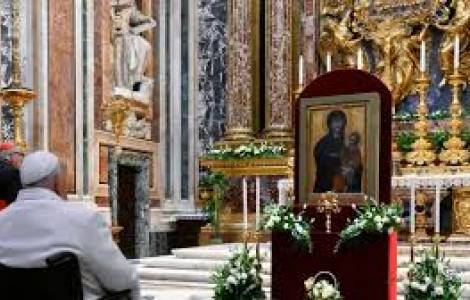
This dynamic continues today in a unique and unexpected way, even at his mortal remains. In the Basilica of Saint Mary Major, Romans and pilgrims walk along the left aisle to pause in silence before his tomb. But they do not stop there: a few steps further they reach the Pauline Chapel to pray before the icon of Mary, “Salus Populi Romani,” before which Pope Francis paused in prayer 126 times during his Pontificate. Thus, the grateful memory of Pope Francis is not limited to his person, but rather envelops him in a single embrace of prayer alongside the supplications and thanksgivings addressed to the Marian image that was so dear to him, in the heart of Rome. (Fides News Agency, 20/4/2026)